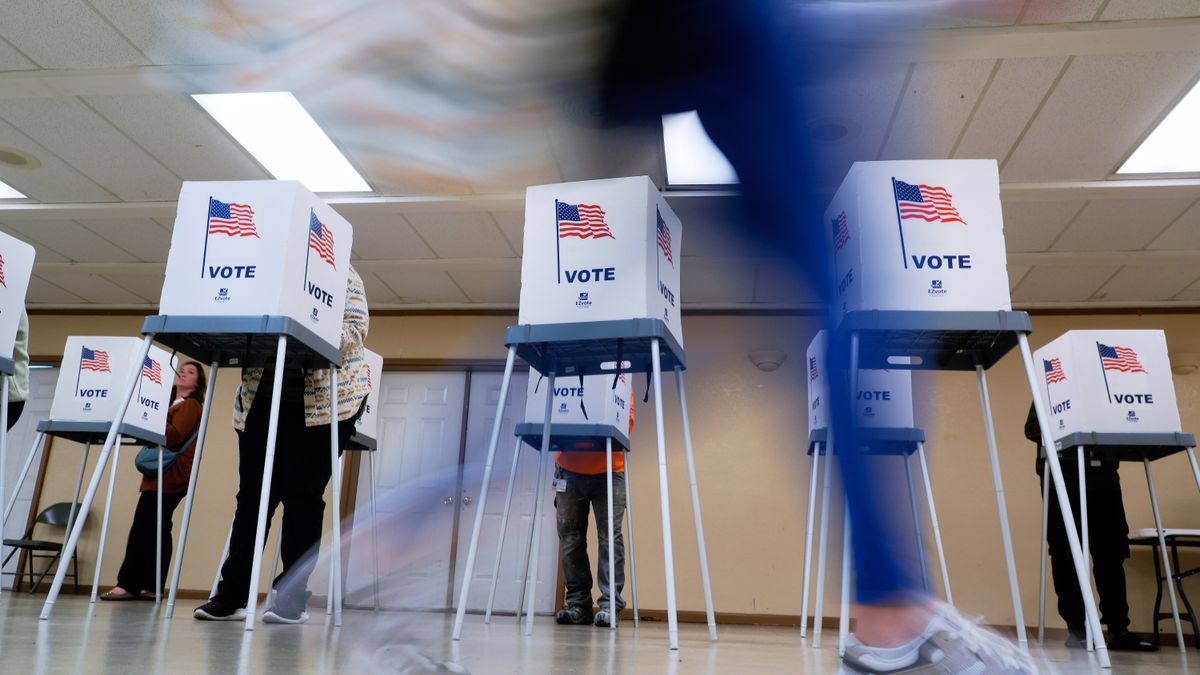
Only U.S. citizens are allowed to vote in North Carolina elections, and state officials are now taking additional steps to make sure no non-citizens have slipped through the cracks.
Elections have long been closely monitored, audited and scrutinized for accuracy and evidence of fraud — efforts that have drawn even more attention in recent years. Little to no evidence of illegal voting schemes or widespread fraud have emerged from those efforts.
Other WRAL Top Stories
Nevertheless, public polling continues to show that large numbers of voters — especially Republican voters — express mistrust in the validity and security of American elections, especially in years when their preferred candidates don’t win. Similar trends have been identified nationally, as well as specifically in North Carolina by a WRAL News Poll last year.
So now state election officials are looking for new ways to comb through the list of North Carolina’s 7.6 million registered voters to make sure they’re all eligible to vote.
On Tuesday, the State Board of Elections voted 3-2 to approve a plan to start citizenship verifications, with the board’s Republicans in favor and Democrats opposed in part over concerns that sensitive information of eligible voters could fall into the wrong hands.
The state already cross-checks various databases maintained by North Carolina and other states to ensure people who move away or die are removed from the list of registered voters. But it’s possible some could make it onto the list illegally in the first place, by lying and claiming to be an eligible voter if they’re not — a felony that happens so rarely that the practice would be unlikely to sway an election.
Republicans recently took control of the State Board of Elections and say they believe the state shouldn’t still just be relying on people to tell the truth at the risk of facing criminal charges for lying. More needs to be done, they say, to cross-check voters’ Social Security numbers to make sure everyone is a citizen.
“The fact we're moving forward should not necessarily be a shocking thing,” Stacey Eggers IV, a Republican on the elections board, said Tuesday. “In fact, the shocking thing should be, ‘Why have we not done this so far?’”
Reasons for opposition
Democrats on the board said that, contrary to Eggers’ enthusiasm, there are several good reasons not to conduct citizenship verifications.
For one, board member Jeff Carmon said, there are numerous legal concerns anytime a state agency gathers people’s Social Security numbers with no real plan to protect against data breaches. This new push is happening so quickly, he said, that there’s no way to ensure the elections board is actually able to safeguard people’s data — or to have the systems in place to properly notify people in case of a breach that exposes their identity to hackers.
Siobahn Millen, the board’s other Democratic member, said the effort will inevitably lead to accidents, caused by bad data or clerical errors, that will lead to legitimate voters being wrongfully accused of committing voter fraud, and possibly cause some U.S. citizens to be unnecessarily investigated by Immigrations and Customs Enforcement agents.
The board’s Republican members acknowledged Tuesday that such a scenario was possible. But it’s worth it, they said, to ensure that there aren’t any non-citizens voting.
Adam Steele, a member of the board’s nonpartisan professional staff, indicated it would be more likely to happen if the board went ahead with the plan using its current data, which shows only the last four digits of voters’ Social Security numbers. The board’s GOP members said they’ve been trying to get full 10-digit Social Security numbers from the DMV — but have so far been unsuccessful.
“The responses could be anything,” Steele told the board of what to expect once the database matches are in operation. “From ‘This person is a citizen’ to ‘This person is not a citizen,’ or, ‘We're just not sure.’ It could be that there may be multiple people with the same name, date of birth and last four of their Social. That's actually something that can happen.”
Last year, when Democrats held a majority on the elections board, the board’s Republican members voted in favor of throwing out ballots cast by tens of thousands of legitimate voters based on a contentious legal theory also involving databases and mismatching Social Security numbers. That theory was pushed by Appeals Court Judge Jefferson Griffin, the losing GOP candidate in the 2024 election for a seat on the state Supreme Court, in an attempt to overturn the election results.
Griffin’s challenge was rejected in a party-line vote by the then-Democratic majority on the elections board, and he also ultimately lost in court. A federal judge who had been appointed by President Donald Trump later shot down that effort — in a ruling that said it would’ve violated the constitutional rights of the voters who were targeted despite doing nothing wrong.
Political implications
Republicans took control of the elections board this year when the GOP-led state legislature passed a new law immediately after the 2024 elections transferring control of the board from the governor’s office to the state auditor.
That change took power away from Democratic Gov. Josh Stein and instead gave control to Republican state auditor Dave Boliek, and shifted the majorities of the state board and all 100 county election boards from Democratic to Republican control.
The most recent court ruling in the case, by a bipartisan panel of Wake County judges, found that the law was likely unconstitutional and should be blocked. But an all-Republican panel on the state Court of Appeals allowed the changes to go into place regardless, while the Republicans’ appeal moves forward in court. The judges also have yet to hold arguments in that case, making it likely that the elections board remains in GOP control heading into next year for the 2026 midterms.
Boliek celebrated Tuesday’s action, writing on social media that the vote “will assist in upholding our State Constitution.”
Millen, however, expressed concern that the data will be turned over to the Trump administration. So any American citizens who are wrongfully accused of being immigrants might not only be wrongfully blocked from voting, she said; they could even wrongfully face deportation proceedings — during which people have limited legal rights, and might have to spend money hiring a lawyer to prove they’re not an immigrant.
“It can be turned over to ICE and to Customs and Border Patrol,” Millen said. “So there's two different things they're saying. They're saying ‘We're going to help you scrub your [voter] rolls,’ but they're also saying, ‘We might use it for some other kind of enforcement’ that — I'm sorry — I don't trust those people.”
The Republican election board members pointed out that the government already checks people’s immigration status before deciding if they qualify for benefits like Medicaid or food stamps; they questioned why it shouldn’t be the same for voter registrations. Millen said there needs to be a much higher bar to protect things, such as voting, that are constitutionally guaranteed rights.
“Voting is not a benefit like food stamps,” she said. “Voting is a right.”