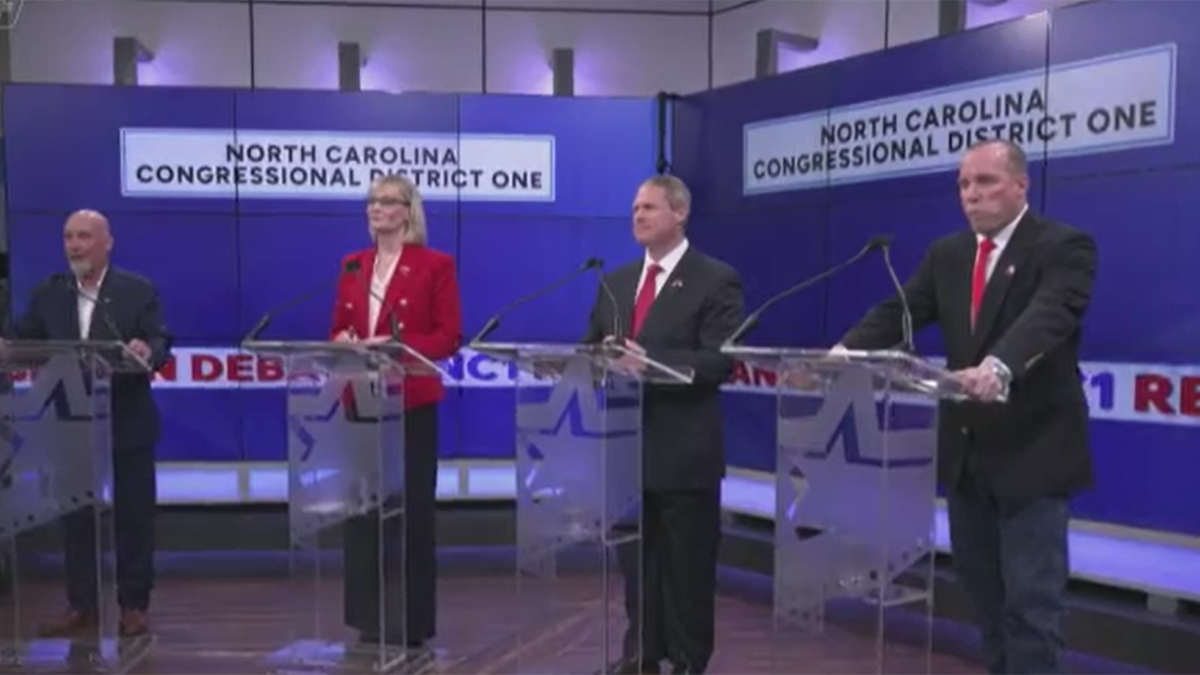
Five Republicans are seeking their party’s nomination for a chance to flip a U.S. House seat in northeastern North Carolina, helping the GOP’s chances of keeping control of Congress for the final two years of Donald Trump’s presidency.
Four of the candidates are faced off Thursday night in a debate in Greenville. The district stretches from the Outer Banks, in far northeastern North Carolina, down the coast into Morehead City — as well as inland toward the outskirts of the Triangle region, through Roanoke Rapids, Rocky Mount, Henderson and Oxford.
Other WRAL Top Stories
Democratic Rep. Don Davis represents the district in Congress and faces no primary challenger this year. Davis, an Air Force veteran and pastor from Greene County, will face off in November against whoever wins the March primary among Republican candidates including:
- Defense contracting consultant Laurie Buckhout, a retired U.S. Army colonel who also served briefly last year in the Trump administration, overseeing the nation’s cyber warfare efforts.
- State Sen. Bobby Hanig, who represents much of this district in the state legislature and is also an Army veteran.
- Duplin County Commissioner Eric Rouse, a firearms dealer who also runs a construction business and other ventures.
- Carteret County Sheriff Asa Buck, who started working for his hometown sheriff’s department in 1998 and eventually rose to the top job.
- Greenville family law attorney Ashley-Nicole Russell, who didn’t participate in the debate.
During Thursday’s debate, hosted by WNCT, focused on a range of topics from rural hospital closures, immigration, Trump’s tariffs and their economic impact, the federal government’s role in responding to natural disasters and how they could help end gridlock in Washington.
The debate saw the candidates largely in lockstep on the issues, particularly when it came to defending various policies of Trump's, including topics that polling shows are generally unpopular such as tariffs.
The debate was cordial, featuring no fiery exchanges, and toward the end all four candidates agreed that no matter who wins the primary, they’ll all rally around that person for the general election against Davis.
“Whatever it takes to get us across the line,” said Buckhout, who was the party’s nominee in the 2024 election.
Economy and immigration
The debate kicked off with a question about tariffs hurting American farmers, a key question for this district which is heavily reliant on agriculture.
All four support Trump’s tariffs. Buckhout delivered a full-throated defense of the tariffs, while the rest acknowledged tariffs are hurting farmers and others by raising prices and cutting off their markets. But said they believe it’ll be worth it years from now if Trump’s vision pans out.
“Farmers, they understand we have a short-term pain, for long-term gain,” Hanig said.
“It's absolutely hurting [farmers’] livelihood,” Rouse said. “... But Trump is a master negotiator. He knows what he's doing.”
They also tackled immigration, again each with strong support of the raids Immigration and Customs Enforcement agents have been carrying out in cities across the country since Trump’s return to power, killing several American citizens and sweeping up thousands of immigrants suspected of being in the U.S. illegally.
“ICE has gotten a bad rap,” Rouse said.
“Public safety and immigration enforcement has become political,” Buck said. “And unfortunately for this country, the Democrats and the liberals have tried to make this a political issue. Sew division between people.”
Hanig noted that Tom Homan, Trump’s ‘border czar’ who has taken a prominent role in recent deportation efforts, also held high-ranking jobs within ICE under former President Barack Obama. Hanig suggested that Democrats who criticize ICE’s recent crackdowns are hypocrites because of that.
“Back when [Homan] was with President Obama, he was getting bonuses for the amount of illegals he was deporting,” Hanig said. “Now he's getting crucified for his work. The only thing that has changed is the president.”
Israel and Iran
The U.S. spends far more on the military than it does emergency response, and the candidates were pressed on several military topics — whether U.S. taxpayers should continue funding the Israeli military, and whether they have any red lines that would cause them to oppose attempts to start a new war, particularly with Iran.
The U.S. Constitution gives Congress the power to declare war, but Congress has largely abdicated that power to the president in recent decades. In Thursday’s debate all four GOP candidates said they’d also defer largely to the president in deciding when, where or why the U.S. should go to war.
“The President's done a tremendous job doing that so far,” Buck said. “And I'm pretty sure he and his team are continuing to look at this situation in Iran, and see how to best move forward at this point.”
They all similarly said they support continuing the nation’s policy of sending more than $3 billion annually to Israel.
Buckhout noted that she has personally served alongside the Israel military on some cyber warfare issues. “They're a very powerful ally to us in the Middle East,” she said. “They keep the peace. They keep a lid on a lot of simmering tensions.”
Fate of FEMA
Questioned about the future of the Federal Emergency Management Agency, the candidates had mixed answers on its role in the future.
Under Trump, FEMA has drastically reduced the amount of money given to North Carolina for Hurricane Helene response and other work. Buckhout said that’s probably how it should be for all emergencies in the future, with states picking up more of their own costs rather than the federal government. “Pushing FEMA responsibilities down to the states is a very important thing to consider,” she said. “I think that's right in line with the America First agenda.”
Hanig called for ending FEMA entirely, a position Trump once supported but has since backed off from. He said that from what he sees as a state lawmaker, the agency is unfixable, and individual states should be put in charge of disaster response and relief.
Buck and Rouse, meanwhile, each said FEMA should continue existing but with major reforms.
“FEMA has done a lot of good work over the years … but like any other federal agency, they're not always very efficient and effective,” Buck said.
National attention on the seat
Davis narrowly defeated Buckhout in 2024, in a race that attracted millions of dollars backing their respective campaigns — most of it from national groups, since it was one of few competitive U.S. House district anywhere in the nation in 2024.
There are even fewer competitive U.S. House seats scattered around the country this year. And with Republicans’ U.S. House majority hanging on by a thread — the GOP controls 218 of the 435 seats, the bare minimum needed for a majority — this seat remains a top priority for both political parties.
In 2024, voters in this district backed Trump for president while also sending Davis to Congress. A moderate Democrat, Davis has been willing to sometimes cross party lines to vote with Republicans on certain topics — particularly on agricultural and immigration issues.
But this year, he may need even more GOP crossover support to return to Washington for a third term representing this largely rural district.
The district looks different this year than it did in 2024. Republican lawmakers sought to make it no longer competitive, redrawing the lines last year in what GOP leaders explicitly said was politically motivated gerrymandering meant to help their party retain control of Congress.
Local voters and advocacy groups sued, but the legislature won, with a panel of three Republican federal judges ruling that the legislature had the right to gerrymander the lines. While the 2024 version of the district favored Trump by a small margin, the new version of the district for the 2026 election would’ve back Trump in 2024 by double digits.
Davis chose not to bow out despite the unfavorable new map. He’s hoping his past success winning over some Trump supporters — plus the historical trend that the party that holds the White House does poorly in midterms — can combine to help him return to D.C.