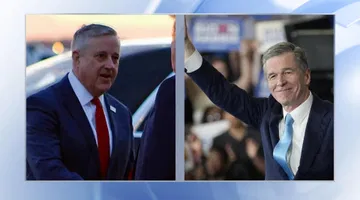
A popular former governor and a key ally of President Donald Trump cruised to their parties’ U.S. Senate nominations Tuesday, setting up an expected matchup that could play a key role in determining control of the chamber in November.
Former two-term North Carolina Gov. Roy Cooper, who is a Democrat, and former Republican National Committee chairman Michael Whatley will meet in the general election in a race for a current GOP-held seat in North Carolina.
Other WRAL Top Stories
2026 primary election: Tap for results
Green Party nominee Brian McGinnis and Libertarian Shannon Bray are also running in the general election, but Cooper and Whaltey are expected to be the headliners in the race to replace retiring Republican Thom Tillis, who first won the seat in 2014.
With all precincts reporting, Cooper had 92% of the vote in the Democratic primary. Whatley had garnered about 64% of the vote in the GOP primary.
“Two candidates who almost seem allergic to controversy and controversial statements,” said Chris Cooper, a political science professor at Western Carolina University. “Both good candidates, quality candidates, raise exorbitant amounts of money. Neither is going to hurt their party’s brand. It’s a true test of where the state is.”
Republicans have won five of the past six U.S. Senate races in the state, but Democrats have rarely nominated a candidate as formidable as Cooper.
Cooper has never lost an election in nearly 50 years as a candidate. Whatley is a political aide and lobbyist who has become a fixture in the party since Trump’s political ascension more than a decade ago.
“I want to thank President Donald J. Trump for his strong and unwavering support in this race,” Whatley said Tuesday night after claiming victory. “His leadership has changed our country, and I am proud to stand with him in the fight to secure our border, to strengthen our country and put America first.”
The race could stand as a referendum on the first two years of Trump’s second term. Trump carried North Carolina three times in his bids for president, but his approval rating has been trending downward since taking office in January 2025. His approval rating is -19, according to a poll by The Economist that was taken after he launched attacks against Iran.
In that poll, 58% of voters say they disapprove of Trump. His approval rating is -13 in an average of polls. The president draws his lowest ratings on inflation and prices in The Economist poll.
“If you want change in Washington, this campaign is for you,” Cooper said. “If you want to toss out the D.C. insiders, this campaign is for you. If you just think things cost too much, this campaign is for you. I’ve never been in a race that is this crucial for the people of North Carolina and our country.”
Affordability key for both candidates
It’s no coincidence then that Cooper is kicking off his general election campaign with a “Make Stuff Cost Less” tour Wednesday in Raleigh.
“I’m running for the hard-working parent who is tired of seeing higher costs at the grocery store and is scared that the family won’t be able to make ends meet,” Cooper said Tuesday.
At a polling site in February, Whatley — who has blamed former President Joe Biden for high inflation and promoted Trump as the best person to bring prices down — said that voters “want somebody who is going to fight for economic policies that will create jobs, that will raise wages, that will lower costs.”
Republicans in Congress passed the One Big Beautiful Bill Act to make permanent tax cuts that were passed during Trump’s first term and set to expire. Trump’s signature economic moves during his second term have been the implementation of tariffs on a host of countries.
“His vision made America stronger, freer, and more prosperous and it’s the vision I’ll fight for in the U.S. Senate,” Whatley wrote on social media during Trump’s State of the Union address.
Cooper has been critical of Trump’s “erratic” tariffs.
Tillis voted against the tax bill over concerns about what the legislation would mean for health care in the state. Tillis has often found himself at odds with Trump, Trump administration officials and other Republicans. Since announcing that he wouldn’t run for a third term, Tillis has been even more outspoken in his critiques of Trump administration officials, notably Department of Homeland Security Sec. Kristi Noem.
Noem’s agency ramped up immigration enforcement in Charlotte in November in “Operation Charlotte’s Web,” arresting more than 130 people. Immigration and crime have been top issues for North Carolina voters in recent years, according to WRAL News polls.
Whatley endorsed the move, praising immigration officials for “taking criminal illegal aliens identified as murderers, rapists and pedophiles off the streets of Charlotte.”
Cooper said at the time that he knows “the importance of using federal resources to deport violent criminals and keep our borders strong, but randomly sweeping up people based on what they look like, including American citizens and those with no criminal records, risks leaving violent criminals at large while hurting families and the economy.”
The 2025 killing of 23-year-old Iryna Zarutska by Decarlos Brown Jr. on a Charlotte light rail train has also become a flashpoint in the race with Republicans claiming that a 2021 settlement led to Brown’s release and saying it’s an example of him being soft on crime.
Whatley said Cooper bears “direct responsibility for this heinous act and must answer to the public about why he prioritizes criminals over public safety.” A WRAL Fact Check found that Brown wasn’t behind bars when the COVID-era settlement between civil rights group and Cooper was made and he wasn’t released as a result of it.
Whatley repeated the allegation Tuesday night.
“It was Roy Cooper who signed an executive order forcing cashless bail and pre-trial release into our criminal justice system, creating a revolving door that put violent criminals back on the streets again and again,” Whatley said. “It was Roy Cooper who released more than 4,000 prisoners, including pedophiles, rapists and murderers back into our communities. Among those on Cooper’s list were 51 inmates serving life sentences and Decarlos Brown Jr.”
Cooper set out Tuesday to define Whatley as “an out-of-touch DC insider and big oil lobbyist who’s only looking out for himself and his well-connected friends in Washington.”
“He has pushed schemes that raise healthcare costs, make communities less safe and make life harder and more expensive for your families,” Cooper said.
Big money race
On Tuesday, Cooper easily topped a field of lesser-known Democrats. He was the top choice of Democrats in Washington, D.C., a proven winner statewide despite North Carolina’s overall lean toward Republicans.
Cooper, 68, won gubernatorial races in 2016 and 2020 even as Trump was carrying the state for president and Republicans kept control of the state legislature. Cooper won four terms as North Carolina’s attorney general after serving in the state House (1987 to 1991) and Senate (1991 to 2001).
Whatley defeated Don Brown, 2024 Republican nominee for superintendent of public instruction Michele Morrow and several others for the GOP nomination.
Whatley, 58, earned Trump’s endorsement after other high-profile Republicans opted not to run, including Lara Trump, the president’s daughter-in-law. Whatley, a lawyer and staffer for former U.S. Sen. Elizabeth Dole, served as chairman of the North Carolina Republican Party from 2019 to 2024. He then served as co-chairman of the Republican National Committee alongside Lara Trump for much of the 2024 campaign.
After the election, Trump designated Whately, who is from Watauga County, to help lead federal Hurricane Helene recovery efforts in Western North Carolina.
“I’d like to put Michael in charge of making sure everything goes well,” Trump said during a Jan. 24, 2025 visit to Fletcher, North Carolina.
Cooper holds an almost 10-point lead in polling averages in a matchup with Whatley, but Republicans have won 10 of the last 12 Senate elections in the state. Republicans have controlled the state legislature, sometimes with super majorities, since the 2010 election.
The race could be key to determining control of the U.S. Senate where Republicans hold a 53-47 edge. Democrats need to net four seats in November to take control of the chamber. The Cook Political Report includes North Carolina among its four toss-up races. Any path to Democratic control of the U.S. Senate would almost certainly have to include winning North Carolina along with flipping three other GOP-held seats, making the state a key national battleground.
More than $301 million was spent by candidates and outside groups in the 2020 U.S. Senate election, including primaries and general election. Tillis won re-election over Democrat Cal Cunningham, 48.75% to 46.9%.
Cooper has raised more than $21 million and has more than $14 million cash on hand, according to federal elections data. Whatley has raised more than $6 million and has about $2.5 million cash on hand, according to federal elections data.