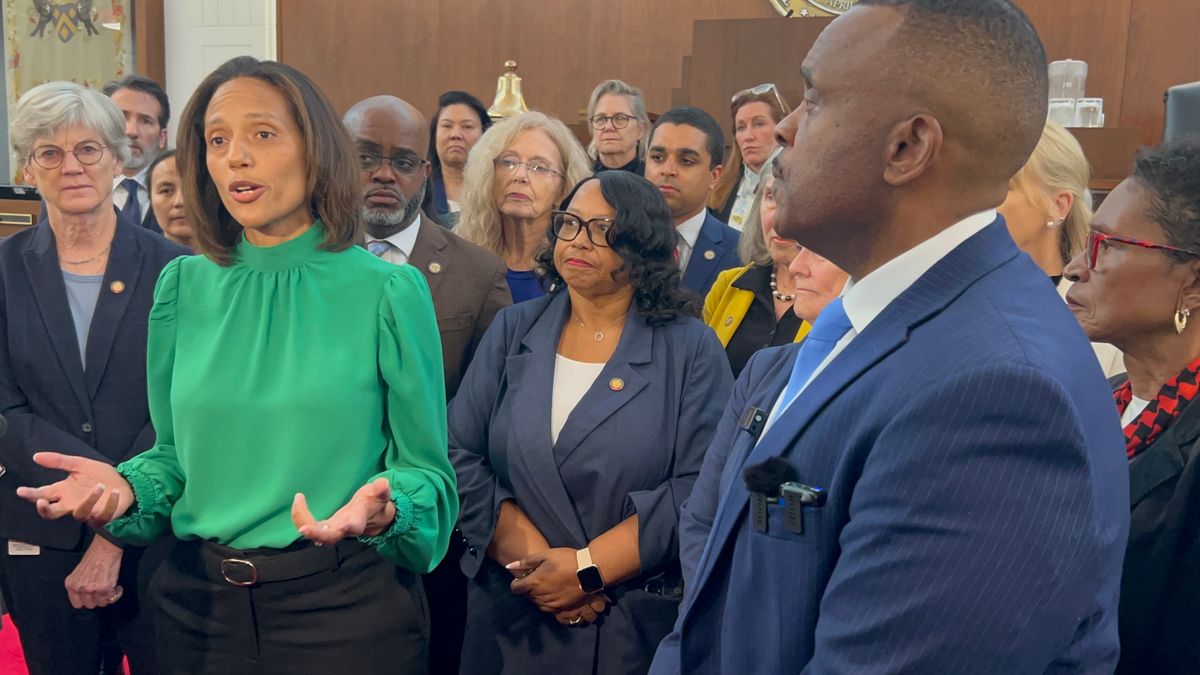
Nearly every Democratic state lawmaker in North Carolina traveled to Raleigh on Monday even though there were no votes to be held, nor any other major business on the legislative calendar.
Rather, they came to talk about what they thought they should be doing: voting to fully fund the state’s Medicaid program. Monday was originally supposed to have been the start of a new special session — one that Democratic Gov. Josh Stein called two weeks ago — to deal with a Medicaid funding shortfall.
Other WRAL Top Stories
Republican legislative leaders rejected Stein’s order last week, saying they have no plans to take more votes until next year.
That means North Carolina will continue moving forward with no new state budget, and with an underfunded Medicaid program.
“The governor asked what he thought was a reasonable thing: For us to come back and at least do part of the job we were elected to do,” House Democratic leader Rep. Robert Reives told reporters Monday, as dozens of Democratic legislators crowded in. “As you can see, we are the only ones here. But we are here, and we’re ready to work.”
Republican lawmakers said Monday that Democrats’ show of force amounted to little more than a political stunt, and that actions by the Stein administration to institute cuts to Medicaid reimbursement rates were premature.
Stein issued a statement Monday thanking the Democrats for showing up for what could’ve been the special session he wanted, adding: “Where are their Republican counterparts? Patients and providers are already hurting due to the legislature’s failure to act, and now the Republican leadership is using them as a political bargaining chip in their own dispute among themselves. It’s wrong and a total dereliction of duty.”
The health insurance program for low-income people serves nearly one in every three North Carolina residents. But it’s underfunded by hundreds of millions of dollars as the Republican leaders of the state legislature have been unable to agree on deals to pass a new state budget, or any of several recent standalone bills for Medicaid funding that have been proposed.
Lawmakers approved $600 million for Medicaid this summer after it became apparent that any deal on the broader state budget was unlikely to happen. But that wasn’t enough, and Stein’s Department of Health and Human Services has now begun instituting cuts to what Medicaid pays doctors and hospitals who treat the more than 3 million Medicaid patients living in North Carolina, about half of whom are children.
Stein and his DHHS Secretary Dev Sangvai say that’s their only reasonable plan of action, since they have no idea when — or if — Republican lawmakers will be able to fund the program fully. GOP leaders say that the cuts are premature and are being done for political reasons; they believe Medicaid could continue at its current spending level for at least a few more months. While the shortage of several hundred million dollars is a lot of money, it's also only a small fraction of the program's multibillion-dollar budget.
“Here’s the truth: Governor Stein’s Medicaid cuts are politically motivated and unnecessary, the N.C. House has already passed three clean bills to fund the rebase long-term, and Medicaid is fully funded through April 2026 thanks to [legislative] appropriations,” Demi Dowdy, a spokesperson for House Speaker Destin Hall, told WRAL Monday. “It’s time for Gov. Stein to stop playing politics and end all rate cuts, given that the General Assembly will add more funding in due course.”
The state House has passed multiple bills to fully fund Medicaid. So has the state Senate. But each chamber has refused to allow the other chamber’s bills to be heard, as part of their standoff over the broader state budget.
‘The finger-pointing’
Hall has signed a pledge to approve the proper amount of Medicaid spending by May, WRAL reported Sunday. But Senate leader Phil Berger didn’t sign that same pledge.
At Monday’s news conference, Democrats made clear that they blamed the Senate, more than the House, for the lack of movement on Medicaid funding and a comprehensive budget.
State Senate leader Phil Berger is facing a competitive primary challenge from his local sheriff, Sam Page of Rockingham County, who accuses Berger of being insufficiently conservative — something Senate Democratic leader Sydney Batch implied is at the heart of the state’s inaction on a new budget, Medicaid funding and other policies. The 2026 primary elections are in March, and it’s possible that no more votes are held in the legislature until after then.
“As we move forward into this primary season, with individuals who don’t want to go on record prior to a primary … that’s why they don’t have a budget,” Batch said. “Because they can’t sit down, they can’t act like adults.”
Lauren Horsch, a spokesperson for Berger, said the Senate has already done plenty of important work this year, including the vote this summer on the $600 million for Medicaid that addressed some of the funding hole, “along with other initiatives to support rural health care from the mountains to the coast.”
She also listed off several other health care policy initiatives Senate Republicans have voted to approve, but which House Republicans have so far refused to allow votes on. “Since the beginning of the session, Senate Republicans have made addressing the cost of health care a priority, including tackling facility fees, surprise billing, and archaic certificate-of-need laws that drive up costs for North Carolinians,” Horsch said.
Batch said that as the House and Senate continue their standoff over the budget and other bills, all it’s doing is causing pain and uncertainty for people on Medicaid — as well as all state state employees whose promised raises are stuck in limbo.
She indicated that Democrats are ready to vote for a fix, even if credit ultimately goes to the Republicans who run the legislature.
“They can take all the credit,” Batch said. “I don’t care. We don’t want the finger-pointing anymore. At the end of the day, we just need to do what’s right.”