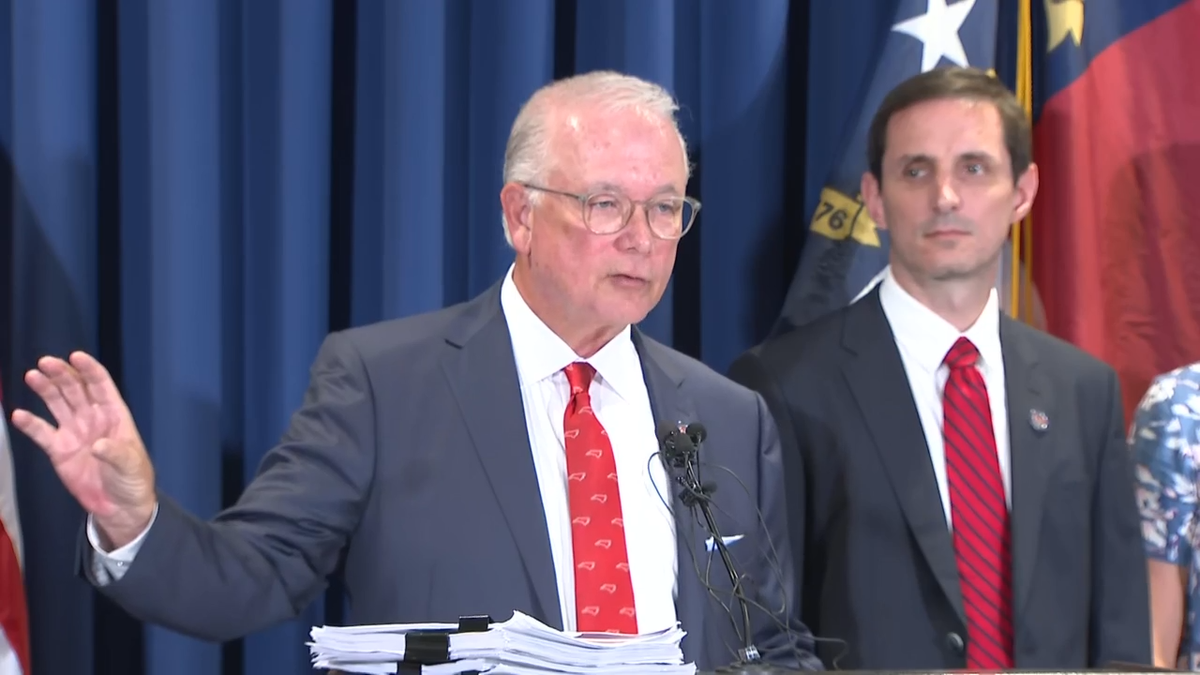
North Carolina could free up hundreds of millions of dollars by eliminating state government jobs that have been vacant for six months or more, State Auditor Dave Boliek told legislators Tuesday. But lawmakers should be judicious in which job — if any — they choose to cut, he said.
Legislators last year tasked Boliek’s office with assessing the employment needs of each state agency and identifying positions that could be cut — a program similar to the federal department of Government Efficiency, or DOGE. Such savings could be redirected to other priorities throughout the state or help fund planned tax cuts.
Other WRAL Top Stories
Boliek’s team — the Division of Accountability, Value, and Efficiency, or DAVE — has reviewed employment records of 46 state agencies and presented its findings to a legislative oversight committee on Tuesday.
Nearly 9,000 of the state’s 79,800 positions — about 11% of the state government workforce — had been vacant for six months or longer as of August, Boliek told lawmakers. Those empty seats vacant jobs are valued at a combined $1.04 billion for state agencies, he said.
Boliek advised lawmakers to consider each agency’s needs before implementing any cuts. He referred them to an interactive database on the auditor’s website that provides details of each agency’s vacant positions.
“I would recommend not making too generalized conclusions” about the vacancies, Boliek said.
He also encouraged lawmakers to consider each job’s potential benefit to the state.
“There are likely — and should be — deliberations from this body across state government of where adding full time employees delivers return-on-investment to the state of North Carolina,” Boliek said.
Some agencies want to fill their vacant jobs but struggle to compete for potential employees because the state-offered salaries are low, Boliek said. Some are slow to hire new employees because the hiring process is too lengthy or cumbersome, he said.
Agencies have also struggled to compete with the private sector for talented employees.
Some agencies are intentionally keeping jobs vacant and using the unused salaries for operational purposes, said Jared Cronk, director of performance audits in the auditor’s office.
“The way that these state agencies are using lapsed salaries provides a great opportunity for state agency budgets to be reviewed … to determine the actual expenditures necessary for them to perform and provide their services,” Cronk said.
The auditor’s office identified 5,275 positions vacant for one year or more; 2,945 positions vacant for two years or more; and 1,377 positions vacant for three years or more. In total, the auditor’s office identified 746 positions that state agencies acknowledged having no intent to fill.
Boliek’s report comes as legislators are at a stalemate over state spending. Republicans control both the state Senate and state House of Representatives, but haven’t passed a comprehensive state budget for the current fiscal year.
The Senate’s budget proposal would pay for new tax cuts in part by slashing a variety of government services and jobs.
Republican legislative leaders have presented competing proposals for funding major projects, changing future tax rates, and boosting state employee pay. Legislators can use the auditor’s report as a resource in the budget-writing process, Boliek said.
Gov. Josh Stein’s office cast doubt on the auditor’s findings, saying the total value of the vacant positions doesn’t add up to $1.04 billion.
Seth Dearmin, Stein’s chief of staff, said in a letter to Boliek that $246 million in lapsed salary reported by the auditor comes from “854 unfunded placeholder positions that have never generated lapsed salary.” Another $47 million in lapsed salaries reported by Boliek comes from federal and receipt-funded positions “that do not generate lapsed salary.”
“We welcome opportunities to engage in a constructive and meaningful dialogue regarding appropriations and budgetary processes that improve the way state government serves North Carolinians,” Dearmin said in the letter. “However, the analysis shared in the draft report and public dashboard released on December 30, 2025, is inaccurate in its accounting of long-term vacancies and lapsed salary, undermining the credibility of its conclusions.”
Randy Brechbiel, communications director for the auditor’s office, told WRAL there’s nothing misleading or inaccurate about the office’s findings. The auditor’s office calculated salary information using definitions outlined by the Office of State Budget and Management, he said.