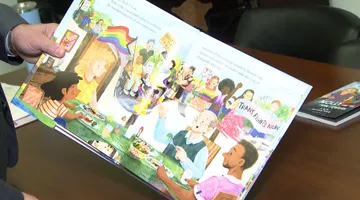
Chapel Hill-Carrboro City Schools officials said Thursday that books in their libraries comply with state law, as do processes aimed at vetting the appropriateness of titles in the stacks — but didn’t appear to convince the Republican state lawmakers who had called them in to testify on the issue.
Now lawmakers are proposing a statewide ban on some books.
Other WRAL Top Stories
“If parents identify a book that they do not want their child to borrow, we have a process that empowers parents to make those decisions,” Rodney Trice, superintendent of Chapel Hill-Carrboro City Schools told lawmakers in written testimony ahead of a legislative oversight committee hearing.
Lawmakers grilled Trice Thursday for three hours on books — and on how the system handles transgender students or others who might be questioning their gender identity — all a precursor to newly proposed legislation seeking to restrict books and amend rules around name changes and access to students’ counseling records.
State Rep. Brenden Jones, R-Columbus, a co-chair of the committee who filed the bill shortly after the hearing, alleges that some of the books in the district’s elementary schools are in conflict with a 2023 law that Republican sponsors titled the “Parents’ Bill of Rights,” which limits instruction on gender identity, sexual orientation and sexual activity in kindergarten through fourth grade.
Jones’s proposal, House Bill 1043, seeks to expand the parents’ bill by banning access to books with those themes in elementary school libraries statewide. The proposal has support from House Speaker Destin Hall, a Hall spokesperson told WRAL News this month.
We aimed to eliminate any ambiguity that could be exploited by bad-faith actors, including CHCCS, and to ensure that the Parents’ Bill of Rights has meaningful enforcement mechanisms,” Jones said in a statement.
The bill seeks to allow parents to seek financial damages from schools that don’t comply. It also would allow the state to withhold state funds if a district doesn’t comply with inquiries from the state auditor. “This bill strengthens accountability by tying compliance to central staff salaries,” Jones said. “If a superintendent chooses to disregard these requirements, they do so with full awareness of the consequences.”
Jones said during the hearing Thursday that he was frustrated that Chapel Hill-Carrboro school leaders didn't make more changes after a previous hearing late last year where he and other GOP politicians asked many of the same questions.
"You made us do this," he told the school leaders Thursday, accusing them of "gaslighting" lawmakers and trying to "make the parents watching feel foolish."
School leaders said they’re following all existing state laws, and that none of the books in their libraries violates the rule against teaching students about sexuality or gender identity as outlined in the 2023 parents’ law.
Just because a book is on a library shelf doesn’t mean it's used in instruction, Trice said. And the current law only focuses on instruction, he pointed out. Books deemed inappropriate by Jones and others on the committee aren’t part of the district’s elementary school curriculum, Trice said, nor are they used to provide instruction on gender identity, sexual activity or sexuality to students.
“The vast majority of books in our school libraries are not part of the district's curriculum or used for instruction,” Trice wrote. “Just as our district does not provide instruction on gender identity, sexual activity, or sexuality to K-4 students, we also do not provide instruction on how to play video games, the biographies of professional athletes, or stories about ghosts — subjects of numerous popular titles in our school libraries.”
Jones’s bill seeks amendments to “age-appropriate instruction” for kindergarten through fourth grade. It seeks to further restrict instruction of gender identity, sexual activity or sexuality by excluding “any electronic, print, or non-print resources for independent use by students and school personnel and not used as part of the standard course of study for any grade or course, and textbooks and other supplementary materials.”
“Teachers teaching students in kindergarten through fourth grade shall not use any third-party resources for instruction, including instructional materials, supplementary materials, or websites, except those provided by the public school unit," the bill says.
Multiple Democratic lawmakers said the effort was a distraction and a waste of time, as Republicans have failed for more than a year to pass a new state budget or address other more pressing issues facing state government.
"It's clear to me that Republicans think if they jangle enough culture war trinkets in front of our faces, that we will forget about the fact they haven’t done the simple tasks they were elected to do," state House Minority Leader Rep. Robert Reives, D-Chatham, said in a written statement Thursday. "North Carolinians are smarter than to fall for their distractions."
'Parents not being able to parent’
During Thursday's hearing Jones referenced the falling enrollment in Chapel Hill-Carrboro schools, the district's budget struggles and recently announced plans to potentially shut down several schools to save money as fewer students are being enrolled.
While many of those same budget and enrollment issues are facing school districts across the state, Jones alleged that in Chapel Hill-Carrboro schools, they’re a result of district officials "protecting ideology instead of protecting the children you were hired to educate."'
Trice defended the district's policies in his testimony Thursday, and not just the policies about library books. He also defended how local teachers and other school employees handle students who might be questioning their gender identity — another section of the law that came under scrutiny on Thursday.
The 2023 parents’ bill requires public school employees to tell parents if their child changes their pronouns or the name they go by at school.
Politicians who supported that law say Chapel Hill-Carrboro leaders are getting around that law, citing a district policy that said teachers shouldn't tell parents about a student coming out as transgender if the student raises concerns about repercussions in their home life. The law contains an exception: School employees don't have to tell parents if they suspect the child will be abused. But Republicans think Chapel Hill-Carrboro leaders are interpreting that exception too broadly, by telling teachers to consider "parental strife," instead of just physical abuse, as a reason to not inform the parents.
Trice said there are circumstances in which a student asks a teacher about changing their name or pronouns, and then after the teacher lets the student know their parents will need to be informed, the student pulls that request and makes no changes. In that circumstance, the law doesn't require parents to be notified, Trice said.
Some legislators were skeptical of that interpretation of the law, including at least one Democrat.
"We're having issues with children, social media, sexual identity," said Rep. Carla Cunningham, D-Mecklenburg. "We are having so many issues with our children and the parents not being able to parent that the children are not learning, they're not even being disciplined, they're not achieving."
'Can we just agree'
Lawmakers also grilled Trice and Al McArthur, the district’s director of digital learning and library services, over books that the lawmakers might soon consider banning from all elementary school libraries across North Carolina.
While GOP lawmakers said local parents are upset with Chapel Hill-Carrboro schools over their book choices and curriculum, they didn't point to any specific parent complaints. McArthur said every parent in the district, which serves about 11,000 students, is allowed to ask schools to prevent their children from checking out certain books from the school library. The school system has received one such request in recent years, he said.
Thursday’s hearing comes on the heels of a similar meeting in December, during which Republican members criticized library materials and accused officials of defying lawmakers. In that meeting, Jones tossed a book titled “Santa’s Husband” over his shoulder, calling it “trash.” School officials said in that meeting, too, that they were complying with the law.
Jones told WRAL News this month that his staff identified dozens of titles in Chapel Hill-Carrboro elementary school libraries that include themes of sexuality, gender identity or sexual activity. WRAL News has reviewed library database records showing some of those titles are listed as available and have been checked out recently.
On Tuesday Rep. Grant Campbell, R-Iredell, asked Trice directly if he'd agree that elementary schools shouldn't have books containing sexual content. Trice declined to agree.
"Materials that talk about sexuality, describing sexual acts, illustrating sexual acts, shouldn't be in elementary school libraries," Campbell said. "And can we just agree on that and just say we're not going to do that going forward?"
Trice responded: "I'm not necessarily agreeing with that. What I'm saying is that we trust the professionalism of our school librarians."
At that response, a number of supporters in the audience cheered and clapped for Trice's answer, causing Jones to threaten to kick them out if they interrupted again.
When Campbell further pressed Trice on policies that encouraged teachers to use curriculum that includes people of different sexualities or gender identities, Trice said there's nothing inherently sexual about acknowledging the existence of LGBT people. "To recognize individuals and families is not teaching gender identity, sexuality or sexual activity," he said. "That's just recognition of individuals and families."
Rep. Eric Ager, D-Buncombe, said he reviewed the list of books that Republican lawmakers claim to teach sexual content. He said one of the books he read contains nothing except for the existence of a character who has two moms.
"It seems odd to me," that Republicans would think that's inappropriate content, Ager said. "I think we've determined here, pretty clearly, that same-sex marriage is settled law here in North Carolina and across the country. ... A book that references two mothers or two fathers is really no more concerned with sexuality than a book that references a mother and a father. It's all the same."
Trice reiterated in written testimony that the district has provided training and written guidance to administrators and teachers regarding how to implement the provision of the law that prohibits instruction on gender identity, sexual activity or sexuality in kindergarten through the fourth grade. He said he recently recirculated that written guidance. “Instruction in gender identity, sexual activity, and sexuality is not part of our district's K-4 curriculum (nor has it ever been to my knowledge),” Trice wrote.
Fight over book vetting
Trice also offered lawmakers a glimpse into the district’s system for vetting books for libraries, pointing to a new state law intended to boost parents’ involvement.
A 2025 law requires school library catalogs to be available to parents online. Trice says his district had been in compliance with that law long before it was enacted. “Around the state, many schools scrambled to implement this directive,” he said in his written testimony, “but no change was required in CHCCS because our school libraries had already been online and available to parents for years.”
He added: “Parents in the district have a right to identify library books that may not be borrowed by their child. Our digital book program also provides parental controls that allow parents to limit their child's access to certain books.
“If a parent has a broader concern about a title in the school library, the district encourages parents to discuss their concern with the school librarian. If this does not resolve the concern, district procedure allows parents to file a formal challenge requesting that the title be removed from the library collection.”
McArthur, in his written testimony, said that no state funding is used to purchase library books in the district, noting that library budgets come from local funds and occasionally from supplemental grants. “Our elementary libraries each contain an average of 10,000 physical books,” McArthur said. “The majority of those titles are not curriculum-related.”
Trice and McArthur added that it’s important to have a catalog with a wide variety to spark students’ desire to learn. “The more children read, the better their long-term academic performance,” Trice said. “This is one reason why it is so critical for children to have access to books for independent reading that appeal to their personal interests and experiences. It is also deeply important for children to see themselves represented in books and media.”
Efforts to restrict school library materials have faced challenges in the past. House lawmakers passed a bill last year that sought to create review boards charged with approving books and other media for school libraries. The bill stalled in the Senate. Democratic opponents of the bill argued that the bill amounted to a book ban and could lead to expensive legal challenges across the state.
When asked to comment on Jones’s idea earlier this month, a spokesperson for the American Civil Liberties Union of North Carolina referred WRAL News to a page on the organization’s website about book bans. “Under the First Amendment, public officials may not bar access to ideas simply because they don't like those ideas for political or partisan reasons,” the group says.
States that have passed similar laws have faced legal challenges from publishers, librarians and citizens. In Iowa, a federal appellate court ruled the state can enforce a law that restricts teachers from talking about LGBTQ topics with students in kindergarten through the sixth grade and bans some books in libraries and classrooms.
Advocates for LGBTQ inclusion say the books at issue can help students better understand a diverse society, while critics argue school materials should be limited to age-appropriate content.