Wake County schools Superintendent Robert Taylor proposed a budget for next school year during Tuesday night's school board meeting, three weeks after he initially informed special education teachers that 130 positions would be cut in an effort to cut $18 million.
Taylor's budget proposal so far outlines $5.2 million in cuts. That's less than he tried to cut last month, but he says they're only a start of planned cuts for next year.
Other WRAL Top Stories
The cuts proposed Tuesday are:
- $2.5 million from transportation, based on spending patterns
- $2.2 million to cut 248 months of employment for elementary literacy coaches, or about 25 10-month teachers
- $500,000 from instructional services
- $50,000 to transition to an digital-only form of the parent/student handbook
More proposed cuts are planned. District officials plan to present some alternatives to the special education cuts at the board's first budget work session.
Taylor told WRAL News he's not necessarily looking to match the $18 million figure in further cuts and noted that the $18 million figure would have been offset in part, under his original plan, by $7 million in new local funding.
Taylor still plans to ask for a $25.3 million more funding from county commissioners, which would take county funding for general operations from $742.9 million to $768.2 million.
The school district will host three budget feedback sessions as they finalize a budget proposal. The first one is Wednesday night at Holly Grove Middle School at 6 p.m. The second is April 15 at Wakefield Middle at 6 p.m. The final session is during the school board meeting April 21, which will take place shortly after the board first budget meeting.
While Taylor is proposing cuts, that's largely at the expense of cost increases.
"We know that benefits increase, that salaries increase, that insurance premiums increase," Taylor told WRAL News, adding that those increases require cuts. "Revenue is not predicted to align with it, and it is our responsibility to identify what kind of reduction that we would have to make."
The district is projecting its budget to grow without adding or expanding any programming. Instead, it's projecting that most of its projected $44.3 million in increased costs will go toward salaries and benefits required by potential pay raises in a new state budget. While the state funds those pay increases, it only does so for state-funded employees, requiring the county to match those increases for the rest of employees.
Taylor characterized his budget request as a "responsible" one.
"The financial landscape is vastly different from a few short years ago," he said.
Later Tuesday night, the school board voted without opposition to ask county commissioners to approve putting a $680 million bond referendum before voters in November. The bond would fund facilities, mostly school renovations. It would require an unknown property tax increase and would be on top of and entirely separate from the educational operating budget Taylor proposed Tuesday.
The $680 million request was in part based on needs and based on what county officials said their calculations concluded revenue would support.
Voter-backed bonds tend to have lower interest rates than other lending sources the school district often uses for other facility needs.
Wake County schools' staff rallied ahead of Tuesday's meeting, many calling for officials to fix the 'crisis' affecting special education. The rally was organized by the Wake chapter of the North Carolina Association of Educators, which argued the $25 million funding increase from the country isn't enough.
Board Member Chris Heagarty credited the county with providing the district with significant funding increases in recent years, deflecting criticism from outside of the school district that the county would be unwilling to fund what the school district needed.
"Wake county government has saved Wake County public schools," said Heagarty, noting that Wake has avoided school closures, deficits and major personnel cuts that other districts have faced in recent years.
Several board members thanked Taylor for reversing his decision to cut from special education.
Board Vice Chairman Sam Hershey said he appreciated Wake NCAE's vision for special education and wanted to see something similar from the district.
"In some areas, we lack a vision," he said.
Special education advocates have long accused the services of being drastically less than needed.
During public comment, several special education teachers and instructional assistant asked the school board for more resources. They described schools with high turnover among special education staff and lapsed support for special education students who needed it while schools were unable to fill those vacancies.
That's resulted in parents opting for private school and in student performance plummeting, they said.
One instructional assistant recalled a student who was no longer being served each day, whom she once served, who stopped completing schoolwork altogether.
"He's taken such a big step backwards this year, and I feel like I failed him," said Crystal Daves, who works at Alston Ridge Elementary.
A parent wondered out loud if some people should move to another state that invests more in special education.
Another parent, Abby Johnston, recalled how life-changing a good special education teacher can be. Her son when he started school was nonverbal, not pottytrained and had a feeding tube around the clock. But his teacher committed to teaching every student how to read, and her son was able to learn, to the shock of the Johnstons.
"Don't cut what can't be replaced," Johnston repeated several times as she left the podium.
Increased costs
Taylor reversed course from his March proposed cuts after pushback from school board and community members, but his upcoming proposed budget is likely to include cuts of some kind. Those could include cuts to staffing.
Employees are a huge chunk of business.
Salaries and benefits comprised 87.5% of school system education expenses during the 2024-25 school year, according to North Carolina Department of Public Instruction data. Another 8% of spending went toward contracted work. Supplies, equipment, travel and other non-labor expenses comprise little of education spending. Separately, the school system also spends hundreds of millions of dollars each year on facilities, often via bonds.
The school district's education budget, excluding facilities, is $2.25 billion for the current fiscal year, with $81.6 million of that going to charter schools, via a state requirement that county charter schools receive equal per-pupil county funding as the school district's students.
Similar to last year's budgeting cycle, the school district is facing increased costs at a pace faster than increasing revenue, largely because the student population isn't growing much. Last year, the school district made about $20 million in non-classroom cuts while still asking commissioners for about $40 million in additional revenue.
School districts across North Carolina and the nation are planning to shrink some expenses because of years of enrollment decline.
In North Carolina, school districts have an added complication of not having a budget for the current fiscal year, a problem that Wake Board Chairman Tyler Swanson said is on top of insufficient funding from the state.
"When we don't have the funding that we need... we are forced to make tough decisions," Swanson said. He was echoed by other board members who noted counties are spending more property tax revenue on schools now.
Swanson and other also lamented the state supreme court's decision last week to throw out a long-running education lawsuit that sought to provide billions more dollars and numerous policy changes to the state's schools.
The school board will recommend a budget to county commissioners, who will ultimately approve how much money the district gets.
Taylor's attempt to cut $18 million from the district's special education programming would have represented less than 1% of the district's overall budget, though a much more significant chunk of funding for those students with disabilities. The district reports having $306 million in its special education budget this year, so $18 million comprises about 6% of that.
Rallying against special education cuts
Ahead of the meeting, about 200 educators, parents and others rallied outside district offices for more than an hour, speaking, chanting and pushing district leaders to preserve special education funding.
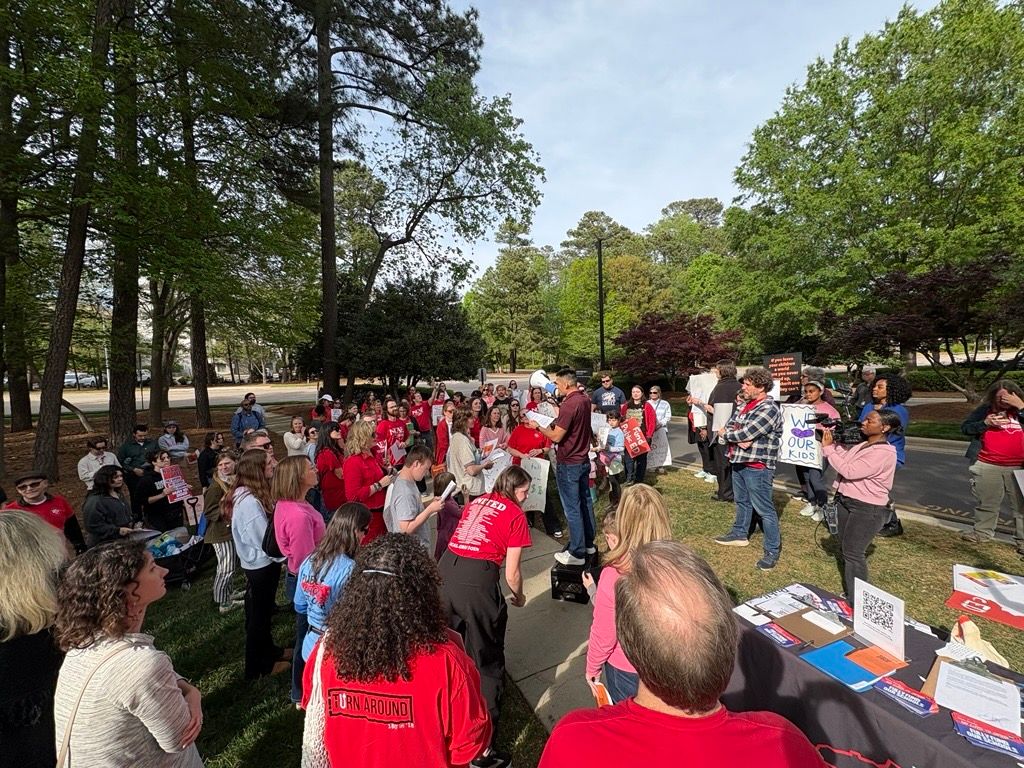
Many of those in attendance said they, or a colleague, had been told last month that their position would be eliminated, before Taylor said he would revise his decision.
That March proposal was an oversight, teachers said, a slight to an special education department that's bene overworked for years.
"Before the cuts were even proposed our [special education] department was in a state of crisis," said Jessica Boone, a special education teacher at Enloe Magnet High School.
Boone says her workload consists of managing the behavior of her students, teaching those students academics and emotional regulation, case management, data collection, meetings, adding to her students individualized education programs, educating other school employees about required laws and policies, and helping other teachers manage their students' behaviors.
"It is not OK to have a bad day," she said.
The district faces many lawsuits already over special education services and "will continue to do so without appropriate funding," Boone said.