The Durham City Council on Monday approved a 60-day moratorium on data center plans, joining other counties and municipalities across the state pausing development.
The discussion took place about an hour into its meeting, with more than 30 people speaking during the public comment section of the city council's agenda. City council members said the 60 days will give them more time to come up with a plan going forward.
Other WRAL Top Stories
"Durham is the first, not the only, of North Carolina's major communities to do this," said Nate Baker, a city council member. "When the moratorium goes into effect, I'm counting on a highly engaging and collaborative process with the community, especially those experts who played a key role in putting this moratorium forward."
North Carolina is already home to several massive data centers. In February, Microsoft said it would continue its plans to build a data center on a 1,385-acre megasite in Woodsdale Township, which extends to the Virginia state line.
"We see hyper-scale data centers are having detrimental impacts in communities across the state, the United States and the South," Baker said. "Many people who came here this evening have spoken to those eliquently this evening."
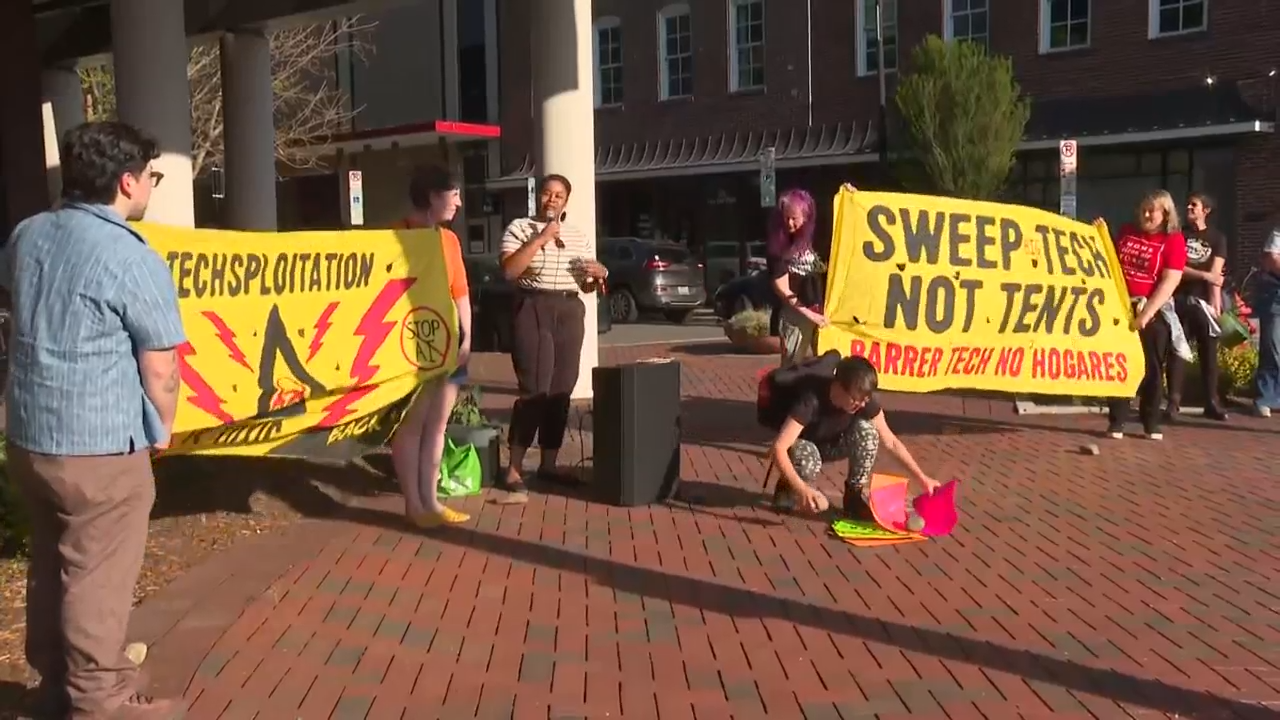
Some people gathered outside city hall ahead of the meeting to voice opposition to data center construction and development, holding signs advocating for the city to support a moratorium.
"Data centers are not a singular issue. It impacts immigration, it impacts your ability to be safe and our ability to breathe easily in our community," said one speaker. "We are paying the energy bill for these industries that are profiting off of us."
What are data centers?
Data centers are massive computer facilities that power artificial intelligence and require enormous amounts of electricity. According to the U.S. Energy Information Administration's household consumption data, a 300-megawatt data center can use as much electricity as roughly 200,000 North Carolina homes running nonstop.
To keep those centers running around the clock, they require enormous amounts of water. Michael Natelli, a developer behind a previously proposed data center in Apex that's now on pause, said that at their peak, they require 1 million gallons of water per day.
However, Natelli believes that the estimate is "conservative."
A new study also suggests that data centers are creating heat islands, which can raise temperatures up to 16 degrees around them.
Neil Bhagat with Duke Energy described the rise in data centers as similar to the solar development boom that hit North Carolina several years ago, when a rush of projects forced them to rethink how they studied and connected new power generation to the grid.
According to Duke Energy, about 6 gigawatts of data center demand is now in its development pipeline for the Carolinas.
How did Durham leaders settle on 60 days?
The Stop Data Centers in Durham Coalition, which organized the rally outside city hall on Monday, said it asked for a "32-month moratorium (or longer) on the development and expansion of large-scale data centers, crypto mining and other high-impact data processing facilities."
Durham leaders said they had intially considered a 24-month moratorium, which would have been one of the longest passed in the state to date. However, council members said it would have raised two issues:
- Any moratorium longer than 60 days would need to be approved by the joint city/county planning commission.
- Durham County is also looking at its own data center moratorium.
Kimberly Rehberg, a city attorney, said the intial proposal would be problematic if the city were to adopt one standard and the county adopted a different one.
"The enabling legislation is pretty clear about moratorium, and we need to a reason [for] why it would be more than six months," Baker said. "This is a fast-evolving issue that needs time."
However, city council members discussed the possibility of making a longer moratorium in the future.
"That buys us more time to bring forward more robust language for a more robust moratorium," Baker said. "I think it is vital that we have no less than a 24-month moratorium on hyper-scale data centers in Durham."
How support for data centers changed to bipartisan opposition
Early evidence suggests that some Americans — once indifferent — are now souring on data centers. Last month, Maine became the first state to pass a moratorium on data centers — only for the governor, a Democrat, to veto it — and similar measures have been introduced in at least 13 other states and dozens of municipalities.
In Virginia, a recent poll found the public had turned sharply against data centers. The same is true in Wisconsin, said Charles Franklin, director of the Marquette University Law School Poll, which found that around 70% of people now say the costs outweigh the benefits.
Data centers do have supporters: Local officials desperate to bring jobs and tax money into sagging economies, aging farmers who want to sell their land and labor unions eyeing construction jobs. Many also recognize that artificial intelligence can be a societal good, and that data centers should not be blocked entirely but simply be regulated, much like civil aviation or road traffic.
Some new bills in Congress are moving in that direction, and, reflecting just how politically unpredictable the issue is, they have come from lawmakers as far apart ideologically as Sens. Bernie Sanders, I-Vermont., and Josh Hawley, R-Missouri.
The New York Times contributed to this report.