Environmental experts from the state said Thursday that while this current drought mirrors rain deficits as the 2007 drought, its impacts may not be that bad. But it all depends if we get enough rain the coming months before summer.
Experts from the North Carolina State Climate Office, NC Division of Water Resources, NC Forest Service and the National Weather Service in Raleigh shared an update on our state's serious drought Thursday morning after the newly dropped drought monitor showed that conditions are worsening.
Other WRAL Top Stories
Much of western North Carolina and the mid-part of the state, from Raleigh north, are in "extreme drought," or the second-highest/worst level. In an extreme drought, major crop and pasture losses are expected, reservoirs and wells are at very low levels and many municipalities limit water use.
The panelists explained the severity of the drought conditions across the state, and how they've impacted farmers' crops. But they emphasized that these conditions didn't pop up overnight; they've been monitoring them since last winter.
"We go back to last fall, that's been especially in the eastern part of the state, things started drying out," said assistant state climatologist Corey Davis. "It had been pretty wet through the summer, and then once we got to mid-August, that faucet stopped. We weren't getting regular rain events, and we also missed out on the tropical systems that we expect at that time of year."
Davis said the drought's origins date back to the summer of Tropical Storm Chantal. After that, he said it was a pretty quiet hurricane season, especially for the N.C. coastline.
Davis said that most of the state is at least six inches below normal for rainfall, and that pockets of the southern and western parts of the state are more than eight inches below normal. He said that most of the state is now in one of their top 10 driest starts to a year on record, since record- keeping began 80 years ago.
RELATED: New drought numbers across NC show drought covers nearly half of state
"When it's the driest on record over almost a four-month period, that is really telling us something," Davis stated. "This is an historic level of dryness that we're seeing at this point in the year."
However, compared to the worst drought in the state in 2007, the impacts from this year's drought aren't going to be as bad.
While Davis said one of the similarities between both droughts is the overall rainfall deficits, he said that the time of year when these droughts emerged is not comparable.
The hottest August on record in the state was during the 2007 drought, which led to higher levels of evaporation at water reservoirs. Davis added that 2007 was considered a warm-season drought that started in late spring and worsened over the summer, making the impacts more severe when water levels were dropping.
What the state has seen so far in this drought is during a cool season, where it started late summer and over the fall in 2025, and the dryness extended itself in the spring. Davis said that this dryness happens at times of the year when we don't rely on as much rainfall, and the evaporation rates are lower because it's cooler.
"It'll sound like that extreme drought level is on par with the 2007 event. Those rainfall deficits are getting close, but the impacts we're seeing to things like lake levels are not there yet, and hopefully won't get there during this event," Davis said.
Concerns for farmers
The panel mentioned that North Carolinians will start to see lower soil moisture, which is a concern for farmers. If the drought continues or if we get intense heat during the summer, shallow roots will dry out very easily and can kill plants.
Davis said that in Hope County, people are seeing grass turn brown because it's so dry.
Davis added that while farmers in the northeastern part of the state have been getting better rainfall, they will still pull water directly from the Albemarle Sound, where it meets the Roanoke River, to irrigate their farms. But because of the drought, water doesn't flow as much from the river, causing salty water to push further inland, which would kill crops.
The good news, according to Klaus Albertin from N.C. Division of Water Resources, is that since record deficits occurred over the winter, conditions and impacts so far have been low. But the bad news is the summer, which he says, if the state doesn't start getting record rainfall, we could start to see the impacts we saw in 2007.
To conserve water these next few weeks, Albertin recommends hand watering your plants instead of using a sprinkler. He said it's better to water heavier once a week versus lighter twice a week.
Water before 10 a.m., as this timing results in less evaporation.
RELATED: Q&A: Water restrictions for Raleigh, Fuquay-Varina and beyond
Droughts during wildfire risks, burn bans
Several brush fires started in the Triangle on Wednesday as breezy, dry conditions persisted. Philip Jackson with the N.C. Forest Service said temperature swings, heat and windy conditions are contributing to the fire risk.
"All of these things are working together to create extremely dry conditions that are exactly what a wildfire wants and needs to become catastrophic, and it becomes extremely difficult for us to contain these fires, because they can go big and cause so much damage in such a short period of time," Jackson said.
WRAL News on Wednesday heard reports of a fire burning near N.C. 540 and High House Road. The scene cleared before the WRAL Breaking News Tracker arrived, but the town of Cary posted this update Wednesday afternoon:
"The N.C. Forest Service is plowing a fire break near White Oak Greenway, N.C. 540, and High House Road to help prevent the spread of recent brush fires. You may see light smoke, especially toward the High House Road area. There is no danger to the public or nearby properties, and the greenway remains safe to use. Crews will continue to monitor conditions on site."
Wake County Fire Marshal Braxton Tanner said a burn ban is needed to "prevent the small fires from getting larger and then you end up with property loss."
"I'm not aware of a burn ban since I worked here since 2014," Tanner said.
Since a statewide burn ban was implemented on March 28, the N.C. Forest Service reports 971 fires across the state that have burned 2,870 acres. Only five of the blazes are being blamed on natural ignition or lightning. Officials have issued 244 citations for burn ban violations.
"I would say anytime we're experiencing extended conditions of severe dryness or drought, yes, I would think we could possibly be looking at additional burn bans in the future," Tanner said.
The region saw the worst drought on record in 2007, according to the WRAL weather team. That year, NC recorded the highest number of wildfires across the state at more than 7,200. 2025 was the second worst wildfire season in NC on record with more than 6,800 reported fires.
The WRAL Breaking News Tracker was livestreaming as firefighters in Harnett County worked to put out a large outside fire on Oakridge River Road near Fuquay-Varina.
Earlier in the week, on Tuesday, Apex firefighters responded to a brush fire along 1800 Old U.S. 1 Highway near Pleasant Plains Baptist Church.
We're currently in severe and extreme drought conditions with very little rain in the forecast. Much of the state is 12 to 15 inches below normal for rainfall, according to the N.C. Drought Management and Advisory Council.
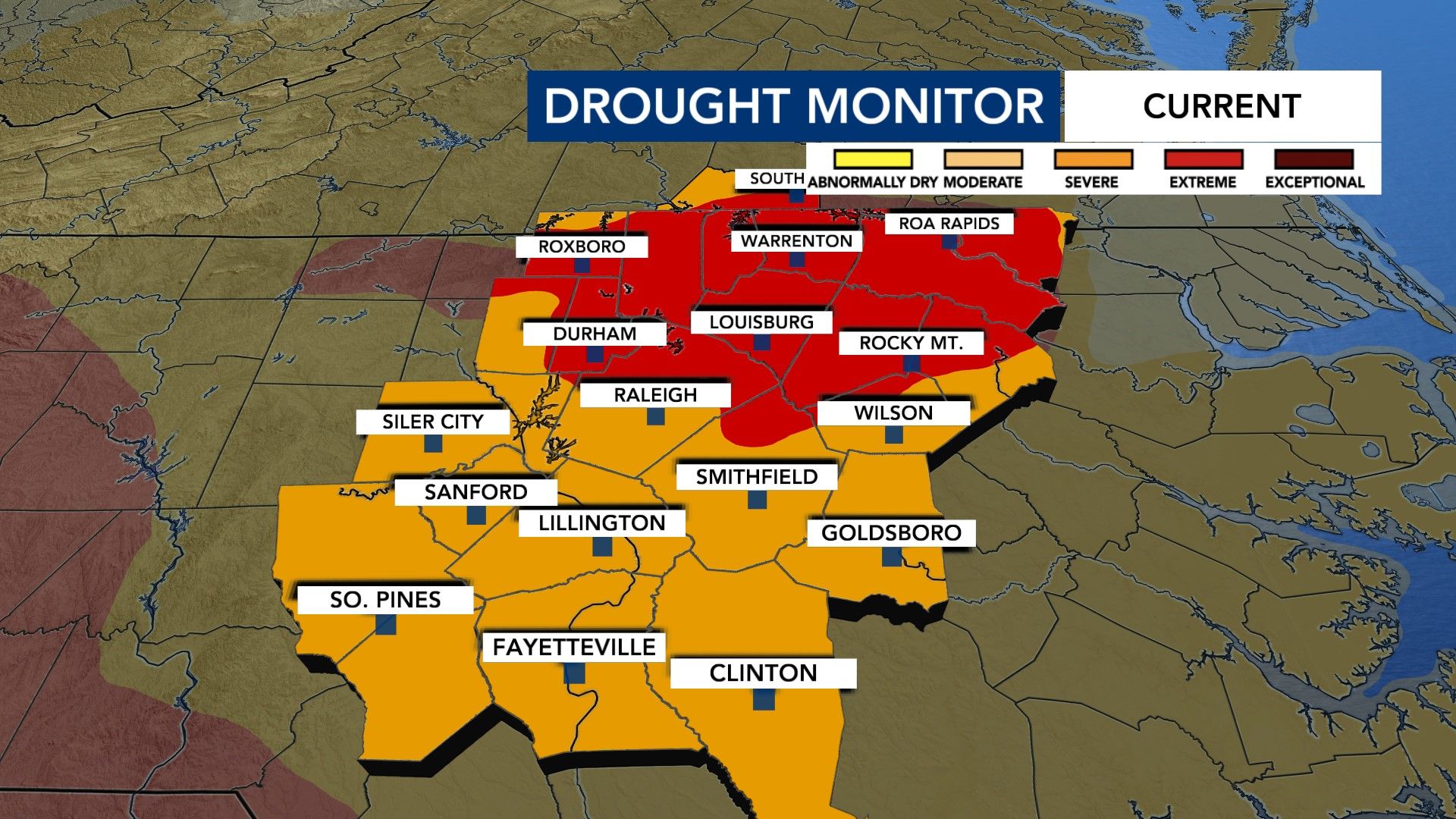
"Our drought has been months in the making, so the ground is very dry," WRAL meteorologist Chris Michaels said. "This time of year, we tend to see lower humidity in the afternoon and we tend to see gustier winds at the same time. Those three things, combined with a warmer-than-average April, make brush and wildfires more likely."
Water restrictions are in place in some areas, including Raleigh and Fuquay-Varina, and the N.C. Forest Service has issued a burn ban until further notice.
New numbers show the N.C. Forest Service has now issued 244 citations since the start of the statewide burn ban. The citation comes with $283 of fines and fees, plus the risk of paying to fight any wildfires you happen to start.
The Wake County burn ban prohibits:
- Burning leaves, branches or other plant material
- Campfires, fire pits, outdoor fireplaces and burning barrels
- Fireworks and other pyrotechnics
Jackson cautions people to be careful, even if they aren't dealing with fire directly.
"We need folks to understand that even activities that are permitted ... come with potential risk," he said. "Under the burn ban, you can still mow your lawn, but even that, with how dry it is, comes with potential risk."