CHAPEL HILL — The University of North Carolina plans to begin work this month on a second campus — a project that university officials consider the most important expansion of the state system’s flagship Chapel Hill campus in 250 years.
The project would be located on more than 200 acres of university-owned land, about two miles from main campus and envisioned as a “full-blown campus” nestled among a forest.
Other WRAL Top Stories
“A live, work, play, learn, research, study environment,” is how UNC Chancellor Lee Roberts described it to WRAL in an interview this week. “I think everyone knows what makes a campus feel special is the mix of uses. It’s not having just residential or just classroom space or lab space or office space, it’s putting everything together with plenty of recreational opportunities and open space that gives a campus its special fee. And we think we can replicate that at Carolina North.”
Roberts outlined his plans for Carolina North at a board of trustees committee meeting Tuesday in Chapel Hill. The university’s board of trustees gave initial approval to spend $8 million on design and planning for the campus at its meeting Wednesday and full approval is expected Thursday.
“Most of our peer universities would give anything to have this additional land available, and I think we have both the ability and the obligation to develop it to serve the people of North Carolina,” Roberts told WRAL.
Construction on phase one would begin in 2027 under Roberts’ timeline. Phase one would include undergraduate housing for more than 2,000, academic research buildings, a hotel and retail spaces. A new basketball arena to replace the Dean E. Smith Center is not included in phase one — in part due to vocal opposition to moving the arena from the main campus.
The entire Carolina North property is about 700 acres and once was home to Horace Williams Airport. It is located off MLK Jr. Blvd. in Chapel Hill.
Williams was a philosophy professor at the university and donated the land to UNC. It includes Carolina North Forest and popular trails for walking, running and bike riding. UNC plans to develop about 250 acres, leaving much of the forest and trails intact. The existing runway will be removed.
“Carolina North Forest is a remarkable asset,” Roberts said. “It’s a tremendous value, not just to the town, but to the broader Triangle region. And that’s not going anywhere. I’m one of the many people that enjoy those walking and running trails, and that’s an important part of Carolina North. It’s going to stay there.”
UNC first laid out development plans for the site in 2007, but they were halted amid the financial crisis that followed. UNC is adding 5,000 additional students over the next decade, beginning in the fall of 2025 with an additional 500 freshmen.
“We’ve been kicking the can on this opportunity for 15-plus years,” said Nate Knuffman, the university’s chief financial officer. “Our team cannot be more excited. We do believe the time is right to move forward.”
Roberts said Carolina North is the largest tract of undeveloped land in Chapel Hill and is a key part of the solution to addressing affordable housing concerns. Trustees were very supportive of the decision to move forward as a way to grow the university.
The academic buildings would focus on research, including biology (the university’s second-most popular major and fastest growing) and other science, technology, engineering and math courses, which now make up one half of all degrees at UNC. While English classes can be taught in classrooms that have been around for hundreds of years, Roberts said, other courses require newer technologies.
“One important component for Carolina North will be the construction of modern lab and research facilities that will help us meet the demand that we’re seeing,” he said.
Roberts said UNC plans to use private sector partnerships to cover the costs of development. The university could partner with life sciences companies, headquartered in and around Research Triangle Park, to build research, lab and office space.
The university, for example, could lease land to a student housing developer, who would then construct dorms or other housing options. Some infrastructure work at the site could be handled with state financing or debt financing from the university, Roberts said, while emphasizing that taxpayers wouldn’t foot the bill for the majority of the project.
“The big advantage is we own the land free and clear,” Roberts said. “That gives us tremendous flexibility, so we see a wide range of financing options.”
Roberts said Chapel Hill is building rapid bus transit that will connect the main campus and Carolina North.
Roberts said UNC can draw inspiration from similar projects at universities across the nation, including Georgia Tech, Purdue’s “Discovery District,” UC Davis and NC State’s Centennial Campus, an effort that began in 1984.
UNC named a stakeholder advisory committee for the project with co-chairs Brian Allen, Anita Brown Graham and Aaron Nelson along with university support from Tiffany Lacey, Ivy Taylor and Marcus Ginyard. Lacey is the executive director for real estate development at Carolina North.
Outgoing athletics director Bubba Cunningham is scheduled to become a senior advisor to the chancellor and athletic director on June 30. His top job responsibility in that role is “overseeing the development of the Carolina North project — planning, funding, and execution of construction of major facilities,” according to his contract.
The most controversial aspect of the project, to date, has been the potential inclusion of a new basketball arena for the Tar Heels’ men’s and women’s programs at the Carolina North site.
“We haven’t made any decisions about the basketball arena,” Roberts said. “There’s no perfect solution. We think Carolina North could be a good solution. What’s not a solution is the status quo.”
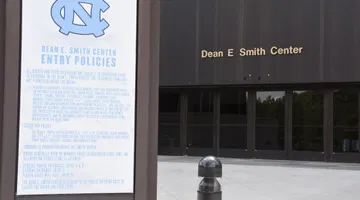
Roberts said the 40-year-old Smith Center needs a new roof, has problems with its bathrooms and concessions and needs improvements to become compliant with the Americans with Disabilities Act — projects that could cost between $80 million and $100 million without significantly adding to the building’s revenue-generating potential. These have been issues for years. Roberts addressed them in October 2024, just months after becoming permanent chancellor.
Roberts said the administration wants as much feedback as it can get from fans, former players, Rams Club members and others. UNC basketball legends such as former coach Roy Williams and former national player of the year Tyler Hansbrough have been vocal in their opposition to moving the arena off campus. The Smith Center is located at the far southern end of campus.
“We want Carolina basketball to be special,” Williams said in a video released on social media. “We want Carolina basketball to be different, and the Smith Center is part of that.”
Building a new off-campus arena with club and premium seating, which the Smith Center doesn’t have, could solve traffic and congestion issues that have plagued the current venue.
“The advantage to Carolina North is you could build a new arena with modern amenities, with premium seating, which would certainly help us on the revenue side,” Roberts said. “Everyone’s trying to figure out how to generate more revenue. We could address this and we could address the considerable traffic and parking issues that we have at the current Smith Center location.”
Roberts said there are additional opportunities around an off-campus venue that the Smith Center’s current location wouldn’t support for a variety of reasons. The Carolina Hurricanes are building an entertainment district around Lenovo Center, which is the off-campus home to NC State’s men’s basketball team.
“Most new arenas now are being built with amenities around them, so you have a place to get a bite to eat before the game or a drink after the game. That also helps with traffic because you’re spreading out the demand. And at a time when a lot of folks have a 4K television screen in their basement, you need to give them reasons to come to the game and that’s why you’re seeing so many more entertainment options being built around modern arenas — giving people more of an experience, more of a reason to fight the traffic, fight the parking and come to the basketball game.”
UNC was founded in 1789. Old East, a residence hall, was built in 1793, becoming the first state university building in the nation.