Wake County students can still film one another without the subjects' permission, using school-issued devices.
The Wake County school board's policy committee decided to cut out proposed policy language that would have prohibited that, citing concerns for students who might want to film an interaction, such as bullying, to protect themselves.
Other WRAL Top Stories
School system officials said Wednesday they hadn't strongly favored it anyway, after going back and forth behind the scenes, before proposing the change to the committee.
They clarified on Wednesday that the change would have only applied to school-issued devices, not to personal devices, such as cellphones.
"That doesn't reach the device that 90, 99% of the time would be used," said Board Chairman Chris Heagarty.
The proposal was part of other policy revisions that the committee favored, including new social media and network access restrictions.
The proposed revision of the Technology Responsible Use policy would do a number of things. Among them:
- Prohibit accessing any social media network by students unless specifically authorized by a teacher for academic use
- Prohibit use of school wi-fi or hotspots by anyone other than students or staff who need them for academic purposes
- Prohibit students taking audio or video or photos of other students or staff without their permission
- Prohibit use of private wi-fi or hotspots on campus
A change to a separate policy also discussed Wednesday would also address Internet usage -- prohibiting access to websites that don’t protect student data.
Social media websites are largely already blocked on the district's network, but the changes in the policy are together intended to prevent students from circumventing that, as well as comply with new state requirements. The requirements came from House Bill 959, which also restricted cellphone use.
The changes proposed Wednesday are only policy matters and don't contain information on how those restrictions will be enforced. Those are typically contained in separate procedures compiled at the district office once a policy passes, though on rare occasions they can be published in the school board's policy manual.
Superintendent Robert Taylor said that he thought the district's policy restricting cellphones would also work to prevent students from access social media by using data, instead of the network. If they can't get out a device that uses data, he said, they couldn't use data.
The proposal expands the explanation of possible consequences for the wide-ranging policy. That could be school discipline up to a long-term suspension for students or firing of employees. Depending on the violation and applicable laws, it could result in criminal prosecution.
Parents and guardians are already required to agree to the district's monitoring of students' internet and technology usage
Pulling back on video restrictions
Before board members removed it, the policy proposal would have prohibited students and employees from taking video, audio or photos of any student or employee who could be recognized in the video, audio or photo, without those people's permission. Sporting events and other public events would have been exempt from that, so long as the event was the focus.
Board members didn't want to take away students' ability to film themselves being bullied, or other interactions for which a video they said could protect them.
If the proposal was actually meant to prevent bullying by taking unauthorized footage of someone, then it would be redundant, Board Member Lynn Edmonds said. The board already has policies prohibiting bullying and harassment.
Having language on an issue in two different policies could also lead to contradictions or confusion, Board Member Wing Ng said.
"We don't want to put [bullied students] in a position where the technology could actually protect them, and it can't [be used]," Taylor said after the meeting. He thought the board made the right move by taking the language out.
While cellphones are now largely restricted during the school day, students in recent years have often taken videos and photos during school of things like fights or other incidents, though it's unclear what kind of permission or acknowledgment is received from the subjects for those videos and photos.
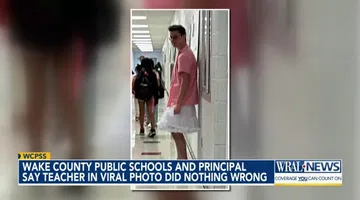
One year ago, a photo of a male teacher dressed for a school spirit day went viral months later when the mom of a student complained and political groups spread it, weeks before school board elections. Before that, videos have been shared of fights, including the fatal stabbing of a student at a school in 2023.
Some high schools may still allow cellphones to be out during passing periods or lunchtime. Cellphones have been restricted largely because educators believed they were distracting from learning or being used in harmful ways, such as for bullying or cheating.
The proposed restrictions to the Technology Responsible Use policy are also designed to curb that activity, in the event a student is able to get their cellphone or another device out.