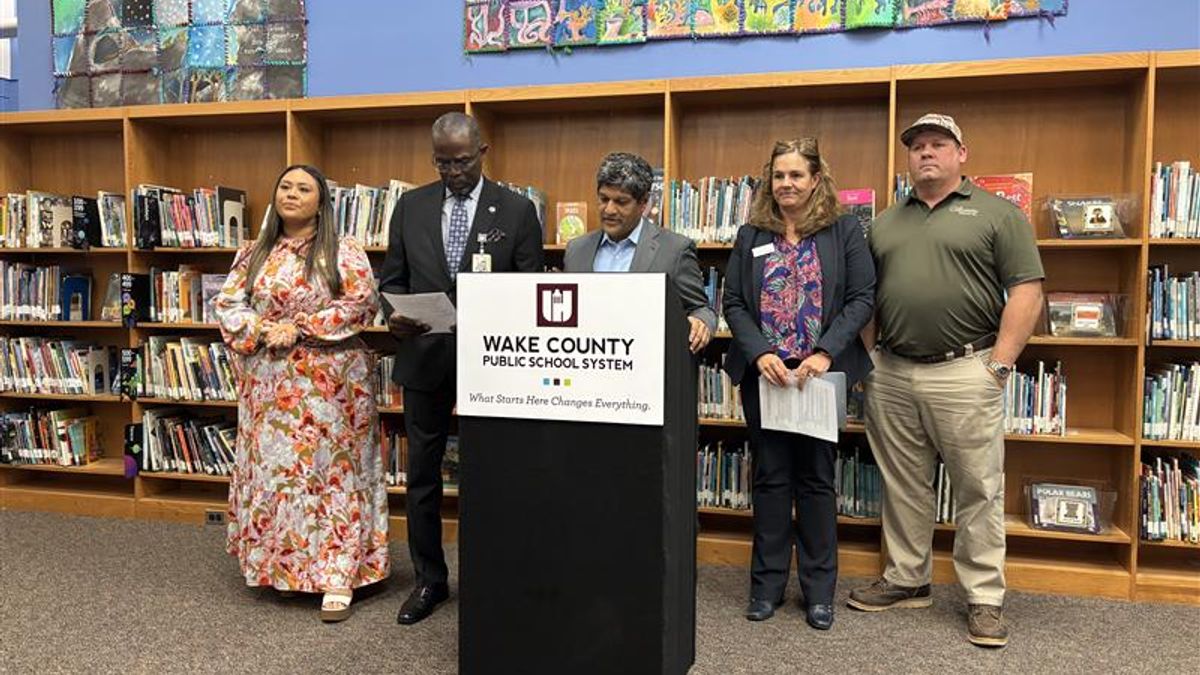
The end of the federal "Farm to School" program will decrease the amount of fresh, local food that North Carolina's public school children eat and hurt local farmers, a group of North Carolina educators, policymakers and others said Monday.
The group is asking for state lawmakers to provide $2.5 million to replace part of the $12.5 million cut by the Trump administration, along with another $1.9 million to replace summer meal programming also cut by the Trump administration.
Other WRAL Top Stories
The officials gathered Monday at Oak Grove Elementary School in Raleigh were concerned about a number of changes affecting or potentially affecting school meal programs, including changes to federal programs for low-income families that could have a trickle-down effect on eligibility for free and reduced-price school meals.
"As an educator, I see every day how access to nutritious meals, it fuels learning," said Rachel Candaso, a Pitt County teacher and this year's Burroughs Wellcome North Carolina Teacher of the Year. "And we know that a hungry student can't focus on equations or essays right when they're hungry for food, the fresh, healthy food that we provide students at school, it helps them be ready to learn."
Farm to School elimination
Other funding programs can help schools buy fresh fruits and vegetables, but the Farm to School program was intended to benefit local farmers, specifically.
"Putting money into our local economies is always good business," said Tommy Wheeler, founder of Tidewater Grain Company. Wheeler grows rice in Pamlico County and sells it to school systems, including the Wake County Public School System. On Monday, his company provided Carolina gold rice -- an heirloom variety that's typically nutty and more nutritious than white rice -- in the meals served at Oak Grove. Wheeler said the Farm to School program had no administrative costs, meaning all of the money went directly to sourcing the food.
"Not one dime goes anywhere else," he said. "It supports the schools, it supports the farms, it supports the communities."
The Trump administration eliminated the program in March, after a review from the so-called Department of Government Efficiency run by former Trump administration official Elon Musk.
Before the cut, schools had seen dwindling funding.
The Wake County Public School System received $183,000 last school year, down from $591,000 the year before.
Sen. Jay Chaudhuri, D-Wake, who helped organize Monday's event, said he believes asking lawmakers to fund just $2.5 million of the more than $12 million cut statewide is a reasonable request. He said he believes there was bipartisan support for the program.
"The ask that has come out of this roundtable is quite reasonable, and it's quite small in dollars," he said.
That amount is in the House budget but not the Senate one. State lawmakers have yet to pass a budget for the current fiscal year, more than three months after the fiscal year started July 1.
Chaudhuri and others said the investment has high returns because of the support it gives to local businesses.
Anticipated effects of changes to SNAP, Medicaid
The "One Big Beautiful Bill," signed into law by President Donald Trump in July, tightens eligibility for the federal Supplemental Nutritional Assistance (SNAP) and Medicaid programs -- programs that can, in turn, make families eligible for free or reduced-price meals.
It tightens eligibility by requiring more recipients to complete additional forms and meet work requirements, and by dropping some legal residents who aren't citizens from the programs. Supporters of the bill, including the North Carolina GOP, celebrated the bill's tax cuts and said they'd increase taxpayers' pocketbooks.
While fewer families will qualify for SNAP and Medicaid, they may still qualify for free or reduced-price school meals. But they'll no longer automatically qualify for the meal program based on their SNAP or Medicaid eligibility. To stay eligible, they'll need to fill out extra paperwork -- paperwork that eligible families often don't fill out.
North Carolina families have been automatically enrolled for years based on their eligibility in several other federal programs for lower-income families. Families who aren't eligible for those programs or don't participate in them can still apply for the school meal program via a separate application.
A family of four is eligible for the program this year if their annual income is $41,795 or less. That's about 130% of the federal poverty level.
The Wake County Public School System estimated earlier this fall that a drop of just 10% in students eligible for free or reduced-price meals could reduce the number of schools where all meals -- lunch and breakfast -- are served free of charge by 33 schools. That's because schools can get all meals for free, for any student, regardless of income, under a federal program if a certain percentage of the student body qualifies for them.
Impact of the federal government shutdown
The federal government shutdown could affect school meals if it lasts long enough. Earlier this month, the U.S. Department of Agriculture told schools they would receive reimbursements this month for free or reduced-price meals served in September and believed reimbursements would be possible for meals served in October, as well.
Wake County Public School System Superintendent Robert Taylor said Monday that two weeks into the shutdown, he had no clearer idea of how school meals could be affected if the shutdown extends for weeks longer.
"Like everybody else, we hope that the shutdown does not go for an extended period of time," Taylor said, adding that the shutdown's impact on many programs is so far unpredictable. "So at this point, we don't have any specific data about that, but it is obviously a concern."