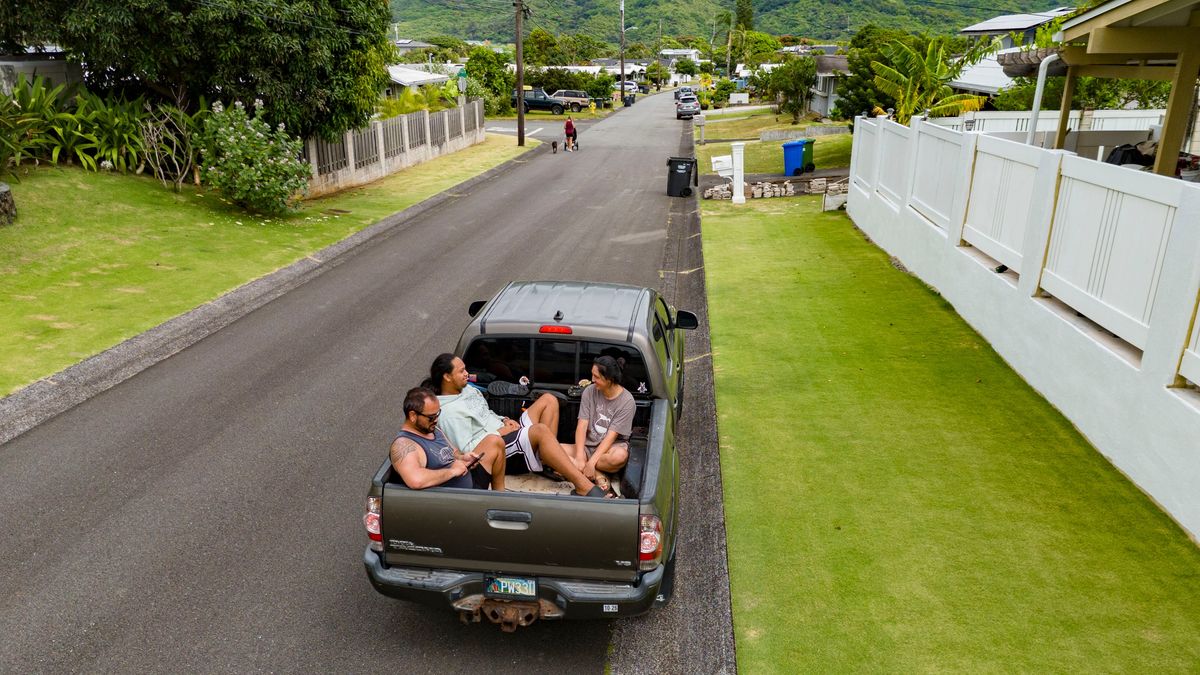
KAILUA, Hawaii (AP) — It’s common to see people riding in the beds of pickups in Hawaii, often along country highways sandwiched between towering verdant mountains and the glassy blue expanse of the Pacific.
“It’s a cultural thing, especially in a small, agricultural community,” said Kimeona Kane, who would jump into the bed of a pickup truck as a kid to get to baseball or football practice. Nothing felt more like island life than rolling through his coastal town fully exposed to the sun and saltwater air.
Other WRAL Top Stories
But as parts of Hawaii have become more urban and roads busier and faster, especially on Oahu, where the capital city, Honolulu, is located, concern has grown about the dangers of riding in an open truck bed without seats or seat belts.
Even now, Kane only allows his family to ride in truck beds on back roads — and mostly in Waimanalo, the Oahu town where he grew up and continues to live.
Lawmakers tried for years to put limits on the practice before passing a bill this spring that raises the minimum legal age for riding in truck beds from 12 to 16. Democratic Gov. Josh Green quietly signed it into law last month.
Green has firsthand experience with the issue. In 2023, he was traveling in a vehicle behind a pickup when a 25-year-old man was ejected from the bed. Green, a physician, sprang into action to render aid.
“I would prefer that nobody ride in a truck bed, because people need to be belted in,” he said in a statement at the time.
‘It’s Hawaii culture’
In a state where many songs romanticize pickup trucks on oversized wheels and dusty roads — like a popular cover of John Denver’s hit “Take Me Home, Country Roads” — it’s easy to idealize island truck-riding.
Richard Landford Jr. remembers skipping school and hitching a ride in the back of a farmer's pickup to get out of Waianae, across the island from Kane’s hometown.
“When you went fast, the dust off the highway would tell you you’re going too fast,” said Landford, now 80 and a lifelong Waianae resident. But it’s tough to tell when you’re going 60 mph (97 kph) with the windows up and air conditioning on in today's sleek, quiet vehicle that doesn’t hum, Landford said.
Still he believes truck beds should remain an option for transporting passengers, even though roads have become too fast.
“You drive to almost any church out here in the rural area, you’ll see people in the back of trucks,” Landford said. “I wish there was a simple answer.”
For Kane, who is Native Hawaiian, riding in a truck bed is a big part of local identity but it’s not specific to an Indigenous way of life. “It’s not Hawaiian culture,” he said. “It’s Hawaii culture.”
“It takes us back to even the plantation days,” Kane added, harkening back to when Waimanalo and other parts of Hawaii were sugar and pineapple plantation communities, whose workers from the Philippines, China, Puerto Rico, Portugal, Japan and other places played a big role in shaping the multicultural local identity of the islands.
Piling into the back of a truck was a common way for more recent waves of plantation workers to navigate fields and get around.
Even today, some people ride in truck beds because they don’t have any other option, state Rep. Darius Kila said, explaining that he knows of large families who only have a pickup truck that doesn’t have enough seating in the cab for everyone.
Kane has rules for riding in his truck bed, even on short jaunts: no sitting against the tailgate and no elevated seating on chairs or coolers, which many people do.
In recent years, farmers began using passenger vans with seats and seat belts for 10 or 12 workers, said Dean Okimoto, chief of operations for Nalo Farms.
“I wouldn’t chance putting people in an open truck,” he said. “They should ban it completely.”
Lawmakers try to balance safety with island lifestyle
Earlier this year, a woman flew out of the truck bed she was riding in when a vehicle rear-ended the pickup on a Honolulu freeway. It wasn’t the first time such a death has sparked calls for limiting or outlawing the practice that many in Hawaii hold dear as a reminder of simpler and slower island life, but this year those calls have been successful.
“Where do you strike the balance of safety and trying to maintain this culture of something that’s so synonymous with people in Hawaii? Like, because what a cool thing it is to ride in the back of a pickup truck,” said Kila, who introduced the bill, which tucked the truck bed age limit into a measure about motorist safety during road emergencies.
He initially intended more restrictions, including making truck bed-riding illegal on certain highways.
“Any time that legislation has been proposed of restricting or removing it, people have viciously fought back because I think for identity and place, that’s something they associate with Hawaii,” Kila said.
Twenty-nine states and the District of Columbia have laws with restrictions on riding in a pickup truck bed, but each has exceptions for when it is allowed, including farm use, parades and emergencies, said David Kidd, vice president of vehicle research at the Insurance Institute for Highway Safety. That's compared with all states but New Hampshire that require adult front-seat occupants to use seat belts.
Hawaii's law includes the same exceptions and permits those over 16 to ride in the bed only if there's no room in the truck's cab.
Kidd likened resisting regulation of riding in truck beds to defying seat belt and motorcycle helmet laws.
Riding in truck beds is extremely dangerous because they lack any safety mechanisms, he said.
Still, Hawaii's new law is a step toward keeping people safe, Kidd said, and could influence how Hawaii residents view truck-riding.
Kila agrees and believes someday Hawaii will ban the practice altogether.
“And it will probably be met with resistance, and then 20 years later after the fact, it will just be like, wow, we should have done that sooner,” he said.