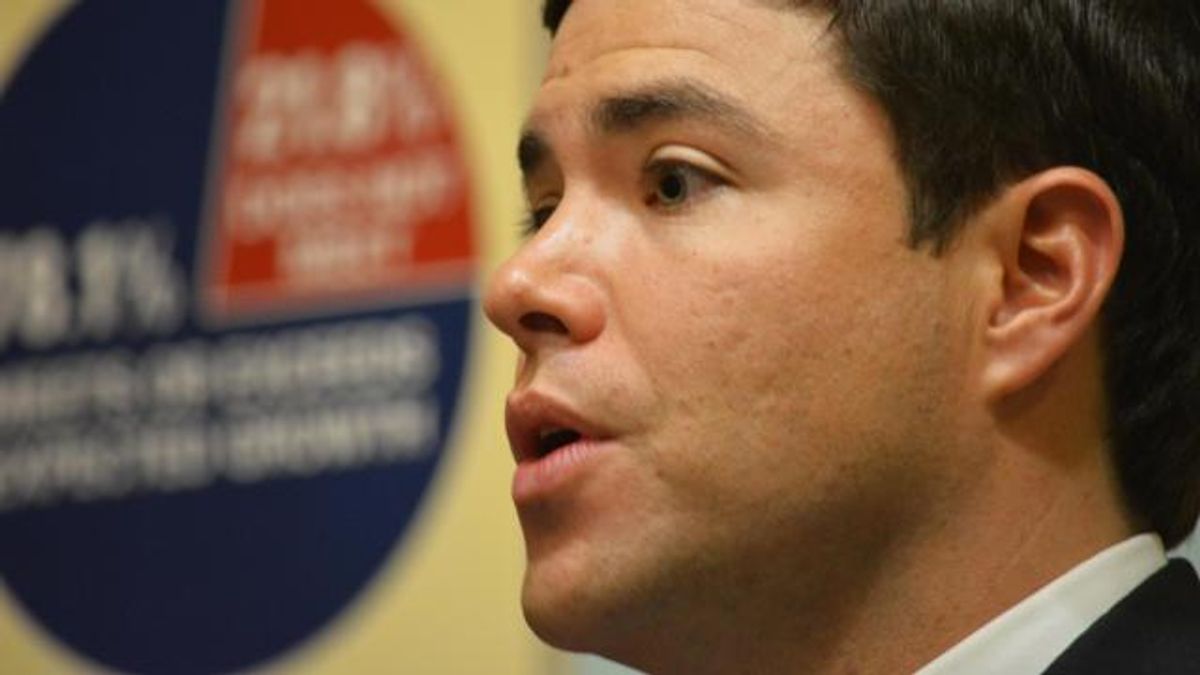
State Superintendent Mark Johnson accused members of the State Board of Education of instigating petty fights with him and creating a hostile environment after several members questioned his recent decisions, including spending $6 million on iPads for teachers, and urged him to be more transparent with them and the public.
This week's contentious meetings were the latest in a nearly two-year battle between the board and superintendent over who should control the state's public schools – a fight that made its way to the North Carolina Supreme Court this year. Johnson, who claimed victory in the case, repeatedly urged board members on Wednesday to "move on" – a phrase he uttered more than a dozen times during the heated meeting.
Other WRAL Top Stories
"The department has moved on. I have moved on. We are willing to work together," he told board members. "Let's not have a back and forth at board meetings anymore."
Board members who are unhappy or have questions about decisions he makes should contact him privately instead of engaging in "petty" discussions during public meetings, the superintendent said.
"I just want to stop what's happening here and just again say, Why are we having this back and forth at a board meeting?" Johnson said. "If this is something you were concerned about, you have my cellphone number. You have my email. I have never refused a meeting with any state board member. This, this is not good."
"The public’s entitled to know this stuff. You know that, Mark," said state board member Wayne McDevitt.
'This is not hostile'
Among the concerns board members shared was the superintendent's recent decision to spend $6 million on 24,000 new Apple iPads for every public school K-3 reading teacher in the state. The move took board members by surprise, with some saying they learned about it through media reports.
"Frankly, it's quite embarrassing when our constituents ask us about expenditures that we're not aware of by the department that we oversee," said board Vice Chairman Eric Davis.
The superintendent's iPad purchase has raised ethical questions, according to NC Policy Watch, which reported that "the multimillion-dollar investment, which was not put out for bid with other vendors, came roughly seven months after Johnson and a trio of influential Republican budget-writers in the North Carolina General Assembly convened for an 'executive briefing' with Apple reps at their Cupertino, Calif., headquarters."
Johnson defended the purchase as a push for more personalized learning for students and said his office worked with the state Department of Information Technology to get the iPads through a pre-existing state convenience contract "that was available to any department in the entire state." Schools have since returned about 2,000 of the iPads to exchange them for devices they prefer, according to the superintendent.
Board member Wayne McDevitt also questioned Johnson about the iPads and $4.8 million in state funds the superintendent used to give K-3 reading teachers $200 to help pay for supplies and books. Due to funding allotment issues, some school districts did not receive $200 for every reading teacher and had to add local money in order to reach the $200 per teacher amount, according to McDevitt.
North Carolina Superintendent of the Year Janet Mason, who leads Rutherford County Schools and serves on the state board, said her district had to chip in some money so each K-3 reading teacher could get $200.
"If you advertise it for a certain grade level, there are possibly teachers that are paid for out of federal dollars, Title I, things like that. So schools might have had more teachers [than allotted for the $200]," Mason said. "We felt it would not go over well or they might question us if we sent $185, so for the amount of the teachers we made it an even $200 ... I would imagine that happened in most every district because most of us have more teachers than just what would have been allotted that way."
Johnson urged superintendents to reach out to him about the issue and said he needed to talk with them "to see what actually happened there."
As McDevitt continued questioning the superintendent, Johnson again urged board members to contact him privately and said the public disagreements were not appropriate.
"This is not good for the people in the department, and it's not good for these meetings and not good for the department. It's not good for the North Carolina public schools," Johnson said. "I am happy to answer these questions and all the questions you have. We don't need to do it in a hostile environment."
"This is not hostile. This is not hostile," McDevitt said. "I want to be real clear. This is not hostile. The public's entitled to know ... I just would say, this is truly not about hostility. And you know you and I have had a lot of conversations and very frank, and not in a hostile thing. That’s not what this is about. This is about this buzz that needs to have transparency out there and the discussion does need to be at this table so that people can feel comfortable that it is."
'It's not good for morale'
Since the Supreme Court decision this summer, the superintendent and state board have tried exerting their power in different ways in an ongoing attempt to decipher who is in charge of what at the agency.
In July, Johnson sent a letter to top leaders at the State Department of Public Instruction telling them that they now report only to him. The leaders were previously in dual-report positions, meaning they reported both to the superintendent and state board. A week later, Johnson announced he was creating a new deputy superintendent structure that reports only to him.
The board drafted its own policy recently that makes certain demands of the superintendent, including requiring him to provide advanced notice of all official communications sent out by his office and the agency. He would also have to provide copies of his public schedule, memos, video messages, newsletters, updates, guidance documents, flyers, press releases, bulletins, promotional videos, and planned speeches/remarks at official events.
Johnson assured board members he could give them advanced notice about his announcements, such as the iPad news, but said providing all of the documents for the entire agency could be burdensome. He also pushed back on the board's proposal to identify "essential employees" at the agency in case of an emergency and post that information publicly.
"To label some people as essential and others possibly as not essential and to do it publicly, it’s not good for morale," Johnson said. "I had someone come to me in confidence and share a concern. If we have some people labeled as essential and others not labeled as essential, what happens if the General Assembly starts looking for budget cuts again at this department? If you have that publicly on the org chart, where are they going to go first?"
As the discussion continued, Board Chairman Bill Cobey said there seemed to be consensus among members that the information about essential employees should not be shared publicly. Johnson urged members to take more time crafting their policies and get more feedback from him and agency employees.
Creating policies is the most effective tool the board has to assert its constitutional responsibilities, board Vice Chairman Davis explained.
"The most effective tool would be working with me," Johnson responded.
At that, board member Patricia Willoughby, one of the longest serving members, moved closer to her microphone. She had some words for the superintendent.
'I have not found you to be very collaborative'
"I agree with the superintendent that working together would be the optimal way to do this," Willoughby said, speaking directly to Johnson. "I have not found you to be very collaborative on any issue, and I understand that you would prefer that we call you and meet with you as I did with the org chart during the month, but this is a very public board. This is a very public agency."
"I’ve been on this board for a really long time, for what feels like half my life," she continued. "And I can tell you we’ve had disagreements on this board among board members and the superintendent and other people, and we talk about them at this table because that’s how people do business ... You know, you talk about collaboration, but you have to walk that walk."
"Absolutely," Johnson said.
Willoughby was bothered, she said, when the superintendent failed to invite the board or give them a heads up about his announcement earlier this week about $35 million in school safety funding.
"I knew nothing about the safety announcement. We were not invited that I know of," she said. "I looked at the poster [announcing the program] and there are a lot of entities listed that are collaborating. Noticeably absent are the state board and DPI."
The announcement also listed a new website, ncsuperintendent.com, which was mostly blank as of Thursday. Willoughby asked why the superintendent needed his own website and didn't use DPI's. Johnson said his policy adviser, Kevin Wilkinson, created the new site because "we are not where we need to be technology-wise with the DPI website." The cost to create it was minimal and includes a hosting fee, Johnson said.
Thursday marked the second day that Willoughby questioned Johnson about the school safety grants announcement, his new website and why the board was not invited to be involved. Despite her disagreements with Johnson, she said she didn't want to continue fighting.
"It has to be you moving on and us moving on. That is what I think you’re not understanding," she told him Wednesday.
"Trust me. I have moved on," Johnson said.
"Why were we not included yesterday [at the school safety grant announcement]?" Willoughby asked.
"The department has moved on," Johnson said.
"Tell me why," Willoughby pushed.
"We are moving on," Johnson said.
A moment later, state board member Olivia Oxendine joined the discussion and urged her colleagues to move on.
"I am moving on," she said. "I mean, this discussion has gone on for far too long, and it’s beginning to remind me of some local school board meetings around the state. So, let’s move on."