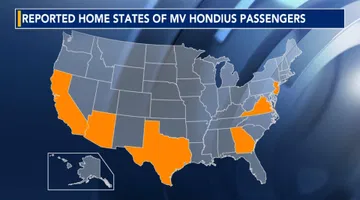
The North Carolina Department of Health and Human Services is monitoring the recent hantavirus outbreak on board the MV Hondius cruise ship.
Health specialists said they are not sharing any personal information about the person from North Carolina. They said if and when the person returns home, they will take the proper precautions.
Other WRAL Top Stories
With news that one of the Americans in quarantine for a mysterious new virus is from North Carolina, some are worried about the possibility of another pandemic and the limitations that came with the last one.
However, hantavirus does not appear to be the next COVID, according to health specialists. They said this is not going to become a pandemic.
What you do need to know is that hantavirus is an infectious disease that has been around for some time, having been recognized in the U.S. since 1993. Betsy Arakawa, the wife of actor Gene Hackman, died from hantavirus in February 2025. The last case in North Carolina was reported in 1995.
'This is not COVID'
Dr. David Wohl with UNC Health said while there's not really much to be fearful of, there's much we can learn from the hantavirus.
"This is not COVID," Wohl said. "This is not flu. It's a pretty unusual circumstance, basically related to being on a cruise ship with people who have a pretty nasty virus."
A hantavirus outbreak aboard a cruise ship left three passengers dead and sickened others, according to the World Health Organization. Hantavirus can be more lethal among those infected, but COVID can spread more easily.
What is the impact on North Carolina?
The U.S. Centers for Disease Control and Prevention has confirmed one person from North Carolina was on board and evacuated with all remaining United States passengers to the University of Nebraska Medical Center’s National Quarantine Unit.
Spread through rodents
Wohl said that unless you find yourself in a rodent-infested area, you probably don't have to worry. The characteristics for building a pandemic aren't there.
"This is a very severe disease with a high mortality rate for people who get sick," Wohl said of hantavirus. "So you have all these elements together. So I understand why the story is so compelling. But the potential, if you were going to design a virus, to make it a pandemic, potential pathogen, you would not design it like hantavirus."
Both hantavirus and COVID-19 are viral diseases that can cause serious respiratory illness. Some early symptoms of hantavirus include fatigue, fever, muscle aches, headaches and dizziness.
While rodents carry hantavirus, not every rodent will be a carrier for it.
North Carolina Public Health Veterinarian Carl Williams said the Andes rodent is not native to North Carolina or the East Coast. He said hantavirus cases are normally in the southwest, closer to South America.
Spread, risks vary between the hantavirus and COVID-19
The ways they spread and the public health risks they carry are different, according to health experts. Global health officials say the risk to the general public remains low because the germ does not easily spread between people.
COVID is a contagious respiratory virus while hantavirus is tied to environmental factors and is generally acquired from infected rodents. However, the hantavirus that has caused the current outbreak, called the Andes virus, may be able to spread between people in rare cases.
"This is just not a virus with global pandemic potential," Wohl said. "So don't worry about it, but it does show us, and I think this is a really important point, infectious diseases are out there."
Hantavirus is not usually very contagious between humans. The Andes virus strain, a cause of hantavirus pulmonary syndrome, is known for person-to-person spread.
COVID spreads through infected persons breathing out droplets and small air particles, making it more transmissible and carrying more potential for widespread outbreaks.
As far as designing a virus, one carries a very significant advantage over the other.
"You would design something very much like COVID-19," Wohl said. "That makes sense, because it's something that can spread very readily, easily. But the good news is, COVID-19 nowadays is no longer as deadly as it was, but hantavirus just isn't that kind of potential. It's harder to catch. It doesn't perpetuate like we talked about with COVID, where one person gets and they give it to five other people, and they give it to five other people, and so on and so on. You could tell even from the 150 people in the boat. That didn't happen."
The incubation time for hantavirus, meaning the time between exposure and symptoms, is usually about one to eight weeks after contact with infected rodent urine, droppings or saliva. Most cases develop symptoms within two to three weeks.
The incubation period is quite long, so an important part of what our health departments will be doing is to keep a track on the individuals coming off the boat to make sure they understand if they develop symptoms," said Dr. Cameron Wolfe with Duke Health. "People may remember the two weeks of quarantine that they initially went through early on in 2020 with COVID. It’s the same argument."
Pandemic, travel risks minimal
The potential for the hantavirus to become a pandemic is relatively low, since most forms do not spread efficiently, as we saw with COVID.
And as for travel risks, Raleigh-Durham International Airport told WRAL News it has not been contacted by public health officials about any potential risk. But officials said they will follow any guidance that's provided, should that time come.