EDITOR'S NOTE: Jonathan Weisman is a New York Times congressional correspondent, veteran Washington journalist and author of the novel “No. 4 Imperial Lane” and the nonfiction book “(((Semitism))): Being Jewish in America in the Age of Trump.”
CHARLOTTE, N.C. — The pep rally at the Lenny Boy Brewing Co. Friday night was a packed and raucous show of confidence as Democratic officials greeted the “next senator” from North Carolina, Cheri Beasley, and the Mecklenburg County faithful asked about her plans for after her inevitable triumph come Election Day.
Other WRAL Top Stories
Then the Rev. Derinzer Johnson, a North Carolina native recently returned from New Jersey, grabbed a microphone, with a worried look, to plead with Beasley, a former state chief justice: Let him help her.
“Being close is not good enough; you’ve got to win,” he said later. “They’re not organized,” he said of Beasley’s political team. “They’re campaigning, but they’re not organized.”
The contest for the seat of Sen. Richard Burr, a Republican who is retiring, may be 2022’s sleeper race, garnering far less attention than the colorful campaigns in Pennsylvania, Wisconsin and Georgia. Even Ohio has captured more of the spotlight, although North Carolina is a more evenly divided state and public polling has shown Beasley knotted in a statistical tie with her Republican opponent, Rep. Ted Budd.
That may be because the sleeper is also the sleepiest.
If fire is what voters are seeking, they won’t find it here. Neither Beasley nor Budd could be called incendiary on the stump, and that appears to be the way they want it: Beasley is running as a judge above the fray, and Budd, hoping to shed his association with former President Donald Trump, is trying to come off as a generic Republican campaigning against an unpopular Democratic president when the national environment favors his party.
For Beasley, what passes for an attack line is her oft-repeated “This Budd’s not for you,” harking back to a beer ad from 1979.
If things continue as it is right now, “it’s a coin toss,” said Michael Bitzer, chair of the politics department at Catawba College in central North Carolina.
North Carolina is a state that loves to break Democrats’ hearts, and they can be forgiven their skittishness. A near lock on the governor’s mansion is countered by a heavily gerrymandered state Legislature that has secured Republicans an impenetrable majority. Democrats thought they had a breakthrough in 2008 when Barack Obama won the state; Kay Hagan knocked off then-Sen. Elizabeth Dole as an underdog candidate; and Beasley, then a former public defender and district judge, cruised to a seat on the elected North Carolina Court of Appeals.
Then Obama narrowly fell to Mitt Romney in 2012. Hagan lost her reelection race in 2014 after leading Thom Tillis for months in the polls. Trump didn’t crack 50% but still beat Hillary Rodham Clinton in 2016, and Joe Biden’s ambitions for the Tar Heel State fell short by more than 1 percentage point in 2020. That same year, a well-regarded Democratic Senate candidate, Cal Cunningham, stumbled on a sex scandal and dashed hopes again.
The Beasley campaign is quick to note that she has won statewide — twice. But since she rode the 2008 wave, it hasn’t gotten easier. After an appointment to the state’s highest court, Beasley won a full term in 2014 by 5,400 votes after a recount. She lost her 2020 reelection by 401 votes, joining the ranks of the Democratic brokenhearted.
Beasley’s bet this time is that in her evenly divided state, she can win in November by turning out the Democratic vote. Her focuses are the booming counties around Charlotte; the Research Triangle of Raleigh, Durham and Chapel Hill; and Greensboro. She also aims to cut into the overwhelming Republican advantage in more rural reaches, especially with Black voters who are less likely to come to the polls. Her calling card is her judicial temperament: She is, she said, not a politician but a judge, who has held people to account in North Carolina and would do the same in Washington.
But in a state where Sen. Jesse Helms once used openly racist advertising to crush a Democratic challenger, and as the super political action committee aligned with the Republican Party leadership goes on the air attacking Beasley as a big-moneyed lawyer, some Democrats want a little less balance and a little more brimstone.
State Sen. DeAndrea Salvador explained the stakes for Democrats: Gov. Roy Cooper, a Democrat, could lose his veto power if Republicans in the gerrymandered Legislature pick up just a few seats. “It’s time to stop worrying about being nice,” she said delicately, “and start thinking about being kind” — her diplomatic prescription for a little tough love.
And the Rev. Walter L. Bowers, the pastor of Chosen City Church on the edge of Charlotte’s sprawl, said Beasley was “a wonderful person, but people need to see how tough she is.”
“When you have strong leaders that are not flamboyant, people mistake that for weakness,” he said.
Playing into those concerns is Budd, a backbench Republican with six quiet years in the House but the kind of bland look that his party hopes can slide him into the Senate with minimal effort.
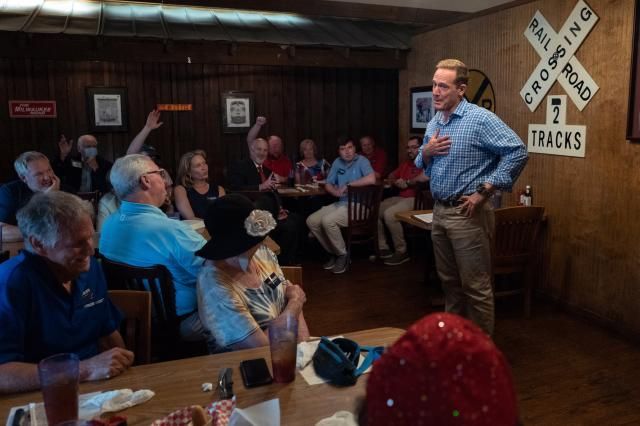
His record is not all that tame. A gun store owner from outside Winston-Salem, Budd secured the Senate nomination by winning the endorsement of Trump.
He did so, in part, by questioning the legitimacy of the 2020 election, voting against its certification and calling the Jan. 6, 2021, attack on the Capitol “just patriots standing up.” Jonathan Felts, a campaign spokesperson, is quick to note that Budd also said Jan. 6 “was a bad day for America.”
“Ted has consistently criticized those who broke the law that day and encouraged full investigations and prosecutions of the rioters,” Felts said.
Budd’s campaign has declined to say if he will accept the result of the November election and claimed without evidence that Beasley might try to disenfranchise voters. Budd also opposed the recent bipartisan infrastructure and gun control bills that his state’s Republican senators supported.
Although Felts cited “Budd Crew Chiefs” in all 100 of the state’s counties and some 113 events and fundraisers, Republican whispers of worry about Budd’s campaign are growing louder as he spends the last weeks of the campaign raising money behind closed doors, attending to Congress and leaving the task of earning votes largely to his advertising.
“He’s depending on ‘I’m not a liberal Democrat, I’m a generic Republican, vote for me,’” said Pope McCorkle, known as Mac, a longtime Democratic strategist now at Duke University’s Sanford School of Public Policy.
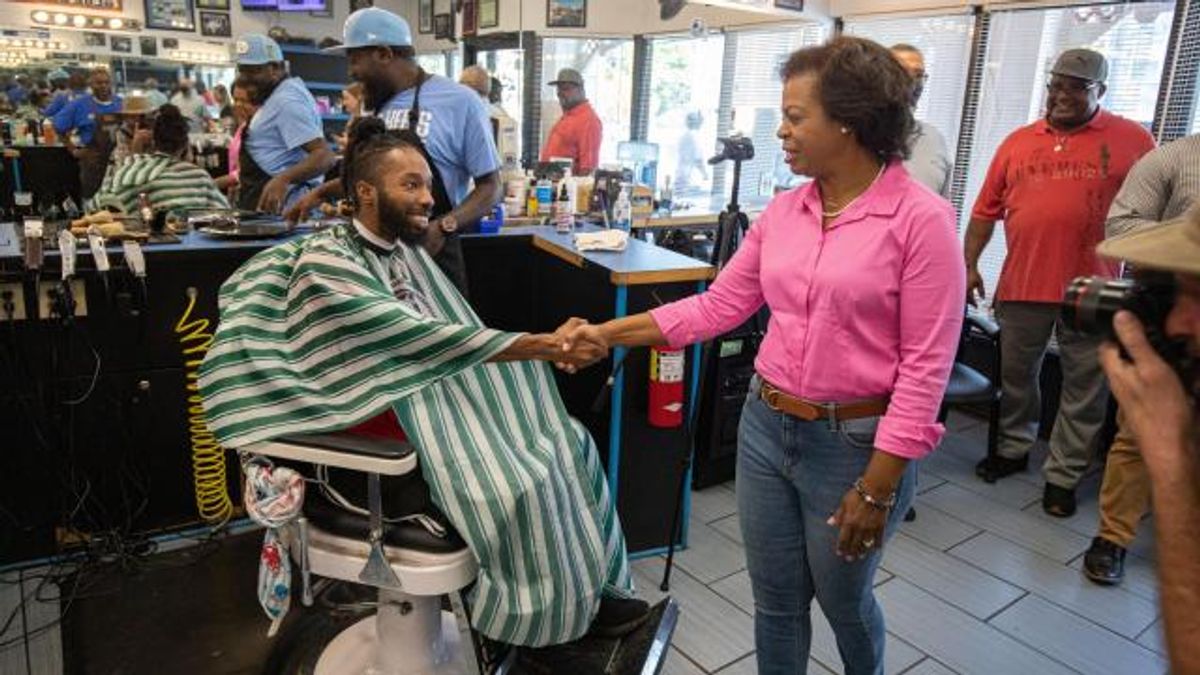
No one could accuse Beasley of letting advertising do the work. On Friday, after two events in Greensboro, she dashed from a family pharmacy in Gastonia to a get-out-the-vote rally at the historically Black Johnson C. Smith University in Charlotte to the packed pep rally. The next morning, she kicked off a round of canvassing outside Charlotte, stopped by the Fourth Ward Barber Shop, spoke at a labor rally and greeted canvassers in Matthews before heading, lunch in the car, to Rocky Mount for a full Sunday slate of appearances in the state’s rural northeast.
For all the talk of “purple” North Carolina, many political scientists say the number of true swing voters is tiny. The state is more a patchwork of deep-blue and deep-red redoubts. Winning might be less about persuading swing voters than about bringing your team out in force.
North Carolina lacks a metropolis like the one Atlanta has become in Georgia, southwest of here. McCorkle points to “countrypolitan” counties that ring North Carolina’s biggest cities, which have remained heavily white and Republican even as the far suburbs of Atlanta have become diverse and politically fluid.
Trump beat Biden in those exurban Carolina counties by a bigger margin than he did in rural counties.
But McCorkle does not count Beasley out. North Carolina has traditionally been more liberal on abortion than much of the South, and with the Legislature on the edge of a conservative supermajority, the issue will resonate. Last month, a federal judge allowed the reinstatement of a 20-week abortion ban. Budd has co-sponsored a 15-week abortion ban with no exceptions at the national level.
And North Carolinians have recoiled against conservative extremism when there was a sense that it had gone too far, as when Helms used the images of white hands to say whites were losing their livelihoods to “racial quotas” and people of color.
For all his effort to look bland, Budd will be appearing at a rally in Wilmington on Friday with Trump.
“Budd could rest on the Trump laurels for the primary. I’m not sure that strategy is effective for a general campaign,” Bitzer said.
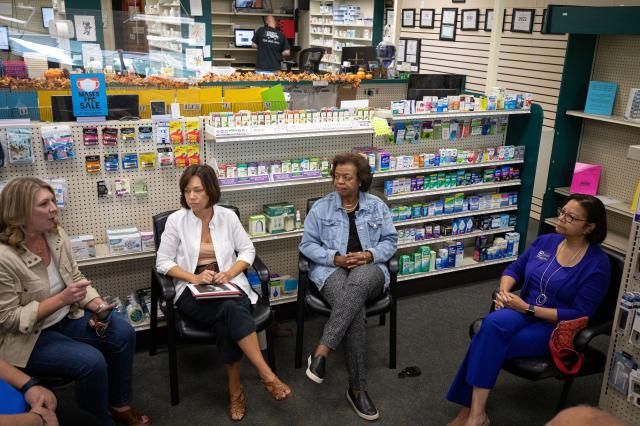
To stay on her message, Beasley will need to resist those in her party who want more fire. At Akers Pharmacy in Gastonia, she listened to voters describe their struggles with diabetes, cancer, soaring pharmaceutical costs and fickle insurance companies.
Then DonnaMarie Woodson, a two-time cancer survivor and party activist, looked at her plaintively.
“I’m not trying to be too controversial,” Woodson told Beasley, before laying in. “Health insurance is a right, and I will go down fighting for that, and I know you will, too. I know you will, too.”
Beasley smiled calmly, then expressed her gratitude to everyone there, never uttering the words “Republican” or “Budd” or taking up Woodson’s invitation. “You’re not pieces of paper or documents,” she said. “This truly is, for you and your children, about saving lives.”
Afterward, Woodson acknowledged that she had been trying to bait Beasley into a stronger response. She said she backed off after catching the candidate’s gestures toward her.
“I didn’t want to open a can that she would be responsible for,” Woodson said.
This article originally appeared in The New York Times.
* * *
Capitol Broadcasting Company's Opinion Section seeks a broad range of comments and letters to the editor. Our Comments beside each opinion column offer the opportunity to engage in a dialogue about this article.
In addition, we invite you to write a letter to the editor about this or any other opinion articles. Here are some tips on submissions >> SUBMIT A LETTER TO THE EDITOR