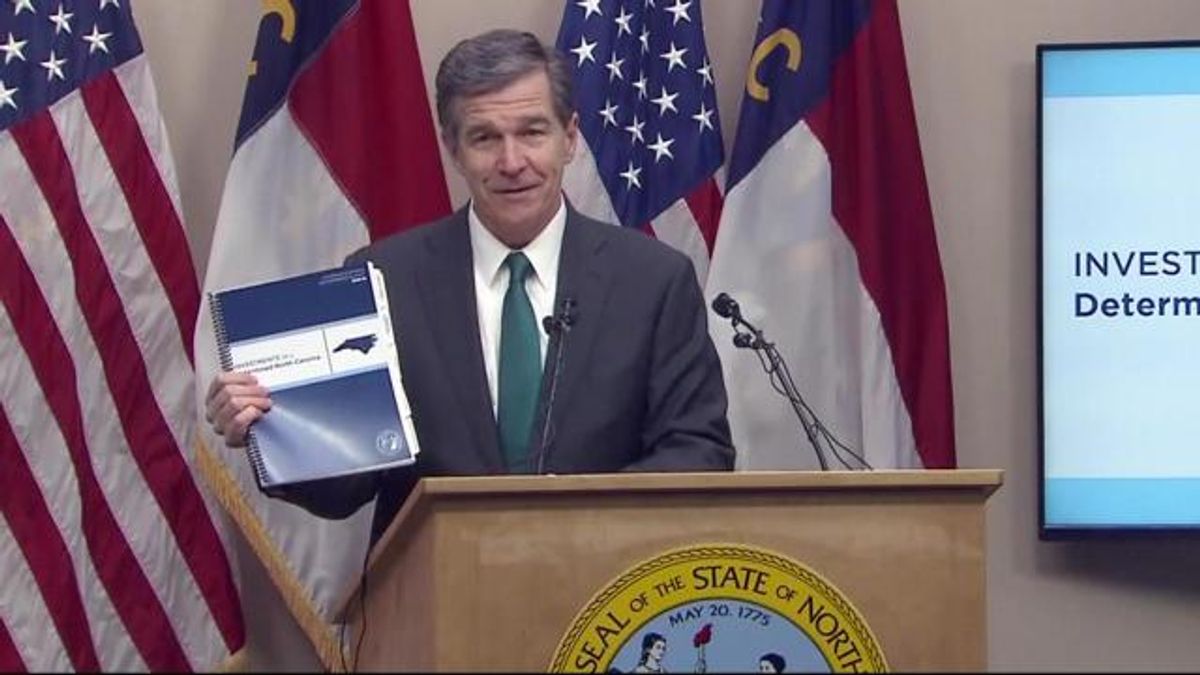
Gov. Roy Cooper on Wednesday rolled out his $25.2 billion budget proposal for the coming year, saying it provides "visionary investments" in education, health care and infrastructure.
Among the budget highlights:
Other WRAL Top Stories
- 9.1 percent average raises for teachers over the next two years, with every teacher getting at least 3 percent
- Raises of 1.5 percent or $500, whichever is greater, in each of the next two years for state employees
- An additional $500 a year, on top of the state employee raise, for law enforcement and corrections officers, people who work in state hospital and non-certified school employees, such as teaching assistants
- A one-time 2 percent cost-of-living adjustment for state retirees
- An expansion of the Medicaid program to provide health coverage for low-income working adults
- Seeking voter approval next year of a $3.9 billion bond that would help fund school construction and local infrastructure projects
Republican leadership in the General Assembly panned the proposal.
"It’s interesting that Governor Cooper now proposes a 9.1 percent raise for teachers over the next two years after opposing the 9.9 percent raise the Republican legislature provided teachers over the last two years," Senate President Pro Tem Phil Berger said in a statement. "We’ve known for years that Governor Cooper has played politics with teacher compensation. Once the facts are laid bare, it’s easy to see that attacks against Republicans over education spending are simply Democrats and their special interest allies playing politics."
But Cooper noted during a news conference that North Carolina still ranks 37th nationally in average teacher salary.
"[That's] not good enough. We must do more to keep and attract our good educators," he said.
Cooper's budget also phases out the Opportunity Scholarships school voucher program – existing recipients could keep receiving vouchers until they graduate, but no new entries to the program would be allowed – eliminates the $50 teachers pay now toward substitutes when they take a personal leave day and eliminates co-pays for the free and reduced-price school meals program, making school breakfasts and lunches free for all 115,000 children who qualify for the program.
The governor's previous spending plans were quickly set aside by the Republican-controlled legislature in favor of smaller budgets. He vetoed the legislative budgets in each of the past two years, only to have lawmakers override the vetoes.
But the GOP lost its veto-proof majority in both the House and the Senate following last fall's elections, and the governor said that gives him more leverage in budget negotiations this time around.
"This budget does put pressure on the legislature, in and of itself, to do good things for our state," Cooper said during a news conference, suggesting that his previous budgets prodded lawmakers to raise teacher salaries more than they would have and take other steps toward his priorities.
"I do think things are different now with the balance," he said. "At some point, we're going to have to work together to come to consensus on this budget. There's going to have to be give and take. I know I won't get everything that I've asked for in this budget, but I do believe that there is leverage so the legislature can do some of these things."
The $25.2 billion in spending would mark a 5.4 percent increase over the $23.9 billion in the 2018-19 budget. Cooper said he assembled the plan without calling for any tax increases, although he does fund Medicaid expansion through assessments on hospitals and insurers.
"We have to live within our means," he said.
The plan would increase spending by another 2.9 percent for fiscal 2021, to $25.96 billion.
GOP: Too much debt in plan
Most of the criticism from Republican legislative leaders focused on the $3.9 billion Cooper wants to borrow.
"This is not a serious budget proposal," Senate Appropriations Committee co-chairs Harry Brown, R-Onslow, Kathy Harrington, R-Gaston, and Brent Jackson, R-Sampson, said in a joint statement. "It is a political document that seems designed to cater to the governor’s tax-and-spend base that put us in a hole 10 years ago. Governor Cooper seems to want our children to pay for his reckless spending habits."
"I invite the governor to submit a revised proposal to the General Assembly that shows he is as serious about balancing budgets as North Carolina families and businesses have to be, instead of using his recommendations as a political game," Senior House Appropriations Committee Co-Chairman Jason Saine, R-Lincoln, said in a statement.
Senior House Appropriations Committee Co-Chairman Donny Lambeth said the people of North Carolina "need leaders willing to make the hard choices."
"The governor’s insistence on spending as much taxpayer money as financially possible every year is the wrong approach," Lambeth, R-Forsyth, said in the House statement.
House lawmakers have proposed a $1.9 billion school construction bond for the 2020 ballot, saying the state cannot afford to go beyond that. Senate Republicans have backed a pay-as-you-go plan that uses general fund revenue each year to cover school construction costs, instead of borrowing money.
Cooper called his proposed $3.9 billion bond "fiscally sound" and said the state needs to take advantage of low interest rates to get caught up on a backlog of school construction and local infrastructure needs.
Cooper's budget would do away with the State Capital and Infrastructure Fund that's key to the Senate proposal. The fund was created two years ago, and the plan has been to put 4 percent of tax revenue in each year to help pay for construction and repairs. That's $950 million next year that Cooper would absorb back into the regular budget, using debt to cover construction needs instead.
"The governor’s proposal just adds more debt," Brown, Harrington and Sen. Joyce Krawiec, R-Forsyth, said in a joint statement. "Our children shouldn’t have to pay for the new schools we plan to build for them."
"Gov. Cooper’s proposed budget invests that money in key priorities like better pay for teachers and training to help North Carolinians get good jobs," Cooper spokeswoman Noelle Talley said in an email.
Medicaid expansion has been a losing battle for Democrats in North Carolina for almost a decade, but Cooper seemed to draw a line in the sand over it on Wednesday.
"It is critical for the future of North Carolina," he said, suggesting that he would keep lawmakers in session as long as needed to secure health coverage for more low-income working adults.
Other provisions in Cooper's proposed budget include the following:
- $30 million to pay community college tuition for people getting trained in high-demand professions, such as architecture and construction, health sciences, information technology, electrical line work and manufacturing
- $40 million for school nurses, counselors and school resource officers
- $6.5 million to eliminate the $50 teachers must pay for a substitute when they take a personal leave day
- $5 million to eliminate reduced-price school breakfasts and lunches, providing free meals to all who qualify
- $12 million to improve prison safety
- $6 million over two years to analyze untested rape kits in evidence across the state
- $288 million in bonds that don't require voter approval to pay for moving Department of Health and Human Services offices out of buildings in Raleigh's planned Dix Park and to expand a state lab for more air and water quality testing
- $6.3 million and 37 new state workers to identify and regulate GenX and other emerging chemical compounds
- $1.5 million for clean energy programs, including studying the potential for offshore wind farms
- $15 million in Medicaid funding to expand treatment options for opioid abuse
- $1 million grants to local food banks