Private investigators hired by Republican lawmakers to look at how Gov. Roy Cooper's administration handled the Atlantic Coast Pipeline permitting found that the Democratic governor didn't personally benefit from actions he and his administration took.
But the investigators said in their 82-page report, which was released to a legislative oversight committee Wednesday, that "it would be reasonable to conclude" from the evidence they collected that Cooper "improperly used the authority and influence of his office" to obtain a $57.8 million fund from Duke Energy and other pipeline developers and concessions from Duke to benefit the state's burgeoning solar energy industry.
Other WRAL Top Stories
"The investigation was not conducted for the purpose of identifying criminal violations, and the information has not been evaluated to determine if specific criminal statutes have been violated. However, the information suggests that criminal violations may have occurred," they said in the conclusion of the report. "An investigative agency with the authority to compel cooperation and the production of documents could potentially obtain additional information to identify violations of criminal statutes."
Cooper said Republican lawmakers are "distorting facts" and know there’s nothing wrong with the so-called mitigation fund.
"Facts are on our side," the governor said.
The Cooper administration announced In January 2018 that environmental regulators had approved a key permit for the Atlantic Coast Pipeline. Less than an hour later, the administration also announced the $57.8 million mitigation fund the pipeline operators would put money into and Cooper would control.
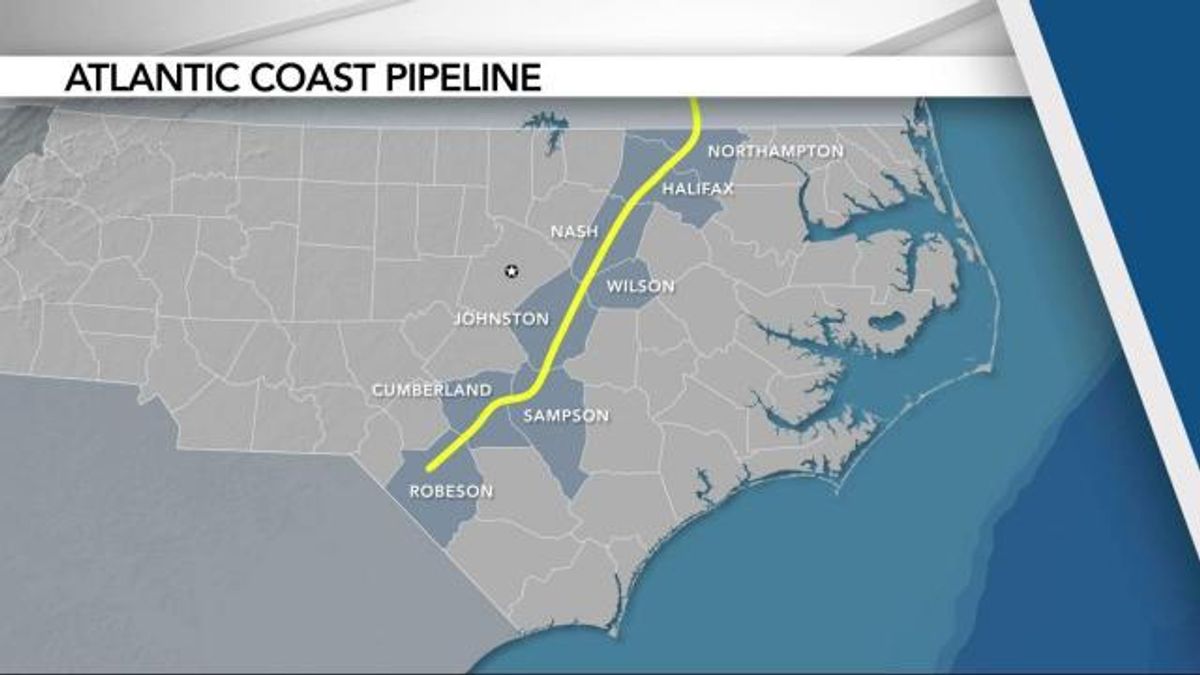
Lawmakers immediately criticized what they viewed as a slush fund, and they eventually redirected any money in the fund from environmental mitigation and economic development projects to school districts in the eight North Carolina counties on the pipeline route.
The fund still hasn't materialized as the 600-mile pipeline, which is expected to move natural gas from West Virginia to southeast North Carolina, remains stalled by challenges in federal court.
Lawmakers hired Eagle Intel Services almost a year ago to determine if Cooper's administration held up the needed environment permit to gain concessions from Duke and its partners.
The investigators lay out a timeline of events leading up to the permit approval, including text messages and emails between administration officials and Duke officials, and subsequent testimony by some of these officials during legislative hearings and interviews with investigators. Following are some of the exchanges noted in the report:
Cooper met with Duke Chief Executive Lynn Good and Duke lobbyist Kathy Hawkins at the Executive Mansion on Nov. 30, 2017, and told Good that he wanted a fund set up by the end of that year to offset the cost of tapping into the pipeline for businesses in eastern North Carolina. He also wanted Duke to settle its dispute with solar companies over connecting to the grid in the same timeframe, which also was the pipeline operators' preferred window for obtaining permits from North Carolina.
"There were no conditions or implied threats of delaying the pipeline by Governor Cooper," the report states. "Good said the requests by Governor Cooper were catalysts to expedite things that Duke already wanted to do."
Duke initially suggested $50 million for the fund, but $5 million was added in December 2017 for environmental mitigation. Administration officials at one point asked for $80 million, but both sides agreed in January 2018 to $57.8 million to match the size of a similar fund the pipeline operators were providing in Virginia.
"The above facts indicate the Governor's Office was asking for more money that was initially offered by Duke, showing the fund was not voluntary," the report states.
On Dec. 19, 2017, Cooper adviser Ken Eudy told Hawkins that Cooper would make the final decision on the water permit, not Department of Environmental Quality Secretary Michael Regan.
Eudy denied any such statement during a recent legislative hearing.
Eudy exchanged text messages with Cooper lawyer William McKinney on Jan. 2, 2018, that the administration shouldn't "sign the ACP agreement unless the solar deal works," suggesting that they were linking the effort to gain concessions for the solar industry from Duke to the pipeline negotiations.
Duke officials, however, insist that they never believed the solar issue or the mitigation fund had anything to do with obtaining permits for the pipeline.
"Duke did not and would not pay for permits," Good told investigators.
"No information has been found to indicate that Duke and the ACP partners 'paid' for a permit that they were not entitled to receive," the report states.
Eudy called Duke's Hawkins on Feb. 8, 2018, to ask that the company write a letter stating that the pipeline partners voluntarily provided money for the mitigation fund, but Duke officials refused to do so.
Eudy recently denied to lawmakers in a hearing that he had asked for such a statement and was unaware if anyone else from the administration had done so.
During a two-plus-hour meeting Wednesday afternoon, oversight committee members peppered the three investigators with questions about the evidence they gathered and their interpretations of it.
"You've shown a lot of connections between when these permits were issued and the governor's input," said Rep. Sarah Stevens, R-Surry. "Do you think they're connected?"
"I think, certainly in the report, we show the connection," said Kevin Greene of Eagle Intel. "The facts that were presented to us, yes, it does show a connection."
"I'm deeply concerned that the Governor's Office interfered with the objective permitting process in an improper manner," said Rep. Dean Arp, R-Union.
But Democrats on the committee asked for the basis for the conclusion that "criminal violations may have occurred." They noted that an ethics complaint filed in 2018 on the same issues was dismissed by the State Ethics Commission for lack of evidence.
The investigators said that conclusion was based on the inconsistencies they found in people's statements and actions, which in their experience as federal agents suggests wrongdoing. But they quickly added that they never looked at specific statutes – state or federal – to determine if any laws had actually been violated. Such a determination would have to be made by prosecutors.
The oversight committee could turn the 82-page report over to prosecutors, but no decision on that was made Wednesday.
Republican Lt. Gov. Dan Forest, who has announced plans to run for governor next year, said the FBI needs to investigate Cooper's actions regarding the pipeline.
"People are lying, and they need to be put under oath, under threat of perjury, and re-answer these questions," Forest said in a statement issued Thursday.