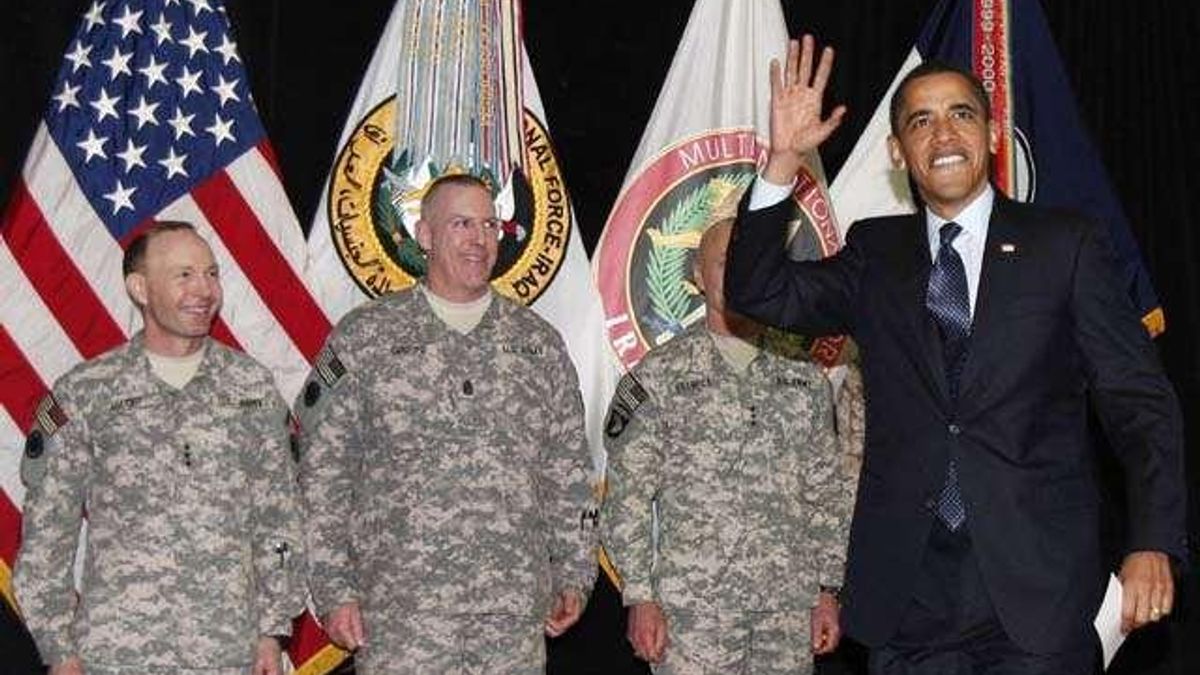
ISTANBUL -- President Barack Obama made a surprise visit to Baghdad Tuesday, saying a trip to Iraq was critical because progress in a country rocked by a new round of bombings lies "in political solutions."
Meeting Commanding Gen. Raymond Odierno at Camp Victory, along with about 600 U.S. troops outside of Baghdad, Mr. Obama said, "We've made significant political progress" in Iraq. But, he added, "with the national elections coming up, many of the unresolved issues may be brought to a head."
Other WRAL Top Stories
Iraqi Prime Minister Nouri al-Maliki plans to join Mr. Obama at Camp Victory. He will confer with Iraqi President Jalal Talabani, since a stand storm has grounded the presidential helicopter, U.S. officials said.
White House spokesman Robert Gibbs told reporters Iraq was chosen over Afghanistan in part because of its proximity to Istanbul but also because troops in the war Mr. Obama hopes to end are just as important as troops in Afghanistan, where he hopes to intensify the U.S. campaign against Taliban militants. The president will award 10 medals of valor while visiting troops at the sprawling base near Baghdad International Airport.
"They're putting their heart and soul into this," Mr. Obama said.
The trip is Mr. Obama's first to Iraq as president. While the White House kept the excursion under wraps for security reasons, the military was mobilizing. Army officers had intended to have at least 1,500 troops from Camp Victory and nearby Camp Liberty, but the secret trip happened faster than expected, beating most of the troops by a couple of hours.
The side trip comes amid increasing worries that a violent power vacuum may already be developing as the United States prepares to slowly withdraw forces. In February, the president announced he will withdraw all combat forces from the country by August 2010, although he could leave behind a residual force of as many as 50,000 to train Iraqi police and military, hunt terrorists and protect U.S. assets, such as the largest U.S. embassy in the world. Even most of those troops would be gone by the end of 2011.
A series of six car bombs in and around Baghdad killed 33 people just Monday, wounding scores more and raising the prospects of a resurgence of violence. Most of the bombings struck predominantly Shiite neighborhoods. Just hours before Mr. Obama touched down Tuesday in Iraq, a car bomb in a Shiite neighborhood of Baghdad killed at least nine people and wounded 18, according to the Associated Press. That followed Monday's carnage: A seemingly coordinated series of bomb attacks across Baghdad killed more than three dozen and wounded 100.
Mr. Obama's visit also comes at an important time for Mr. Maliki. A little more than a year ago, he was being criticized by Iraqis -- and some U.S. officials -- for being weak and ineffective amid a host of security challenges. Militias aligned to his own coalition partners appeared out of control, locked in bloody rivalries. But in a surprisingly effective military campaign early last year, Mr. Maliki cracked down, winning respect among political partners and foes, and everyday Iraqis.
Meanwhile, the U.S. military surge strategy had already started paying dividends, and violence ebbed sharply in Baghdad and across Iraq. Car bombings and other violence are still common, but attacks against U.S. troops, Iraqi security officers and civilians are down sharply.
Mr. Maliki solidified his political gains in local elections earlier this year. While his own political party is a religious one, he cobbled a slate of candidates with a technocratic veneer, and came out the election's clear victor. The local voting didn't change the make-up of his national, governing coalition. But it strengthened his political organization considerably ahead of parliamentary polls expected by year's end.
from the Wall Street Journal