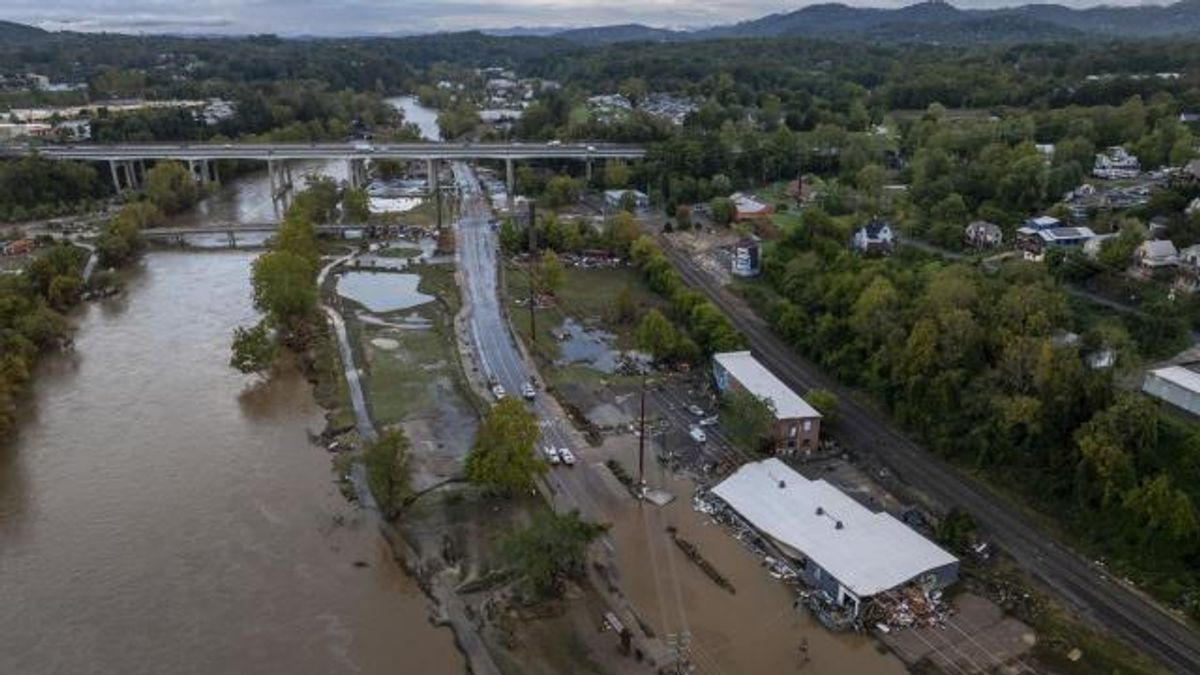
Half a billion dollars in additional Hurricane Helene relief won approval at the North Carolina legislature Thursday as lawmakers prepared to take much of the rest of the summer off.
The last-minute push to help western North Carolina’s recovery came as the state’s Republican legislative leaders struggle to reach a deal on the broader state budget, even though the new budget year begins next week. Talks between the chambers have all but broken down.
Other WRAL Top Stories
Democratic Gov. Josh Stein this week had urged lawmakers to at least pass something on Helene — even if they couldn’t come up with a full budget deal.
“The legislature should work quickly this week to set aside their differences and do their job to support folks rebuilding after Helene,” Stein wrote on social media Tuesday. “I stand ready to get this sorely needed relief out the door.”
On Thursday the Senate and House each voted unanimously on a plan that would spend $500 million in new state funds on Helene relief, as well as redirecting several hundred million more dollars of already-approved state and federal funds.
"Our number one priority this session has been Helene relief," House Speaker Destin Hall said in an interview after the vote. "It's going to continue to be. We passed this bill out today, so tomorrow we'll begin on the next round of that. I'm hopeful that sometime this year we can pass another round of Helene relief."
The lead House negotiator on the new bill Rep. Karl Gillespie, R-Macon, acknowledged that the bill didn't have all of what local residents and business leaders have asked for. But it's a good next step on top of what's already been approved, he said, and hopefully won't be the last round of relief either.
"We're certainly not addressing all the needs," he said. "There will be more to work on later. But we believe that this bill is addressing the needs that are the most urgent right now."
Details of the bill
State lawmakers have already approved $1.6 billion for Helene relief. This new plan could bring total spending past the $2 billion mark if Stein signs it into law, which he's likely to do. The bill would also direct how to spend tens of millions of dollars in federal disaster spending, which some local officials have complained has been slow to trickle into the region.
The $500 million in new Helene spending is broken down among numerous issues to be used on, including:
- A western North Carolina tourism marketing campaign.
- Efforts to map landslide risks, repair dams and mitigate flooding risks.
- Repairs for public and private colleges in the area.
- Crop-loss payments to reimburse local farmers.
- Repairs to privately owned roads and bridges.
- Grants to local governments that need a cash infusion to make repairs and keep schools and public safety efforts running.
Stein and the state House had initially favored passing Helene relief separately, as ultimately happened Thursday, but Senate GOP leaders originally wanted to tie it to the broader state budget.
Senate Democratic leader Sydney Batch, D-Wake, said she and fellow Democrats deserve credit for putting political pressure on GOP leadership in the Senate to agree to separate the Helene money from the rest of the budget — which appears unlikely to pass for at least several more months.
"We're proud of what we accomplished by staying united and standing up for the people of western North Carolina," Batch said. "It shouldn't take a cattle prod to do what's right."
Thursday evening, Stein urged Republican legislative leaders to continue negotiating on the budget as well.
"While I am gratified that the legislature took action to get more Helene funding out the door, we face many other urgent challenges across the state that need to be addressed through a fiscally responsible, full budget," Stein said in a statement.
"Our teachers, law enforcement, and other state employees deserve real pay raises so we can recruit and retain the best," Stein continued. "In addition, at a time when the federal government is proposing severe cuts to Medicaid, leaving Raleigh without taking steps to fully fund North Carolina’s Medicaid program is irresponsible."
Uneven attention?
One provision that drew some debate Thursday was the money for private and public universities harmed by the storm. Rep. Lindsay Prather, D-Buncombe, noted that Appalachian State University and UNC-Asheville received only a small fraction of the millions they'll need to fix repairs, meanwhile Western Carolina University was receiving $2 million despite reporting no damages.
She also noted that Montreat College in Black Mountain is getting $1.5 million but another school that also took on millions of dollars in damage and is located just a few miles away in Swannanoa, Warren Wilson College, received nothing. Montreat has a conservative reputation and Warren Wilson has a liberal reputation.
"I hope this isn't politicization of recovery, but it's hard not to read it that way," Prather said.
In an interview after the vote, Prather noted that Republicans have refused to put any of the Democrats from western North Carolina on the committee in charge of negotiating Helene recovery — even as some of the seats were given to GOP lawmakers who don't even represent western North Carolina.
"None of us were included on those conversations," she said. "It's really unfortunate. We represent the same number of people that every other House member represents in this chamber. And the fact that our people were not heard on this issue? It's unconscionable."
She wasn't the only western North Carolina lawmaker upset with the latest funding bill.
Democrats say more needed
"I am trying, with all the tools that I have learned as an adult, to try to control my temper and my emotions from what I see as a complete failure of the General Assembly to address the needs of western North Carolina," said Rep. Brian Turner, D-Buncombe.
He referenced the bill's lack of business grants for the area, despite repeated requests by Stein and other Democrats. The bill has some targeted handouts to individual businesses, and money for farmers, but nothing that local hotels, restaurants and mom-and-pop stores trying to hang on in the area could apply for to keep their doors open.
Turner indicated that Republicans are refusing to approve those grants because it would mostly help people living in the liberal city of Asheville.
"Whether you like it or not, Asheville and Buncombe County is the economic engine of western North Carolina," Turner said. "And when you start to throwing sand in the gears of that, the whole region will suffer."
Hall, the House Speaker, told reporters that his caucus would support those grants but that Senate Republicans kill the idea every time it comes up. He added that the bill does at least have money for a tourism campaign.
"One of their their biggest drivers of their economy is tourism," Hall said. "And folks who are not from that part of the world, a lot of them still think that it's still a disaster area. That you can't go visit there. But many of those businesses are back open."
A top House budget writer Rep. Dean Arp, R-Union, also said the legislature isn't engaging in politically motivated decisions on Helene relief. It's simply a matter of prioritizing the state's limited funds, he said.
"Not one teacher has been laid off for us to be able to do this," Arp said. "Not one person has been furloughed. This is a conscientious object effort to meet the needs of our neighbors, and I just don't think we should politicize or undermine the efforts of the entire state to help rebuild our friends and neighbors."
Prather doesn't buy the argument that GOP lawmakers are having to scrounge for funding for disaster recovery. There's plenty of money to be had, she said, it's just tied up in projects that deep-pocketed conservative donors want instead.
"We're putting $1.3 billion over the next two years into the private school voucher program," she said. "And they want us to be grateful that we're putting $2 billion, total, into western North Carolina recovery?"