This month, North Carolina State University officials announced plans to remediate, renovate, and reopen Poe Hall. The announcement came just over a year after toxic chemicals were discovered in the building, prompting its closure.
However, even with a comprehensive remediation plan, students say the university will face significant challenges in convincing people to return.
Other WRAL Top Stories
"There’s a lot of fear associated with Poe Hall," said Mary Ledford, a sophomore at NC State.
Ledford, an education major, arrived at NC State just months before Poe Hall was abruptly closed in November 2023. Prior to the closure, she frequently met with her advisor and studied in the building which housed the College of Education and the psychology department.
Midway through the fall semester, NC State shut down Poe Hall after tests revealed parts of the building were contaminated with polychlorinated biphenyls (PCBs).
"It was scary," Ledford said. "My first thought was, 'Was I exposed to something?'"
What are PCBs and where do they come from?
Now classified as a human carcinogen by the World Health Organization, PCBs were once widely used in machinery and building materials such as paint, caulk, sealant, fluorescent lights, and insulation.
PCBs, which do not readily break down, were commonly used in heavily trafficked structures such as schools and municipal buildings, including Poe Hall, built in 1971.
"The thinking was that if you wanted your building to last, you should pump it full of materials with PCBs," said Dr. Keri Hornbuckle, a professor and environmental engineer at the University of Iowa who studies PCB contamination in buildings.
That legacy is now precisely the problem. Although the Environmental Protection Agency (EPA) banned PCB production in 1979, the chemicals continue to linger in many older buildings. The EPA estimates that 60 percent of buildings in the U.S. may still contain PCB products.
While PCBs don’t degrade significantly, they can volatilize over time. As people inhale or come into contact with PCBs, they may face health risks.
Investigating the PCBs in Poe Hall
In the year since Poe Hall's closure, WRAL has received reports from 215 individuals claiming they developed cancer after working or studying in the building. An investigation into a possible link between the chemicals and these cancer cases is now underway.
A month after the closure, NC State announced it had hired Geosyntec Consultants to conduct additional testing to identify the source and extent of the contamination.
In June, NC State released more than 1,000 pages of test results. Investigators used various methods to collect samples, including wiping surfaces like desks and windowsills, drilling into bulk materials such as caulking and sealants, and testing the air inside the building.
Ledford described the reports as confusing and “convoluted.” When WRAL News sought clarification, the university responded that the “report spoke for itself.”
WRAL compiles all documented PCB testing conducted at Poe Hall
To provide a clearer picture, WRAL News spent six months analyzing and compiling all available PCB sample results from Poe Hall, including tests conducted on the building's exterior in 2018 and those leading up to its closure in 2023.
WRAL also consulted Dr. Robert Herrick, a retired Harvard industrial hygiene expert with decades of experience investigating contaminated buildings. Based on these findings, WRAL created a detailed database of the results:
- Poe Hall testing results 2018-2024 air samples
- Poe Hall testing results 2018-2024 bulk samples
- Poe Hall testing results 2018-2024 wipe samples
How to understand the results
The spreadsheet outlines where samples were taken, what kinds of PCBs were found (e.g., Aroclors), and at what levels.
The levels are crucial for assessing risks to human health.
The EPA has established threshold limits to define acceptable PCB exposure levels.
WRAL News mapped out which samples were above levels and which ones were below.
Investigators took a variety of air, wipe and bulk material samples.
- Air Samples: Measure PCB concentrations in the air. Because inhalation is one of the primary ways people can become exposed to PCBs. to assess inhalation risk, the primary route of exposure.
Over the past six years, approximately 245 samples were collected at Poe Hall, including about 20 from the building’s exterior. Inside, more than 200 samples were taken from around 100 of the building’s 475 rooms.
Sample findings
- PCBs were detected in around 56 rooms, often in the HVAC system.
- High PCB levels exceeding EPA safety limits were found on every floor.
Inside Poe Hall
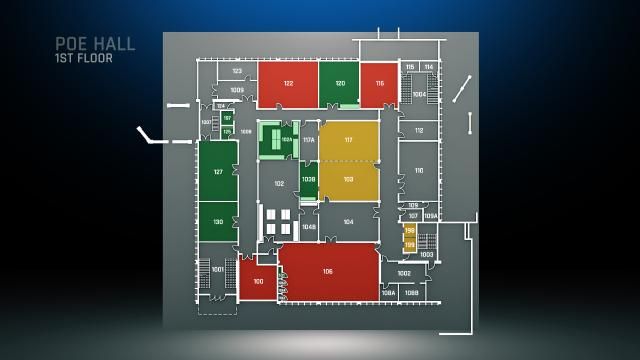
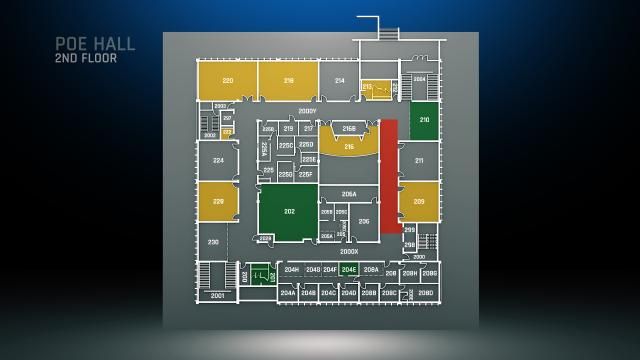
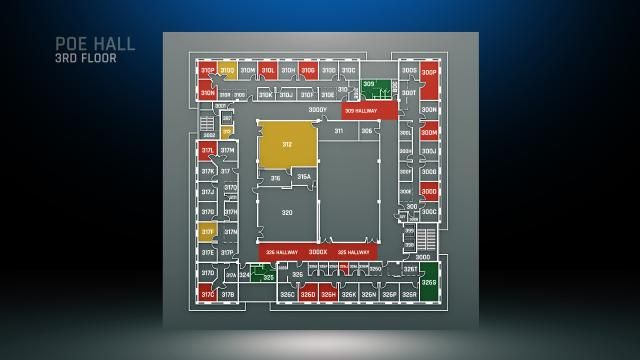
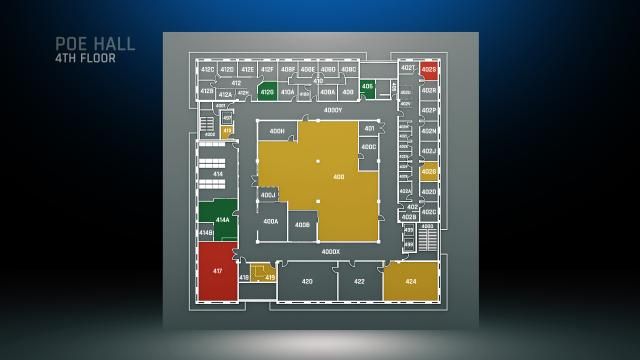
WRAL News digitally recreated the floor maps of Poe Hall based on designs provided by the university following the building's most recent renovations in 2017 and 2018.
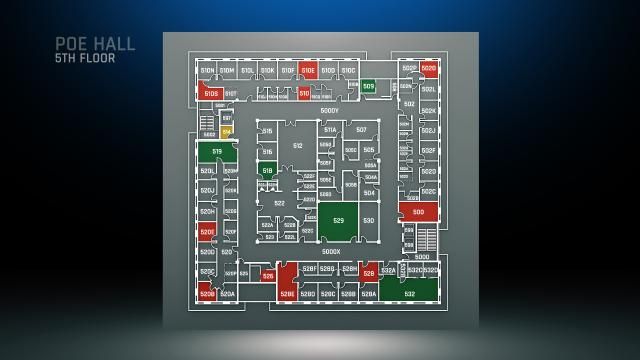
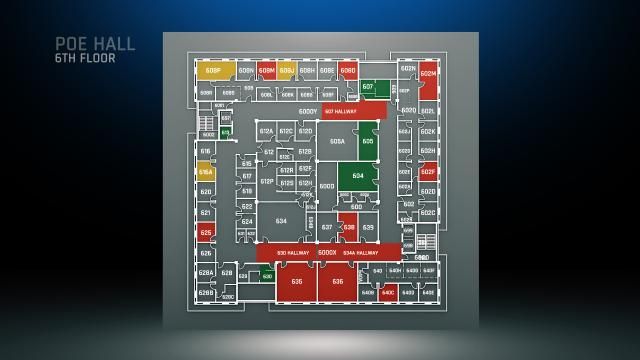
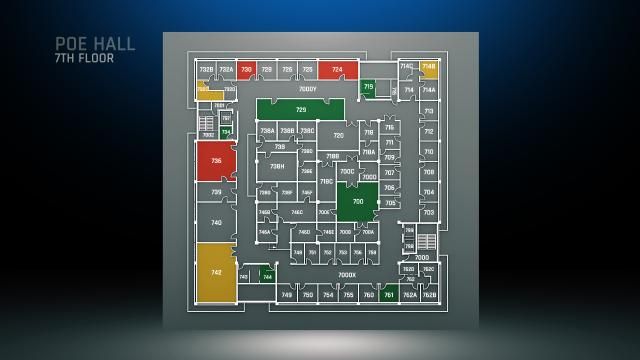
Green indicates where samples were taken, yellow indicates were PCBs were found and red shows were PCBs at levels exceeding the EPA safety thresholds were found.
Floor-by-floor breakdown:
First Floor: 29 of 39 samples tested positive; 15 exceeded EPA limits.
Second Floor: 14 of 20 samples tested positive; 4 exceeded EPA limits.
Third Floor: 44 of 49 samples tested positive; 35 exceeded EPA limits.
Fourth Floor: 18 of 22 samples tested positive; 5 exceeded EPA limits.
Fifth Floor: 29 of 41 samples tested positive; 18 exceeded EPA limits.
Sixth Floor: 33 of 38 samples tested positive; 27 exceeded EPA limits.
Seventh Floor: 11 of 18 samples tested positive; 3 exceeded EPA limits.
The highest concentrations were found in bulk material samples, particularly in the HVAC system. More than 100 HVAC-related samples showed PCB levels hundreds of times above EPA limits.
The cancer cases and the samples
Of the 215 people who spent time in Poe Hall, about half could identify specific areas where they worked or studied. Notably, on the sixth floor, an office in Suite 608 was found to have PCB levels 460 times higher than EPA limits. Three individuals who worked in that office have since been diagnosed with cancer.
Jeremy Tuchmayer worked on the third floor as a graduate student from 2010 to 2014, primarily in offices 300H and 310F. His colleague, Darren Masier, who joined the program a year earlier, recalls working in office 310J.
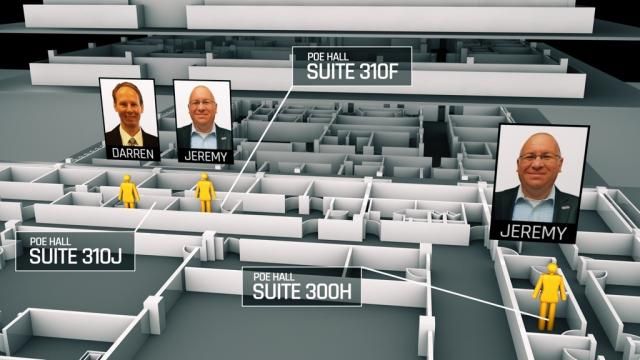
Records of PCB testing show that these locations were not tested by NC State. Both Masier and Tuchmayer spent four years in the building. In January 2023, Tuchmayer was diagnosed with leukemia, and seven months later, in July, Masier received the same diagnosis.
This spring, Masier filed a petition in court to allow further testing. In August, NC State approved the request, but the results of that testing have not yet been released.
The role of the HVAC System
Approximately 40 air samples were collected—half in December 2023 with the HVAC system off, and the rest in April 2024 after the system was reactivated. Initial samples showed lower PCB levels, but concentrations increased once the HVAC system was turned back on.
"The HVAC system was likely contaminated with PCBs that had settled in the ductwork," explained Dr. David Carpenter, an expert on PCBs. "When the system was restarted, the PCBs likely volatilized again."
While none of the air samples exceeded the EPA’s threshold, Carpenter cautioned that this does not guarantee safety.
"If bulk materials show high PCB concentrations, you don’t need many air samples to know the building is contaminated," he said.
Geosyntec Consultants identified gold-colored insulation sealant in the HVAC supply ducts as a primary contamination source. However, Dr. Herrick believes this conclusion might be incomplete.
In 2018, testing revealed that PCB levels in Poe Hall’s exterior caulking exceeded EPA limits by over 300 times. Research shows that exterior PCB-laden caulk can migrate inside over time.
Moving forward
The university has allocated more than $3 million for remediation and renovations, estimating this approach will save more than $10 million compared to demolishing the building.
Ledford, however, said she would rather see Poe Hall gone.
WRAL News has created an interactive experience that takes you inside Poe Hall. See the rooms and areas where PCBs were found in the NC State building. You can view it here or by clicking the link above.
This experience is best viewed on a laptop or desktop computer.