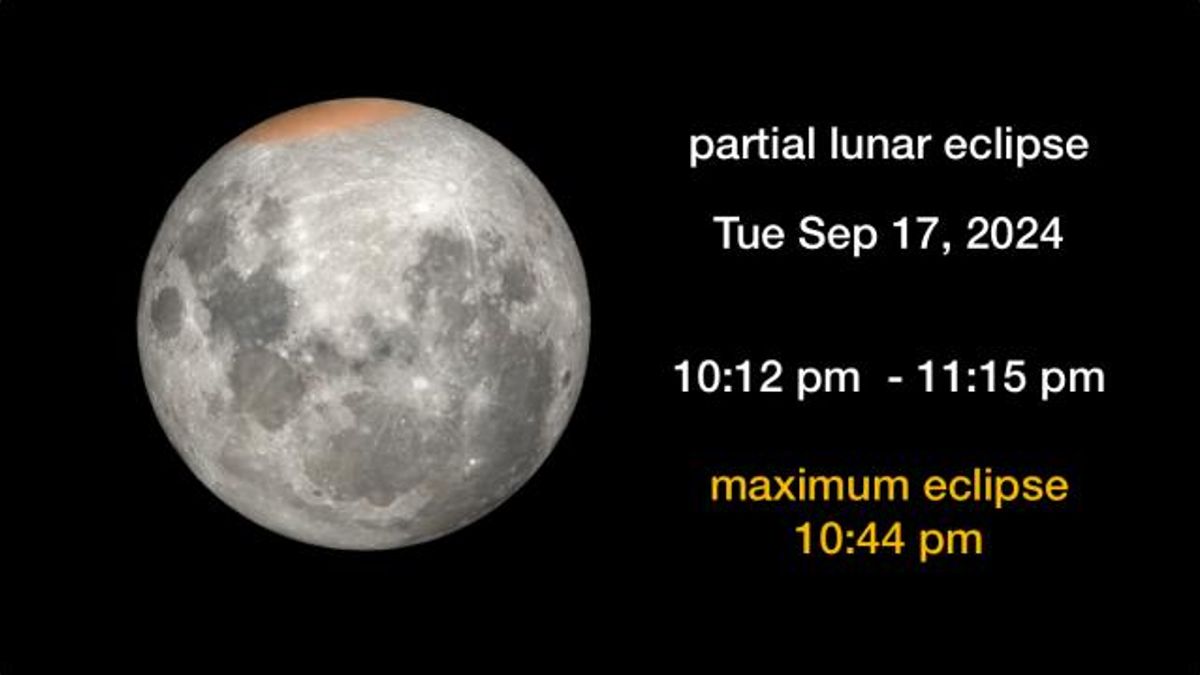
While it may not be as dramatic as a total lunar eclipse, Tuesday night’s partial lunar eclipse is still a great reason to step outside and look up. Just don’t expect to see a glowing red or orange Moon lighting up the evening sky.
The Earth's shadow will appear as a darker, possibly slightly orange or even reddish color to Moon's upper left edge.
Other WRAL Top Stories
The eclipse starts at 10 p.m. but the best time to view the will be between 10:30 - 11:00 p.m., with the maximum eclipse happening at 10:44 p.m. This is when the Moon, the second of four supermoons in 2024, will be deepest in the Earth's shadow.
Partly cloudy skies are expected, so the Moon may occasionally duck in and out of view. However, the eclipse lasts for over an hour, giving you plenty of opportunities to catch it at its best!
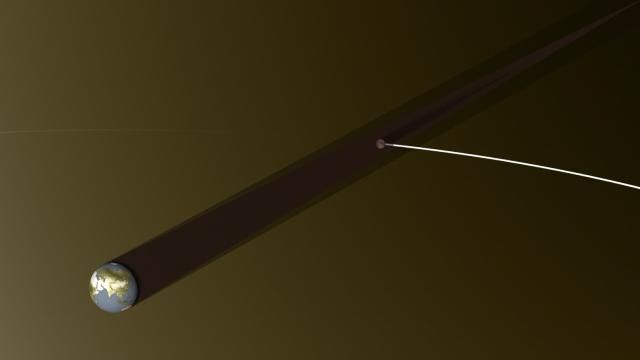
Anatomy of a lunar eclipse
Lunar eclipses occur when the Earth casts two types of shadows. The darker central shadow is called the umbra (UM-bruh), while the lighter outer shadow is known as the penumbra (pe-NUM-bruh). The Moon will first pass through the penumbra, beginning at 8:41 p.m., but this faint shadow is often hard to notice—especially under cloudy skies.
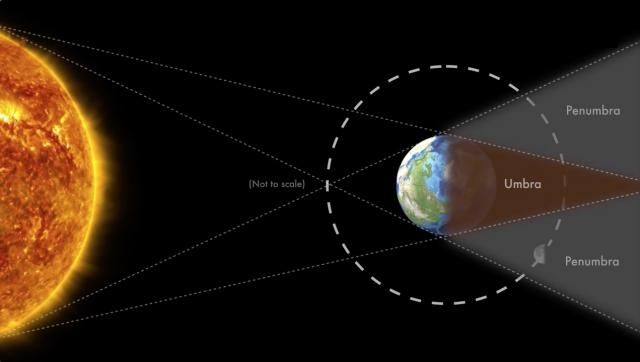
The reddish hues during a lunar eclipse are due to Rayleigh scattering, the same effect that makes our skies blue. Earth's atmosphere scatters shorter blue wavelengths of light, letting longer red and orange wavelengths pass through and onto the Moon's surface.
Smoke from wildfires in California, Oregon, and Idaho could intensify that effect possibly adding a bit more color.
Tuesday's lunar eclipse will be partial because the Moon is passing beneath the shadow cast by the Earth. The next lunar eclipses visible from our area on March 14, 2025 and March 3, 2026 will be total as the Moon passes directly through the Earth's (umbral) shadow.