Prepare for a busy hurricane season.
NOAA (the National Oceanic and Atmospheric Administration) issued a forecast on Thursday that says there is an 85 percent chance of more named storms, more hurricanes and more major hurricanes than the average.
Other WRAL Top Stories
NOAA 2024 hurricane forecast
The forecast is NOAA's most aggressive ever issued in May ahead of a hurricane season. It predicts:
- 17 to 25 named storms
- 8 to 13 hurricanes
- 4 to 7 major hurricanes (of Category 3 or higher)
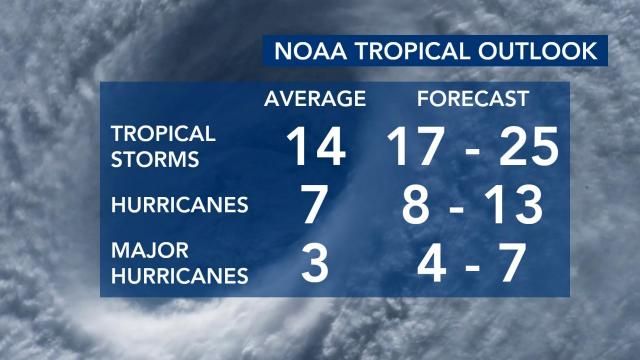
The forecast for a busy season is in line with forecasts from North Carolina State and Colorado State university experts, who released their forecasts earlier in the spring.
How accurate are NOAA hurricane season forecasts?
NOAA does not tend to over-hype the chance for hurricanes.
"Over the past five years, NOAA forecasts have been very accurate," WRAL meteorologist Kat Campbell said. Where they have not been right on, they have forecast fewer named storms than what actually happened.
- In 2023, NOAA forecast a near-normal hurricane season. They got it right for the number of hurricanes and major hurricanes, but the season produced more named storms than were forecast.
- In 2022, NOAA forecast an above-normal hurricane season. They got it right for the number of named storms and hurricanes, but the season produced more major hurricanes than were forecast.
- In 2021, NOAA forecast an above normal hurricane season. They got it right for the number of hurricanes and major hurricanes, but the season produced more named storms than were forecast.
Average hurricane season
The average over the past 30 years has been:
- 14 named storms
- 7 hurricanes
- 3 major hurricanes (of Category 3 or higher)
Each of the forecasts anticipates for a greater number than average of tropical storms, hurricanes and major hurricanes, and the NOAA forecast pushes those numbers the highest.
Record number of hurricanes
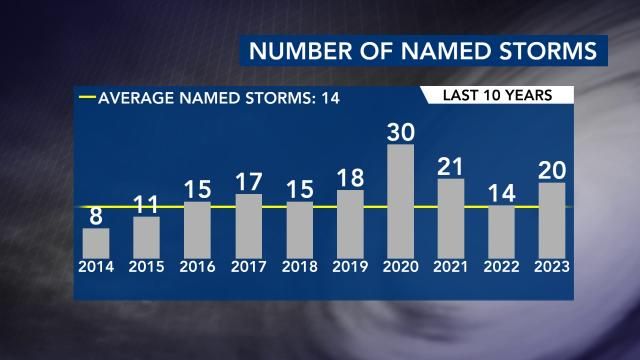
Although the 30-year average is for 14 named storms, we have exceeded that average in seven of the past 10 years.
The record was set in 2020, when there were 30 named storms. That same year there were 14 hurricanes and 7 major hurricanes.
Recent years have seen 20+ storms. In 2021, there were 21 named storms; in 2023, there were 20.
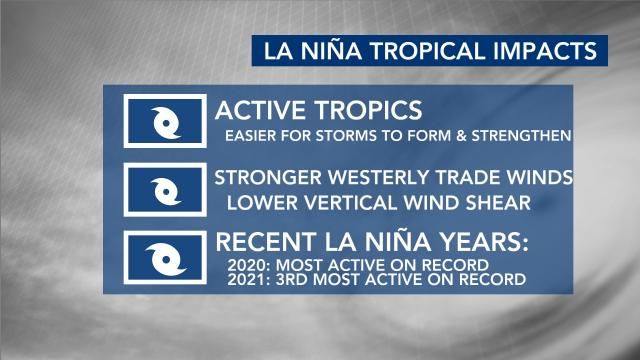
2020 was also a La Niña year, and similar conditions are setting up for the summer of 2024.
What is La Niña?
The forecasts for the Atlantic hurricane season factor in a La Niña pattern, means weaker easterly trade winds and below average vertical wind shear. Basically, in La Niña conditions, there is less wind to break up a tropical system as it organizes.
During a La Niña pattern, Campbell says, "It's easier for storms to form and easier for them to strengthen."
Through the spring of 2024, the east coast will be in an El Niño period, but it is weakening.
NOAA said there is a 77 percent chance for La Niña conditions to develop in July, August, September of 2024. It's very common to have a quick transition from an El Niño to a La Niña.
"It's not a guarantee that we will have a La Niña for the tropical season, but all signs are pointing in that direction," WRAL meteorologist Aimee Wilmoth said.
The last summer La Niña came in 2020, when a record 30 storms were named.
Added on top of record warm temperatures across most of the Atlantic Ocean already, with summer's heat still to come, the conditions are right for storms to be strong and organized.
Prepare your home, family for hurricane season
Atlantic hurricane season officially begins June 1 and runs through November. Storms can form at any time, but there are precautions the North Carolina residents – from the coast to the mountains – can take ahead of time.