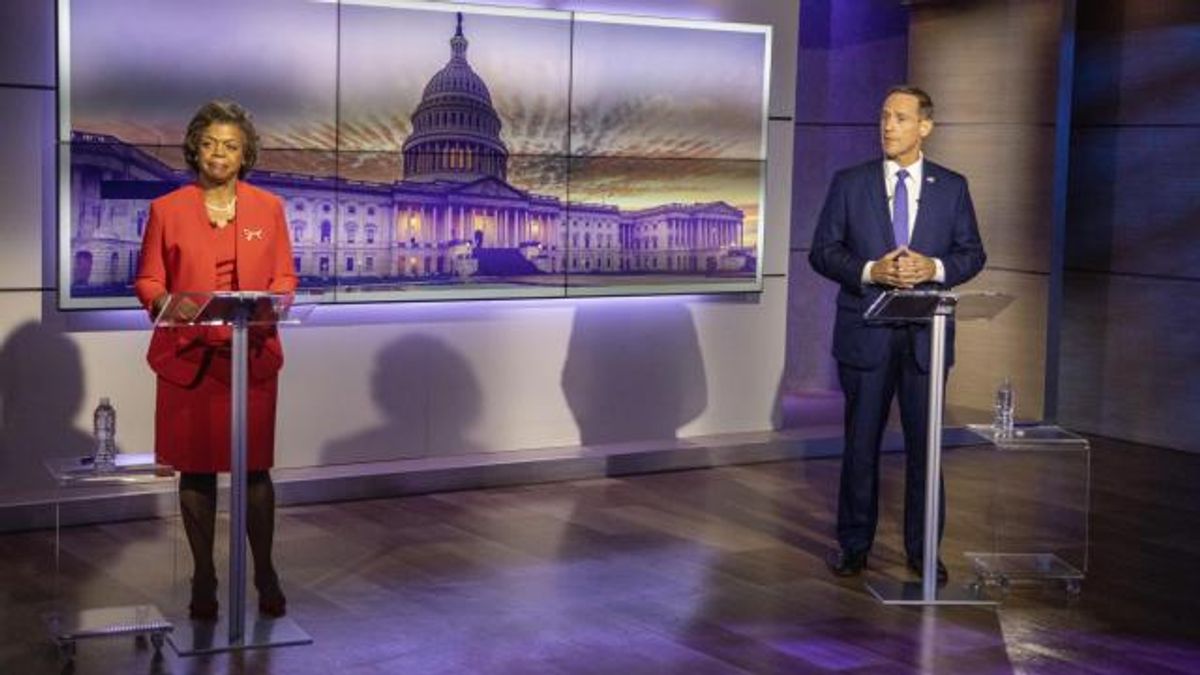
Candidates in North Carolina’s deadlocked U.S. Senate race entered the home stretch of the campaign with similar amounts of cash left in their campaign war chest, but wildly different levels of outside support. Hefty spending from conservative groups could prove impactful as Democratic groups look to make a late push.
While Democrats outraised Republican opponents from July through September in key races across the state, newly released campaign filings with the Federal Election Commission show the gains didn’t equate to large cash advantages entering October. Outside spending from conservative groups further diminished Democrats’ financial gains in the state’s U.S. Senate race and lone congressional toss-up.
Other WRAL Top Stories
Outside political action groups are spending less in North Carolina than they did in 2020, but the groups continue to play a sizable role in elections across the state this year.
In the state’s hotly contested U.S. Senate race, the Democratic candidate, former North Carolina Supreme Court Chief Justice Cheri Beasley, took in almost three times what Republican U.S. Rep. Ted Budd raised from July through September. Conservative groups backing Budd, however, have outspent Democratic ones supporting Beasley by a 4-to-1 margin during the general election.
Filings released on Saturday show Beasley raised about $13.4 million and spent $14.8 million during the quarter. Beasley entered October with $3.3 million in available cash.
Budd took in almost $4.8 million and spent $3.6 million. He had $2.9 million in the bank at the start of October.
But the campaign numbers only tell part of the story.
Through Monday, outside groups had spent more than $32.8 million against Beasley during the general election cycle in North Carolina and $8.3 million against Budd, according to campaign finance data gathered by OpenSecrets, a nonpartisan group that tracks political spending.
“Put it in tandem and I think what you see is a competitive campaign finance environment in a competitive state with two competitive candidates,” said Chris Cooper, a Western Carolina University political scientist.
Limited attention
The money Beasley and Budd are raising pales in comparison to the influence of outside groups.
In 2020, North Carolina’s U.S. Senate race saw more outside spending than any general election in the country. Conservative groups spent almost $101 million to reelect Republican U.S. Sen. Thom Tillis or oppose Democratic challenger Cal Cunningham. Democratic groups spent $104 million to boost Cunningham or oppose Tillis. This year’s general election in North Carolina was 10 weeks shorter than 2020 because of a monthslong court battle over the drawing of congressional and legislative lines. While the drawing didn’t impact who could vote in the statewide Senate race, it did delay all races.
The total spent on the state’s 2020 U.S. Senate race was far more than the country’s next most expensive U.S. Senate contests, including $165 million spent in Iowa and $108 million in Montana.
Despite Beasley and Budd being in the most competitive race in the country this year based on public opinion polls — including three recent surveys showing the candidates within a single percentage point of one another — the contest has received considerably less national attention compared with the state’s 2020 Senate contest and Senate races in other states this election cycle.
General election spending for U.S. Senate races are greater in Pennsylvania, Georgia, Nevada, Wisconsin and Arizona than in North Carolina, according to FEC data collected by OpenSecrets.
“There's just no candidate in this race that has pierced the national consciousness in a way that candidates in these other states have,” Cooper said.
As of Monday, outside groups had spent $53.5 million in North Carolina’s general election, less than the $106.9 million in Pennsylvania, $89.3 million in Georgia, $76.5 million in Nevada, $69.7 million in Wisconsin and $61.6 million in Arizona general elections.
The bulk of the outside spending in North Carolina has come from Republican groups — a move that could prove impactful as prime television advertising spots become more difficult and more expensive to purchase as the Nov. 8 election nears.
Cooper said national Democrats could come to regret not spending more. He attributes some of the limited spending to frustration party leaders may have developed after Cunningham’s 2020 loss and prior defeats in North Carolina in 2010, 2014 and 2016.
“They may be thinking, ‘Look, we've invested money in North Carolina in the past and it hasn't panned out. Let's put it elsewhere.’”
The Senate Majority PAC, a Democratic group working to elect Democratic U.S. Senate candidates, has spent most heavily on efforts to gain seats in Pennsylvania and Wisconsin and defensive moves to retain seats in Arizona and Nevada.
The Democratic political group plans to spend at least $15 million in North Carolina’s senate race during the entire election cycle. The group has already spent $21.7 million on the general election in Pennsylvania, $20.3 million in Nevada, $16.8 million in Wisconsin, $13.8 million in Arizona and $7.9 million in North Carolina, according to FEC data collected by OpenSecrets.
“Cheri Beasley’s strong campaign and record of independence and integrity has made this race more competitive by the day, which is why national Republicans are being forced to burn through precious resources to distract from Ted Budd’s extreme record,” J.B. Poersch, president of Senate Majority PAC, said in a statement. “Our investments will ensure that voters continue to see and hear the truth about Ted Budd’s self-serving agenda to benefit himself at North Carolina’s expense all the way through to Election Day.”
Budd’s campaign said the congressman is seeing strong support among unaffiliated voters and that Democratic groups won’t succeed in electing Beasley.
“The Senate Majority PAC wasted their money in 2014, 2016 and 2020 and lost,” Jonathan Felts, a top campaign adviser to Budd, said in a statement. “The only difference this year is they waited until undecided voters had already started breaking to Ted Budd before lighting their money on fire.”
Doug Heye, a Republican strategist and former communications director for the Republican National Committee who worked on three successful North Carolina U.S. Senate campaigns, said the larger-than-life personalities of candidates in other states have created less spotlight on the more mild-mannered Budd and Beasley in North Carolina.
He pointed to the Pennsylvania contest between Republican Mehmet Oz and Democratic Lt. Gov. John Fetterman, bestselling author J.D. Vance of Ohio and former NFL running back Herschel Walker of Georgia as examples of more interesting political figures.
“It hasn't gotten the national attention that it otherwise would have because we don't have a TV doctor running against a giant in a hoodie, the guy who wrote ‘Hillbilly Elegy’ or the football star or all of that, but the seat is every bit as important,” Heye said.
Beasley’s campaign manager, Travis Brimm, said in a statement that the latest campaign finance report shows Beasley is “the only candidate who will stand up for the people of North Carolina and put them first.”
Budd, meanwhile, thanked his supporters for their contributions but said voters are far more concerned about rising costs they’ve experienced.
“These numbers aren’t what voters care about,” Budd said in a statement. “The numbers that matter to the working families of North Carolina are the skyrocketing cost of living due to inflation and the rising violent crime rates.”
Dems outraise other Republicans
FEC data shows Democrats outraised Republicans in other competitive races but are coming under more fire from outside groups in the state’s lone toss-up district.
In North Carolina’s newly drawn 13th Congressional District — a Triangle-area seat that includes parts of Wake, Wayne and Harnett counties and all of Johnston County — Democrat Wiley Nickel took in more than $1.1 million from July to September. His opponent, Republican political newcomer Bo Hines, brought in $864,000. Nickel entered October with $455,000 in available cash compared to Hines’ $309,000.
The congressional seat is widely considered highly competitive with a slight conservative bent based on past voting behavior. It is also one of the 31 toss-up districts in the nonpartisan Cook Political Report’s analysis of U.S.House races and the lone such swing seat in North Carolina.
Only 23 congressional districts in the country have seen more outside spending in the general election this year, and pro-Hines groups have outspent groups backing Nickel by a 2-to-1 margin. Of the $5.1 million spent by outside groups in the general election cycle, $3.4 million was spent attacking Nickel or boosting Hines while $1.7 million was spent boosting Nickel, FEC data shows.
One race flying more under the radar is North Carolina’s 1st Congressional District, the northeastern seat of retiring Democratic U.S. Rep. G.K. Butterfield that stretches from Wilson to Elizabeth City. The Cook Political Report considers the area a Democratic-leaning seat and the second-most competitive U.S. House race in North Carolina.
In that contest, Democratic state Sen. Don Davis raised $619,000 from July to September, while Republican businesswoman Sandy Smith took in $540,000. But Smith took a slight money edge over Davis heading into October, with $418,000 in available cash compared to Davis’ $320,000.
A little more than half of the money Smith received came from individual donors. She loaned her campaign $200,000 on the last day of the fundraising period, received $27,000 from other political committees and had $13,000 transferred to her campaign from Take Back the House 2022, a conservative group seeking to reclaim GOP control of Congress.
About two-thirds of Davis’ fundraising came from individual donors. He took in $203,000 from political party committees and other political committees.
Davis also has an advantage through outside spending in the race. Nearly all of the $3.2 million in outside general election spending has benefited Davis, with $2.8 million going against Smith and $391,000 going for Davis. Just $26,810 has been spent for Smith and $619 against Davis.