When it comes to the heat, this summer has been part memorable, part miserable.
North Carolina is no stranger to oppressive warmth during the summer months, and the past few weeks have been no different.
Other WRAL Top Stories
When put into proper context, the heat is making this summer a historic one, even for those familiar with sweltering temperatures.
Highs will be in the 90s with heat indices in the 100s through the end of July and into August, as we find ourselves howling through the dog days of summer.
As of Monday, the average mean temperature at Raleigh-Durham International Airport has been 80.2 degrees since the start of meteorological summer (June 1). That makes for the third-highest ranking on record through a 54-day period. As far as average high temperature, this summer is also among the hottest, checking in at 91.4 degrees for fourth-warmest.
Meteorological summer lasts through August, so we still have a way to go before the entirety of the season is logged. The records date back to 1944.
"So far for this summer, we're dealing with the third-hottest summer in Raleigh and Durham," WRAL meteorologist Peta Sheerwood said. "With the kind of heat we are going to see for this week, we could add to that number."
For July, we've seen 20 days of 90-plus degree temperatures so far at RDU, which exceeds our average for the month of 15.
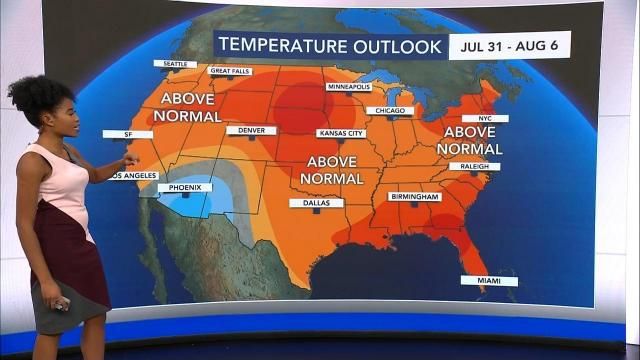
Much of the country will experience above-average temperatures into early August. Large swaths of the country are also experiencing extreme drought conditions.
"We'll be dealing with above-normal warmth, and we see that in place for much of the United States," Sheerwood said.
Hottest summers in Raleigh (by average mean temperature)
- 2010 (81.87)
- 2011 (81.58)
- 2022 (80.26)
- 1986 (79.96)
- 1952 (79.85)
- 1981 (79.72)
- 2008 (79.7)
- 2015 (79.51)
- 2005 (79.06)
- 1993 (78.89)
- 2019 (78.88)
- 2018 (78.85)
2011 and 2012 featured historic heat waves for much of the U.S.; in each of those years, dozens of deaths were attributed to the heat.
The National Weather Service notes that most heat waves in North Carolina start out in Canada as a result of high pressure over the Great Lakes and upper-level ridging over eastern Canada.