Update: The object on course to impact the Moon is not the upper stage of a Falcon 9 rocket, but instead part of China's Chang'e 5-T1 mission launched by a Long March 3C rocket in 2014. Jon Giorgini, a senior engineer at NASA's Jet Propulsion Laboratory (JPL) who was a navigator on JPL missions to Venus, Mars and near Earth asteroids, discovered the misidentification.
The Chang'e 5-T1 debris is still expected to impact the far side of the Moon "within a few kilometers of the predicted spot on 2022 March 4 at 12:25 UTC, within a few seconds of the predicted time" according to Gray.
Other WRAL Top Stories
Images of the object were captured by the Virtual Telescope Project as it made its last fly-by Earth on February 8.
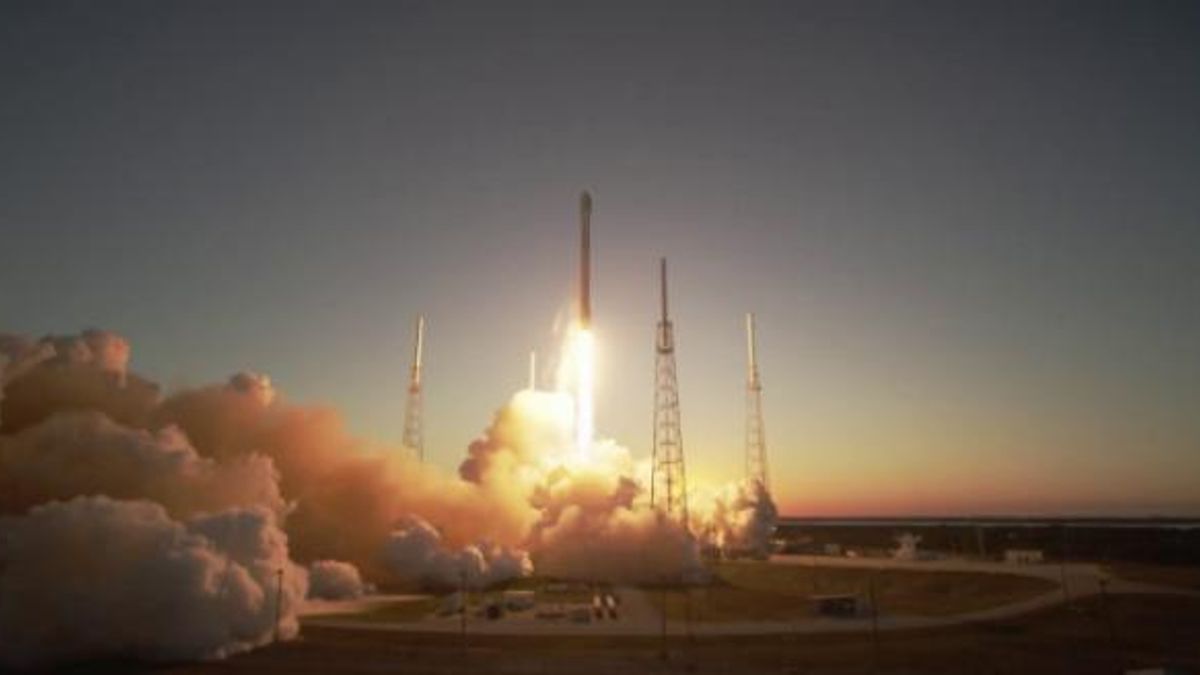
The leftovers of a 2015 SpaceX launch are expected to hit the Moon in the coming weeks.

Bill Gray, a software developer and astronomer, discovered the 47 foot long upper stage left in an elongated orbit stretching beyond the Moon after the February 11, 2015 launch was drifting into the Moon's path.
Based on observations from nine astronomers in Europe and the United States, Gray calculated that the tractor trailer sized upper stage will slam into the far side of the Moon on March 4 at 12:25:39 UTC near the equator.
"I'm pretty confident in that date" explains Gray,"the location of the impact could vary by a degree or so depending on the solar winds between now and then."
The booster stage from that launch is at the bottom of the Atlantic after 30 foot waves at the drone-ship forced the company to skip the second attempt to land a booster for later reuse.
Because this space junk will impact on the far side, it will not be visible. It is also not expected to seen by either spacecraft orbiting the Moon.
NASA's Lunar Reconnaissance Orbiter will be more than 2,600 miles away, above the near side of the Moon we see. India's Chandrayaan-2 orbiter is also extremely unlikely to be in the right place at the right time from it's position just 62 miles above the lunar surface.
A crater left by the 4 ton object might be visible to a future flyover of one of those orbiters however.
How rare are lunar impacts?
The Moon gets hit by about thee tons of meteoroids each day, mostly on that far side giving it the cratered look it has today.
Since lunar exploration began in 1959, 57 satellites artificial, rocket bodies, and parts of Apollo landers have crashed into the Moon. In the early days, this was intentional, that's all we could do and the Soviet Union and United States traded off crashing Luna, Surveyor and Ranger missions.
This will be the first time I can recall space junk impacting the Moon. This is because space junk is rare this far out.
Of the more than 50,000 entries in the catalog of objects tracked by the U.S. Space Force, all but 6 are within the Moon's orbit.
This SpaceX upper stage, also known as 2015-007B —or the seventh launch of 2015, second item tracked from that launch — has a really unusual orbit. It's highly elliptical, looping its way around the Earth and Moon about every 26 days.
That orbit was perturbed, or changed, by the Moon's gravity when 2015-007B and the Moon came within about 6000 miles of each other on January 5. This redirected on an intercept path ending on March 4 according to Gray.
2015-007B is out there because it placed the Deep Space Climate Observatory (DSCOVR) into an orbit around the first LaGrange point or L1. Like the James Webb Space Telescope's new home at L2 on the other side of Earth, L1 is a point of gravitational balance between the Sun and Earth about 1 million miles from Earth. It's a great place to monitor space weather.

DSCOVR
The Deep Space Climate Observatory, or DSCOVR, provides real-time solar wind monitoring capabilities. That L1 position allows researchers at NOAA's Space Weather Prediction Center in Boulder, Colorado, 15 to as much as 60 minutes advanced warning of solar storms.
That L1 position has also provided a unique vantage point for events like the 2017 total solar eclipse seen across the U.S.