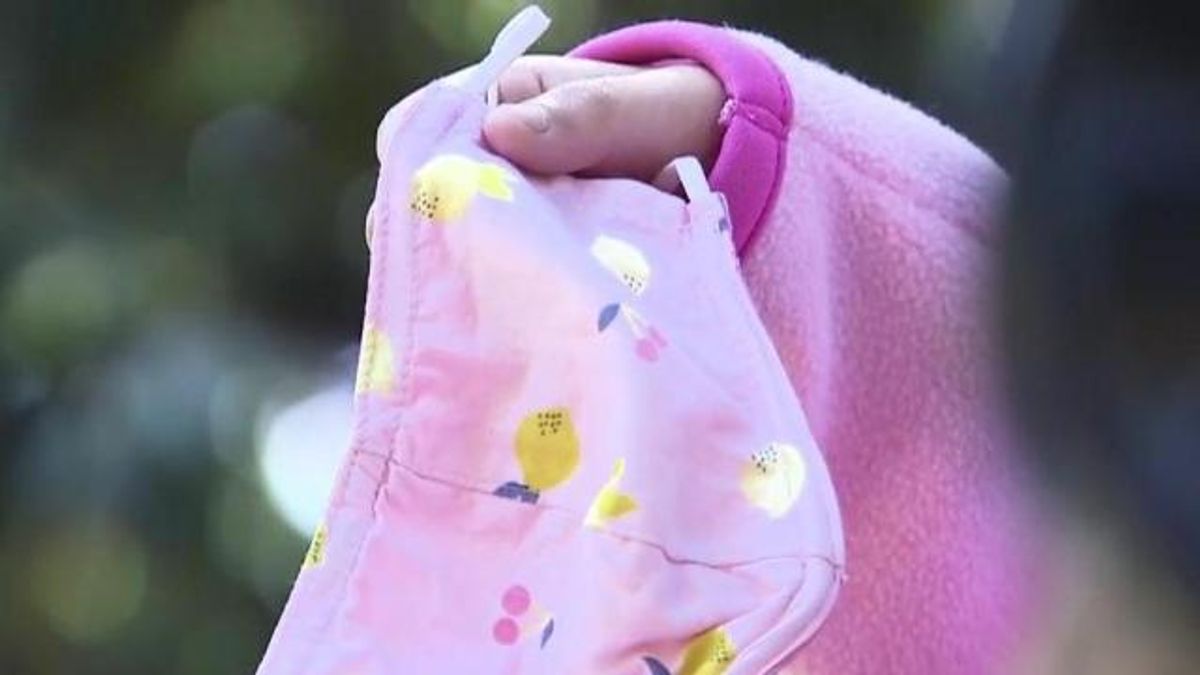
With the Centers for Disease Control and Prevention (CDC) considering updating its mask guidance to suggest KN95 or N95 grade masks over cloth face coverings, many parents are left wondering which masks to buy for their children.
What's the difference between N95 and KN95 masks?
Other WRAL Top Stories
You will see a lot of healthcare workers using N95 masks. Throughout the pandemic, those were the only people who really had access to these types of masks, which can filter up to 95 percent of particles in the air. KN95 masks also filter 95 percent of particles.
N95 masks are made in the United States by the National Institute of Occupational Safety and Health (NIOSH), while KN95s are manufactured in China and must pass that country's requirements.
According to the CDC, about 60 percent KN95 respirators in the United States are counterfeit or fake and do not meet NIOSH requirements.
Are N95 or KN95 masks made in children's sizes?
N95 masks are hard to find in kids' sizes and since NIOSH only regulates products for adults, there is no official, approved N95 masks made specifically for children at this time. But you can measure your child's face and determine if a NIOSH-approved N95 mask will fit your child. In some cases, older children can fit into smaller-sized adult masks.
There are a lot of masks that claim to be KN95 available in children's sizes, so you will need to do some investigation before purchasing.
Emily Sickbert-Bennett, PhD, director of UNC Medical Center Infection Prevention, told WRAL that the many counterfeit versions out there are not designed to have higher level of filtration.
"From our tests of them, we found time and again that the fit on the face was critical for it to be effective," Sickbert-Bennett said.
It's all about the fit
Parents should focus on finding a mask that is "comfortable and acceptable to the child (because a high filtration mask that isn't worn consistently is not useful for prevention of COVID)," Sickbert-Bennett told WRAL. "Beyond that, multi-layer masks that are well fitted to the face (adjustable nose pieces, minimal gaps around sides, chin and cheeks) will offer the best protection."
The goal is a tight fit with the least amount of air leaking out from around the mask. A mask that has a nose wire or brace to hold it against the face is also a good option, according to UNC Health Talk.
The mask should cover the child's chin and nose but not impair their vision.
“The way your mask fits your face is the most important factor in determining how effective it (the mask) is,” Dr. Sickbert-Bennett said in recent UNC Health Talk interview. “You should have a nice fit across the bridge of your nose and underneath your eyes. If you wear glasses with your mask on and you’re getting a lot of fog on your glasses, that’s a sign that it’s not fitting very well.”
Double masking is also an option to explore.
"We have shown that doubling masks can also serve to achieve a better fit. For example. cloth mask or gaiter over a procedure mask was a simple way to greatly improve the mask effectiveness," Sickbert-Bennett told WRAL.
What masks are best for my family?
The most important thing is finding a mask your child will wear. One that fits properly and offers some layers of protection. The fit is key, so you might have to try a few different ones.
When looking for masks for my children, I searched the internet and found some good articles that review specific masks. This article from USA Today has some good suggestions. Good Housekeeping also had a nice list of mask options, and I really found some good picks on the Parents.com.