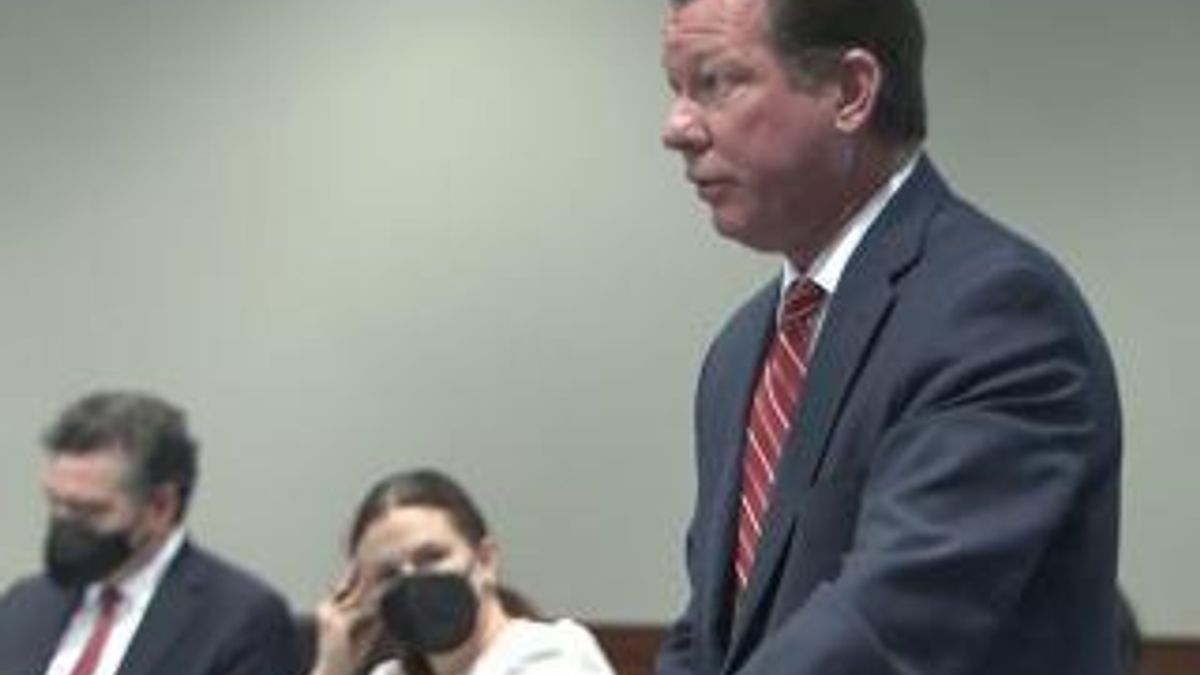
Closing statement in the January 2022 N.C. Superior Court case challenging congressional and legislative redistricting maps enacted by the North Carolina General Assembly from Phil Strach, lawyer for the legislative defendants.
Other WRAL Top Stories
If there's any threat to democracy here, it's the plaintiff’s theories. They want more Democrats elected in North Carolina. But instead of engaging in the pool hall and trade of finding common political ground, they rely on black box computer algorithms to draw conclusions about political intent. And in case that doesn't work, they revert to using race as a pretext for line drawing.
Now you don't have to look any further than plaintiff's expert Dr. Leloudis. He's the only witness in this trial who said the quiet part out loud. He testified there needs to be a Democratic majority in the legislature for minority voting strength not to be deluded. That's the endgame. Concoct algorithms to put the thumb on the scale in favor of Democrats and against Republicans to ultimately drive Republicans out of office.
The NCLCV optimized maps are a great example of how they intend to do this. The NCLCV came to court promising to harness the power of mathematics and computer science to identify and remedy the severe constitutional flaws in the General Assembly's plans. But what they did was not quite that. Their proposed plan was drawn by General Block Attorney Sam Hurst with the help of so-called data scientists. And they use the computer algorithm to optimize the maps for Democrats. They could have submitted their optimized maps to the General Assembly during the map drawing process and provided testimony about their algorithm to push for their maps’ adoption. Instead, they fought hard to keep the details of their map-making process secret and reveal the maps themselves only as part of their lawsuit. And there's a reason for that. The maps were designed by a computer to drive lots of Democratic seats and to achieve something tantamount to proportional representation.
And more disturbingly the mapping data code attempted to draw districts using race despite there being no evidence in the record that a Section 2 majority-minority district is required anywhere in North Carolina. The ruthless partisan and racial efficiency of the NCLCV computer code highlights the ruthless bias in the plane of simulation expert reports. In order to act as proper comparisons to the enacted plans, the instructions going into the simulations need to match the criteria the General Assembly applied. We saw in this trial how these different instructions matter. We saw how Dr. Pegden and let his comparison districts be drawn less compact by a meaningful margin than the enacted districts. He did not make an effort to make the comparison maps look good or pass the legislature. We saw how Dr. Pegden let his comparison districts be drawn to split more municipalities in a way that affected thousands and thousands more people than the enacted plan, which had many municipality splits that affected zero people.
But we know from Dr Mattingly's analysis that relaxing the municipality rules changes the outlier status of the district. Look at his treatment of the Senate districts where when he relaxed the municipality standard enacted plan was suddenly an outlier. We saw how Dr. Magleby used a patently illegal population deviation standard and he didn't test what his results would be if he used the legal deviation standard.
So when I think of these simulation experts, I think about the Wizard of Oz. When you approached the Wizard, he was grand. Awe inspiring and majestic. And then what you learned was that the Wizard of Oz was nothing more than a man behind the curtain. Plain, ordinary, biased and definitely imperfect. Behind all of plaintiff's complex and shiny simulation exercises, it's just a man behind the curtain.
As Sam Hurst testified, the computer can't program itself, only a person can. In fact, he specifically designed the NCLCV code to seek out like a heat seeking missile districts that would benefit Democrats and minorities. Dr. Chisholm is the man behind the curtain of his simulations. He claimed to account for municipality splits, but he clearly did not. That introduces a fundamental bias in his simulations. He could have programmed his code on the congressional plan to draw districts that split Guilford, Wake and Mecklenburg twice in order to make a fair comparison of the partisan effect. But he did not. And Sen. Hise justified those splits on the basis that had allowed him to split fewer overall counties. Dr Magleby did the same with his simulations as the population deviation. Simply put none of the plaintiffs of simulation experts fairly attempted to make an apples-to-apples comparison by using the criteria the Legislature actually used in drawing the districts.
And the criteria, of course, were not a secret. The adopted criteria were known as early as mid-August. During committee hearings and floor debates, legislative leaders gave exhaustive testimony detailing the rationale behind the state house senate and congressional plans. Any of these experts could have reviewed this material and incorporated it into their models, but they did not. And these were not post hoc explanations. They were explanations provided at the same time the maps were being debated and then voted on. And when asked about whether the legislature's explanation of the map should be considered, the answer from plaintiff's experts was that if they considered these alleged post hoc rationales for why a single line was placed where it was, and that was followed throughout, then there would be only one map, the enacted map. Thus, plaintiffs would say that the legislative record doesn't matter.
Now, outside of the redistricting context, would a court ignore the detailed legislative record we have here? If we were determining the intent of the legislature for the budget or another act is challenged as unconstitutional, would the explanation offered by the legislators be cast aside completely in favor of running alternative ways the General Assembly could have answered a public policy question?
No. The fact is this contemporaneous legislative information would make it harder for plaintiffs experts to rig their algorithm against the maps and so they simply ignored it. So it's not surprising that the plaintiffs would then resort to relying on the irrelevant so-called concept plans. Rep. Hall already testified about those plans. And he showed the court that if he was using concept plans that had political data and he wanted to do that to help Republicans, then he did a pretty bad job. Because the maps could have been drawn a lot more to benefit Republicans than they were.
This is simply the hallmark of a weak case. Ignore the actual legislative record. Ignore the actual maps. And focus on the shiny irrelevant object in the corner. The only expert to attempt to faithfully analyze the plans according to the legislature's criteria was Dr. Barber. Dr. Barber testified that it should not be surprising that the application of neutral redistricting criteria in North Carolina would lead to a set of Republican leaning districting maps do the spatial distribution of North Carolina voters and the clustering of Democratic voters in the urban and northeastern areas of North Carolina combined with the group rules.
Dr. Barber’s simulations showed that just one county grouping in the House and just to county groupings in the Senate were outliers. But, and this is important, simply finding a grouping to be an outlier is not enough. That's the beginning of the analysis, not the end of it. Dr. Barber testified that once an outlier has identified, additional analysis is needed to determine what caused the district to be an outlier. Simulation cannot measure all the inputs that are at issue when legislatures enact new districting maps. All of the outliers Dr. Barber found in the United maps had reasonable explanations. the fact that doctors Pegden and Mattingly found that the Senate Moore-Cumberland grouping was evidence of an extreme partisan gerrymander. But the NCLCV Plan through the exact same district, calls into question plaintiff's expert analysis. And compared to the NCLCV Plan, that plan had six outliers, five in favor of Democrats, whereas the enacted plan had only three. Under Dr. Barber’s reasonable analysis, neither the enacted House nor the enacted Senate plans were extreme partisan gerrymanders.
But even under the analysis of plaintiff's experts, it's clear that the number of districts and issue in this case is marginal at best. A handful of districts separate the enacted plans and the analysis by plaintiffs experts. For instance, Dr. Chen says that for Congress, there should be nine Republican districts, but the enacted map allegedly has only 10 Republican districts. That's just one. Dr. Pegden, regarding the congressional districts, argues for 5.8 Democratic seats compared to 4.6 seats in the inactive plan. And the state House plan, Dr. Pegden argues for 55.5 Democratic seats compared to 52.85 seats and enacted plan. And in the state Senate, he argues for 22.3 Democratic seats Compared to just 21.87 seats in the enacted plan. Marginal differences. For the state house plan, Dr. Magleby argues for 52 seats compared to 48 in an active plan. In the State Senate, 22 seats compared to 19 in the enacted plan and for Congress, five seats for Democrats compared to four in the enacted plan.
This is excessive? Of course, not even if you believe the rig mathematical analysis of the simulations, there's simply no evidence that the enacted maps excessively favor Republicans. What is truly revealing about the plaintiff's expert analysis is that they don't even agree with each other about what are outliers and what or not. That is clearly enough not to overturn the plans. And why is that? Primarily, it's because in the legislative plans, the Stevenson requirements themselves act as anti-gerrymandering limitations. The plaintiffs have not offered any objective principle to limit so called gerrymandering. None is needed. The Stevenson rules already served that purpose.
At bottom, the plaintiffs have failed to answer the key question that vexes all courts struggling with partisan gerrymandering claims: What is the line between permissible and impermissible partisan considerations when drawing a map? The fact is that is an unanswerable question, unless the courts try to answer it with brute force alone. Plaintiffs have not even put forward a consistent measure of how a partisan gerrymander is detected. They put forward expert testimony that conflicted internally. One expert thinks the county grouping is an outlier, but the other two don't and so on. Even the plaintiff's experts are disagreeing about where the problems reside. This means that there is no consistent measure of a quote “partisan gerrymander” to be relied on by this court. They certainly have not set out a standard by which the court could hold that the plans are unconstitutional, beyond a reasonable doubt which is the applicable standard.
But of course you don't need to seek a line here because the maps very clearly passed muster. The process the legislature engaged in was truly the most transparent and nonpartisan in the history of North Carolina redistricting. It was so transparent that plaintiffs witnessed Tyler Daye said he was overwhelmed by it. That's high praise for the transparent process. The legislature used for this redistricting process. The maps comply with their own criteria. All of the maps tried to balance the goals of not splitting counties, municipalities and VTDs. And they achieved that.
Amplifying the ridiculousness of plaintiffs’ claims is that they challenge state house districts that are nearly identical to those drawn by a special master in a federal case, or those approved by this court in 2019. No serious case can be made that the districts drawn in those instances are unlawful. And in Mecklenburg County, the House districts are drawn based upon districts that the Democratic legislators themselves drew in 2019. Did the Democrats in 2019 draw Republican gerrymander? And in 2021 Democrats drew the districts in the Senate Guilford grouping. And they confirmed that they were fair and posed no VRA issues. Did the Democrats draw Republican gerrymandering in Guilford County in the Senate? Of course not.
The maps look good. We're not looking at the sort of ugly districts you think of, when you think of gerrymandering? We don't have Elbridge Gerry’s salamander district, the genesis of the term. There's no ink blot. There's no freeway district. These all look like reasonable districts based on the state's geography because that's what they are.
Map drawing in North Carolina is committed to the legislature, not to some nonpartisan committee. It is committed to the political body of the government of this state. Indeed, when the residents of North Carolina had an opportunity to amend the Constitution and decide whether the governor is able to veto redistricting plans, they voted to keep it veto proof. Meaning they wanted their elected representatives, not a soul individual executive to decide.
Respectfully, Rep. Hawkins and others may wish that redistricting is handled by a special commission, but under our system of government in North Carolina is the legislature's sole prerogative. This year the legislature opened up that normally closed process in ways that were never voluntarily done in the state's history and likely in the entire country. That process produced lawful and fair maps.
Race is a red herring in this case. Plaintiffs’ counsel tried to bait the Legislature into committing a violation of the equal protection clause during the map drawing phase. Plaintiffs’ counsel told the legislature to look at race and when the legislature rightfully said they could not do that without legitimate evidence of legally significant racially polarized voting showing that it was not necessary. None of that evidence appeared. Plaintiff's counsel never provided it and they never provided it during this litigation. We provided it. And what the evidence shows is that VRA districts are not necessary because a black candidate can win anywhere a Democrat can win. And here we come to what plaintiffs are really after. They want a Democratic gerrymander using effectiveness scores or something similar to use Black voters to help elect Democrats. And there is no evidence that Black representation has suffered after the race blind draws of the last decade. Publicly available data on the General Assembly website shows that minority representation in the legislature is in line with the minority population in this state.
In the end, politics is not a math problem. Simulations are no doubt interesting, but there's still a big gap between solving a math problem and understanding political issues. Drs. Taylor and Barber have both testified to the human element in politics and voting behavior. Models can only take you so far. Where does permissible partisanship end and an illegal gerrymander begin? Plaintiffs have brought a veritable Justice League of simulation experts and math professors to this court and none has offered this court a principled and understandable standard to assist in answering that key question.
At the end of the day, plaintiffs want this court to use a computer to decide if a plan is an unconstitutional gerrymander. If the computer says the plan’s an outlier, then it must be redrawn until the computer says the plan is OK. But that is simply replacing the General Assembly’s discretion with that of a computer and the math professors develop and run the algorithm on these computers. That’s not democracy. It is, in fact, a threat to democracy and a recipe for further political polarization of the citizens of North Carolina. This court should affirm our democracy, not undermine it, and dismiss these clients.