The General Assembly is changing its email retention policies and planning to delete most correspondence after three years, raising questions about public access and access to documents often sought in lawsuits.
The change is part of a move to cloud computing and a desire not to pay for too much storage space, according to Legislative Services Officer Paul Coble, who oversees day-to-day logistics at the General Assembly. Lawmakers can pick certain emails to archive for up to 10 years, Coble said, but standard practice will be deletion after three.
Other WRAL Top Stories
"We don't want to pay to hold everyone's email for eternity in the cloud," Coble said in an email Thursday.
Coble didn't respond Thursday or Friday to requests for written copies of the new and old policies, nor did he respond to other follow up questions on the new policy. But Senate President Pro Tem Phil Berger's office, after initially referring questions to Coble, said late Friday afternoon that the General Assembly hasn't had an email retention policy before now.
Berger spokeswoman Lauren Horsch called the new policy "appropriate and similar to those of other state agencies."
"Legislators and staff send and receive thousands of emails every day regarding a multitude of topics, all of which do not need to be retained indefinitely at significant taxpayer expense," she said in a statement. "The email retention policy allows legislators and staff to keep emails beyond three years if needed or otherwise required by law. We trust legislators to keep their emails as they deem necessary."
Speaker of the House Tim Moore's office did not respond to questions about the new policy.
Court cases targeting laws passed by the General Assembly are common, they often take years to play out, and sometimes they're not filed until well after a law passes. Kym Hunter, a Southern Environmental Law Center attorney engaged in litigation now with the state legislature, called the new email policy "really bad."
"You should not be destroying emails, regardless of who you are, that might be subject to subpoena," Hunter said.
Deleting emails too early could also be a misdemeanor under North Carolina law, though that interpretation of the law is in doubt.
Uncertainty
Just how much of a lawmaker's email is public record is something of a gray area in North Carolina law, and it has never been fully litigated.
Lawmakers' communications with staff are specifically privileged under North Carolina law, meaning legislators can keep them secret. There's an exception, though, to this legislator-staff privilege: redistricting. Once new election maps are finished, communications about the process of drawing them become public record, even if they include staff.
Beyond emails with staff, though, lawmakers may claim privilege, but it's not laid out in the law. The state Attorney General's Office said in 2002 that, since lawmaker-staff emails are specifically privileged in the law and the law is silent on other privileges, that suggests the correspondence is public record.
But Chief Deputy Attorney General Edwin M. Speas Jr. said in that letter, which dealt primarily with records pertaining to the redistricting process, that the Attorney General's Office was "unable to determine the legal status of communication solely between legislators about redistricting."
"This uncertainty can best be resolved by the General Assembly itself," the letter states.
Hunter said Friday that lawmakers often claim privilege at the start of negotiations over releasing records, but "any time I’ve pushed them on that, they’ve given me the records.”
Hunter filed an open records request earlier this year for back and forth involving Senate President Pro Tem Phil Berger and the state Senate's decision not to confirm Gov. Roy Cooper's initial pick this year to head the state Department of Environmental Quality.
Hunter got a response from Berger's office Friday, arguing that emails between legislators, and "between legislators and non-legislators," including lobbyists and a lawmaker's constituents, aren't public records.
However, Berger's office also told Hunter that it didn't have any relevant records, regardless of whether they would have been covered by the claimed privilege.
"It makes it harder to test the issue in court when they're saying they're not withholding records because of a privilege," Hunter said. "If they had said that today I could jump right into court immediately."
'No person may destroy'
State law makes it a misdemeanor to "destroy, sell, loan, or otherwise dispose of any public record without the consent of the Department of Natural and Cultural Resources."
State Archivist Sarah Koonts said Friday she can't remember the department pursuing those charges against anyone over a records retention issue.
"I expect that first part of the sub-chapter is more for those who remove records from an office or willfully destroy them," she said.
Hunter said "just a plain reading of the law" suggests the legislature needs some sort of agreement with the department to destroy records. Koonts said she wasn't aware of one for emails and that the legislature's retention policies are up to the legislature.
“That’s nothing that we’ve ever collected or kept," Koonts said. "I don’t know of any states that do."
But Coble referenced these DNCR policies in 2018, when Hunter asked him for a copy of the General Assembly's retention policies. He linked her to a DNCR chart laying out various retention timelines, including one for "General Assembly Messages."
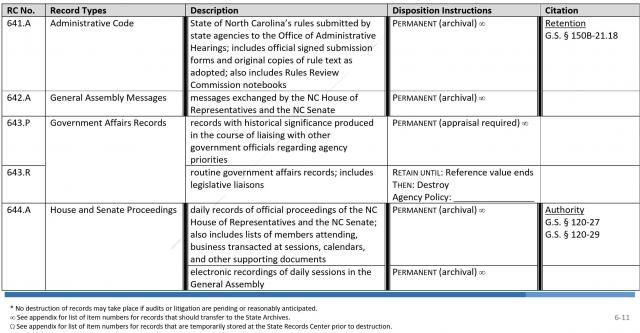
Koonts clarified Friday that entry is meant for formal communications that go back and forth between the House and the Senate, not individual lawmakers' messages. Horsch, Berger's spokeswoman, said Friday that legislative emails, "to our knowledge, have never been kept indefinitely.”
Mike Tadych, a North Carolina attorney who represents WRAL News and other media outlets in open records cases, said Friday that the three-year retention plan could cause problems down the line, given how much of the legislature's work has more than a three-year impact.
"Deploying advanced, cost-saving technologies is a sound investment," Tadych said in an email. "While implementing such improvements, the General Assembly, its members, its staff and its vendors and partners need to be mindful of the continuing obligation to protect and preserve public records, as they are the property of the people of North Carolina."