You may have read that the planet Uranus is visible with the naked eye this week. This might be possible from a very dark location with very good eyesight, but for most of us this seventh planet from the Sun lost will be lost in the light pollution. Uranus is about 175 times dimmer than Mercury.
Thursday's new Moon begins a new month for lunisolar calendars including the eighth month of the Chinese calendar, the second month of the Islamic calendar (Safar), and the first month of the Hebrew calendar (Tishri).
Other WRAL Top Stories
The NC Museum of Natural Sciences popular BugFest event continues online this year all week. Visit BugFest.org for a full list of programs including how NASA’s Earth-observing satellites are helping study mosquito-transmitted disease.
Monday September 14
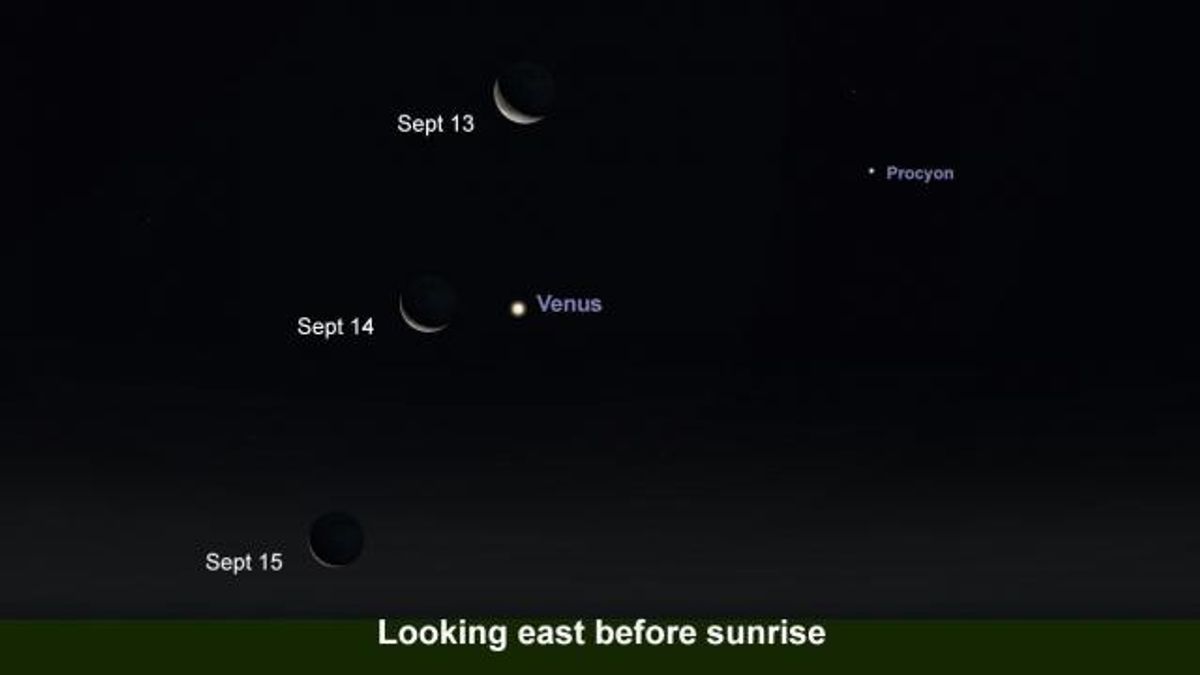
- Before dawn: the Moon and Venus will be less than 5 degrees apart. Rising before 4 am, the pair will be visible until dawn.
- 2 pm: Author Jacqueline Mitton joins the Astronomy Society of the Pacific for Astronomy at Home Storytime to share her book Zoo in the Sky: A Book of Animal Constellations. Free sign up.
Tuesday September 15
- 10:00 am: The Morehead Planetarium presents September Carolina Skies, learn more
- 1:30 pm: NASA is hosting a live discussion with astronomers about careers in planet hunting via YouTube.
- 8:58 pm: Look to the southwest for the International Space Station, it will disappear into Earth’s shadow nearly overhead about three minutes later.
Wednesday September 16
- After dark: as the Moon passes between Earth and the Sun, the new Moon, it’s a great opportunity to see just how dark your sky is. If your sky is really dark, you may be able look out across our galaxy, the Milky Way, running straight up from the southwestern horizon down to the northeast horizon.
- 8:11 pm: look to the southwest for the International Space Station, it will set on the northeastern horizon about five minutes later.
Thursday September 17
- 1 pm: NASA will host an “ask me anything” sessions with experts from the Solar Cycle 25 Prediction panel about recent progress toward declaring solar minimum and beginning a new ~11 year solar cycle. Watch live on NASATV
- 2:17 pm: SpaceX plans the launch of another batch of Starlink satellites. Watch live via YouTube.
Friday September 18
- After finding and fixing a problem which scrubbed the last launch attempt with just three seconds left, United Launch Alliance plans another attempt of a National Reconnaissance Office satellite just after midnight EDT Friday morning.
- Look low on the southwestern horizon about 30 minutes after sunset for a day old sliver of Moon about six degrees away from Mercury.
- At 9:44 a.m. EDT, the Moon will be at perigee, its closest to the Earth for this orbit.