Throughout the week, bright Jupiter and then about 20 minutes later and five degrees away, dimmer Saturn rise before midnight.
Mars rises in the east around 1 a.m shining brightly a faint orange-red color until dawn. It will double apparent through the summer months.
Other WRAL Top Stories
Venus has emerged from its trip behind the Sun and is now visible before dawn. It still close enough to the Sun that it can be a challenge to see, we'll see it again more easily in about two weeks. Mercury is fading fast as its orbit takes it closer to the Sun in our sky.
The International Space Station's orbit doesn't take it through our skies in the hour or so before sunrise or after sunset this week. It will again be visible in our skies beginning on Jun 24 with very bright pass on June 29.
Sun Jun 14
The Moon reaches apogee at 8:57 pm, its further point from Earth, at 251,404 miles (404,596 km).
Mon Jun 15
Tue Jun 16
Wed Jun 17
If you are up at this hour and your skies are dark, it's worth looking for the latest batch of Starlink satellites launched by SpaceX this week. Dozens of the desk sized satellites will be rising in the east at 4:13 am, following one after another, setting a little more than a minute later. This batch of satellites is equipped with shades to limit the amount of sunlight reflected back to Earth in response from complaints from astronomers.
Thu Jun 18
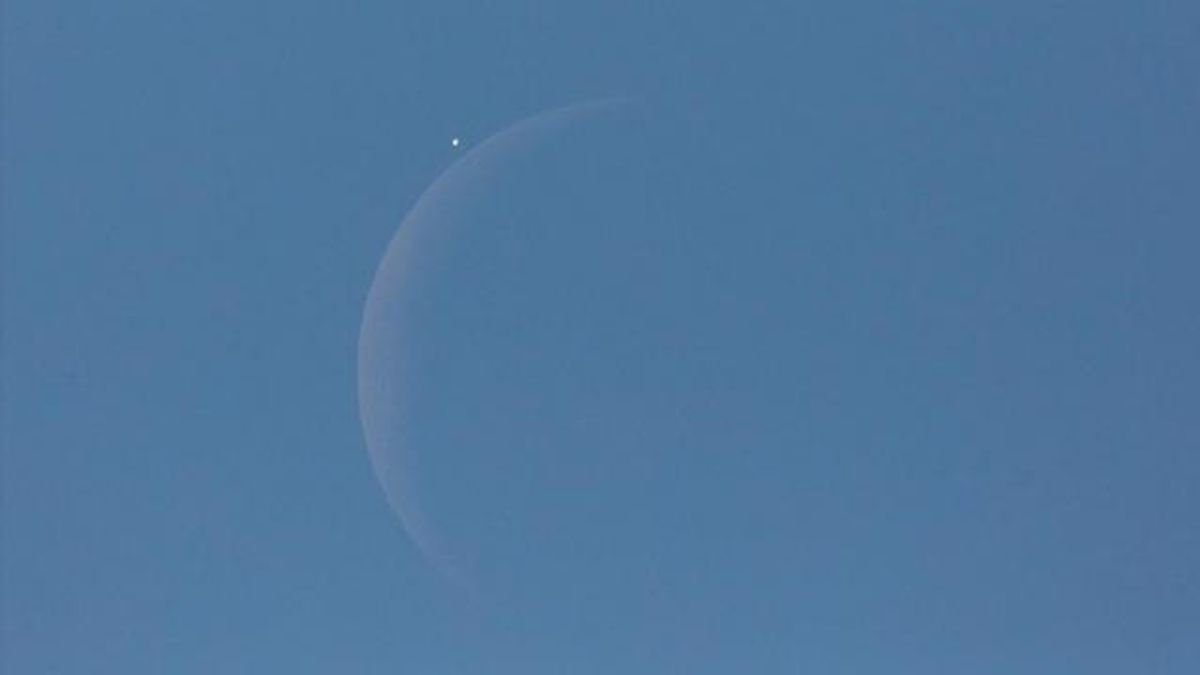
Look to the east-northeast horizon for the thin crescent Moon alongside Venus, less than 2 degrees apart.
Fri Jun 19
While not visible from the Carolinas, look for some interesting photos to come from the lunar occultation of Venus. From portions of the northeastern states, the Moon will pass in front of Venus shortly after 4 am. We'll next see an occultation by the Moon of a bright star in the constellation Scorpius the evening of September 21.
Sat Jun 20:
Astronomical summer begins in the northern hemisphere at 5:44 pm with the solstice. The Sun travels in its longest, highest arc in its daily journey across the sky. That path, and the number of daylight hours, gets increasingly lower each day heading toward the September equinox
The term "solstice" comes from Latin and means "the Sun stands still." Over the course of the year, the Sun's arc across the sky is always moving higher or lower each day, except on the solstices.
Sun Jun 21
An annular, or partial solar eclipse will be visible from parts of Africa and Asia. Because this eclipse occurs near the point in the Moon's orbit when it is furthest from Earth, it appears smaller and does not cover the Sun completely, leaving a "ring of fire" around the Moon.
The next eclipse visible from our area will be a penumbral lunar eclipse on July 4. The next umbral (darker) lunar eclipse will be on May 26, 2021. The next solar eclipse visible from our area will be a partial one on June 10, 2021. The next total solar eclipse visible within driving distance from our area will be April 8, 2024.