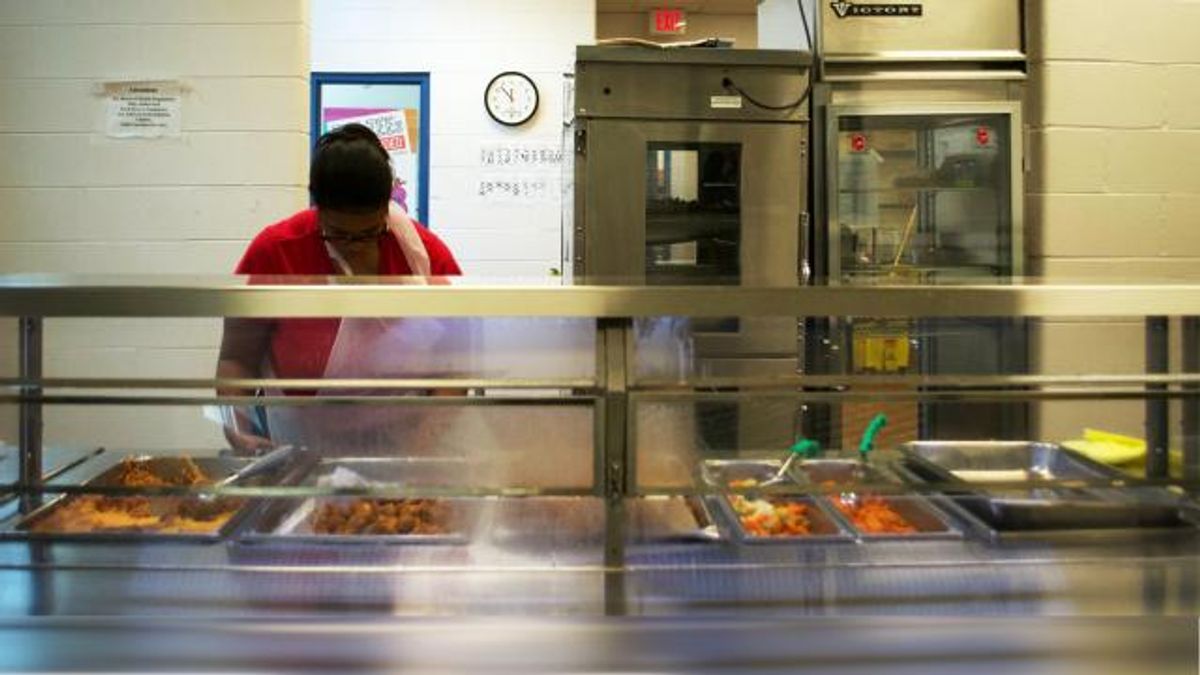
Gladys Stroud runs a tight ship at Neal Middle School in Durham.
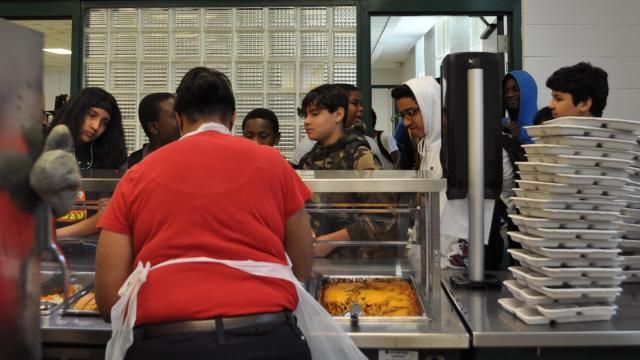
It’s 11:45 a.m. and the cafeteria manager is already serving the second lunch period of the day – just hours after breakfast earlier that morning. Seventh graders file into the cafeteria and form two lines at the counter, meeting at cash registers in the center. There’s a condiment table adorned with a patriotic tablecloth.
Other WRAL Top Stories
In red, white and blue, it reads “Stars and Stripes” and “Freedom.”
"You think that table is cute," Stroud laughs, "but I hate it. Kids stop and ask each other, 'How many packets of ketchup are you taking?' 'Oh, maybe three. What about you?' 'Cool. Same.' They talk and it slows down the whole line."
When you feed more than 250 students in a 25-minute lunch period, you move quickly.
Next fall, lunch will be radically different here.
After five years of waiting, Neal Middle is adopting a relatively new federal program that provides universal free lunch. Called the Community Eligibility Provision, it's proven to increase the number of kids eating, boost student achievement and reduce suspension rates.
Participating in CEP will also provide much-needed financial relief.
Even with 80 percent of students receiving free or reduced price lunch, Neal was left with over $27,000 in unpaid meals by the end of last school year. With CEP, that number will go to zero.
But it’s taken years for Neal Middle, and other Durham County public schools like it, to participate in the program.
That's because if they do, schools could face losing thousands of dollars in funding from Title I, another federal program aimed at helping disadvantaged students, or face a shortfall in cases where federal funding doesn’t cover the cost of universal free lunch.
Following a WRAL investigation into competition between CEP and Title I, Neal Middle is now among six additional schools that will participate in CEP next year, according to James Keaten, director of Child Nutrition Services for Durham Public Schools.
That brings the total number of Durham schools participating in the program to 19.
Some of the new additions, four of them high schools, aren’t Title I schools. For the others, including Neal Middle, Keaten said that adopting CEP will impact Title I funding, but the changes won’t be detrimental.
"I really do think that there's just going to be a parent relief that is going to trickle down to the kids' relief,” Michael Fuga, the principal of Neal Middle. “You don't have to worry about where your next meal is coming from."
{{social}}
The U.S. Department of Agriculture launched the Community Eligibility Provision in 2014 with a simple goal: free lunch for every student. Schools are eligible to participate if at least 40 percent of their students are identified as low-income.
But an unintended consequence of the provision puts participating schools at risk of losing Title I funding – an important resource for hiring additional staff, enriching curricula and getting parents involved.
The competition is further complicated by the fact that both CEP and Title I are aimed at serving low-income schools, forcing districts to choose between feeding students and academic enrichment.
By the end of the 2017-18 school year, Durham Public Schools owed more than $209,000 in school lunch debt. That’s roughly 72,000 unpaid lunches and over four times the average starting teacher salary in Durham County.
It's the most debt the district has seen in the past eight years.
Despite only constituting 23 percent of Durham public schools, those eligible but not participating in CEP accounted for 40 percent of all unpaid meals, running up a total debt of $83,000.
The 13 Durham public schools that participate in CEP have zero debt, despite previously having been among those with the most unpaid meals.
Lunch debt accumulates for a lot of reasons.
Neal Middle, like most schools in the country, feeds low-income students through the National School Lunch Program, which has been around since 1946.
In Durham, a full-price lunch costs $2.90. Just over 62 percent of students qualify for free lunch, or reduced-price lunch at 40 cents.
But the application process for free and reduced price meals can be tedious and time consuming.
Applications must be filed with the school district every year. Parents with multiple children might file for just one child without realizing they need to submit an application for each student attending a public school, Fuga said.
The principal of Bethesda Elementary, Shaneeka Moore-Lawrence, said that before CEP, some families simply didn’t fill out the application.
Even when students are eligible and enrolled for free and reduced price lunch, the program has its limitations.
“A lot of kids have free lunch, but then there's access to chips and a drink – all the stuff that isn’t covered under the free lunch, and a kid doesn't understand that,” Fuga said. “So they take chips and a drink on a Thursday and don’t understand that they just accumulated $1.40 in debt. That accumulates over time, and then their parent gets a letter saying they owe 100 and whatever dollars.”
In Durham, gone are the days where kids needed cash for lunches. Instead, when they reach the cash register, a member of cafeteria staff punches in a six-digit code to charge the student’s account with the school district.
The process makes it easy for add-ons to mount in debt that a family can’t afford to pay.
It can also lead to a somewhat dreaded practice among educators: At the end of every month, students with negative balances get sent home with a debt letter from their cafeteria manager.
“When you saw the person coming in with these letters in this envelope and you're getting a letter from the office, you're getting a letter from the cafeteria, it's kind of like, ‘Ooh, you're in trouble,’” Moore-Lawrence said. “That was a very painful part of my existence when I first got here.”
“It just wasn't creating a very conducive environment for those students who were accruing balances – and not to any fault of their own or their parents,” Moore-Lawrence said.
Since the letters are distributed to students, Fuga noted, there is also no guarantee that they make it home.
When a student accumulates five or more unpaid meals, cafeteria staff is technically supposed to give them an “alternative meal," Keaten said.
Among educators, the alternative meal – a cold sandwich, juice, milk and piece of fruit – carries both time constraints and its own stigma.
But at Neal Middle, Fuga said, they “don't enforce that at all.”
When students move through the lunch line at a rate of 10 kids per minute, there is hardly a chance for cafeteria staff to identify students with negative lunch balances. Even if they could, Fuga said they would “never take a tray of food away from a student.”
For parents who can’t afford the debt or simply aren’t expecting it, a letter at the end of the month detailing upward of $100 in unpaid meals can be a stressful surprise.
“Even if a parent gets that,” said Fuga, “it's like you owe $111 to the cafeteria. What happens if they don't pay?”
“It comes from the district, which can reduce money for teachers and books," Keaten said. "That money directly comes from there."
{{social}}
Ten Durham schools participated at the start of CEP and saw quick results.
Merrick Moore Elementary School had over $21,000 of unpaid meals just two years before enrolling in CEP – over $30 of debt per student. Within a year, the school saw its total debt drop to below $100.
But the Community Eligibility Provision provides schools with much more than just financial relief.
“With [CEP], we have more students eating meals,” said Moore-Lawrence, who has been principal at Bethesda elementary through its transition to CEP in 2014. "We have more students who don't have to worry about any stigma that may be associated with free or reduced price lunch, going through the lunch line and being identified as having free or reduced price lunch."
The program has the most impact in areas with a lot of food insecurity, said Krista Ruffini, who has researched the impact of CEP on both student performance and suspension rates. Her study, among others, showed that the simple act of offering universal free lunch can increase the number of students who claim those meals.
At Bethesda Elementary, where 57 percent of students are identified as low-income, offering CEP in combination with Durham’s universal free breakfast program is particularly important.
“For some of our students, we're very well aware that this is one of two meals or two of two meals that they're going to get that particular day, and that some of them may not have balanced meals when they go home,” Moore-Lawrence said.
Feeding students through CEP can also increase student performance and reduce disciplinary problems. In one study, Ruffini found that participation in CEP reduced suspension rates in elementary schools by 15 percent and in middle schools by 6 percent.
It's a trend educators see on the ground as well through both CEP and the free breakfast program.
“It’s been a blessing,” Moore-Lawrence said.
{{social}}
{{footable source_id="18437633" source_identifier="cep-schools" paging_limit="3" header="Durham CEP schools" credits="*School will begin participating in the 2019-2020 academic year"}}
Despite its potential impact, participation in CEP is cut short by competition with Title I funding – an issue that comes down to numbers.
Title I funding is allocated to school districts based on the total number of low-income students. The district then reallocates those funds to schools based on the percentage of low-income students.
In Durham, schools are ranked by the percentage of low-income students and divided into "poverty bands." Schools in the same band receive the same amount of Title I funding per pupil.
This school year, Durham schools with the highest percentage of low-income students received $477 in Title I funding per pupil. The next band received $464 per student, and so on. Schools received no Title I funding if their population of low-income students was below 38 percent.
When a school isn’t participating in CEP, the percentage of low-income students is typically determined by how many are qualified for free and reduced price lunch.
Once a school adopts the program, universal free lunch eliminates that statistic.
While this may be a win for parents, who no longer need to file the form each year, it also means that the school district must determine the number of low-income students through an alternative measure.
Instead, school districts, including Durham, identify low-income students at CEP schools through federal measures, primarily whether they receive SNAP benefits, commonly known as food stamps. Other measures of poverty include a child’s status as a runaway or migrant, or whether they are in foster care.
But calculating low-income students with federal measures almost always results in a smaller percentage than using free and reduced-price lunch figures. So school districts use a multiplier to bring the numbers in line.
Even with the multiplier, if just one more school were to adopt CEP, other schools would shift ranks. Effectively, the school district would have to recalculate each poverty band.
As a result, the allocation of Title I funding to each school could dramatically change.
“It's all complicated by the fact that school lunch is administered out of the Department of Agriculture, and all these other funds are administered at the Department of Education,” said Sarah Crittendon, a researcher at the University of North Carolina who studies CEP. “They don't always talk to each other well.”
The more schools that adopt CEP, the more dramatic the changes.
If all 12 Durham public schools eligible but not participating in CEP had adopted the program this year, 16 schools in the district would have shifted ranks, according to a WRAL analysis of Title I funding and CEP eligibility data.
The findings suggest that some schools could lose over $10,000 in Title I funding if all schools eligible for CEP participated.
"CEP is one of the factors you consider for Title I," Dietrich Danner, director of federal programs for Durham Public Schools, said. "There are a lot of different scenarios."
Title I funding for next year is not yet finalized, so the impact of Neal Middle and Brogden Middle adopting CEP cannot be measured. Danner said that while their rank will probably shift, the change in funding won’t be a lot of money.
The expansion of CEP has also been limited by its reimbursement rate.
Schools participating in the program are reimbursed by the federal government for feeding 1.6 times the percentage of low-income students.
Although 40 percent is the cutoff for participation, schools will only receive a full reimbursement if at least 62.5 percent of students are low-income. Any meal not covered by the program must be paid for by the district.
Universal free lunch programs also mean more kids eating. Although that’s great for students, it also means schools participating in CEP may still be left with debt at the end of the year.
“We just can't afford to operate on 50 or 55 percent,” Keaten said. “If it's not 80 or 85 we can't operate effectively.”
Four of the six schools that will adopt CEP saw an increase in the number of students who receive SNAP benefits, Keaten said, making the reimbursement rate financially viable.
He also said the six new schools have a combined 86 percent of low-income students. Such bundling can alleviate some of the financial stress from the reimbursement rate.
Concern about the impact of CEP on other forms of federal funding extends beyond Durham.
A 2014 study commissioned by the USDA found that 68 percent of eligible but not participating school districts believed adopting CEP would create issues for determining eligibility for other assistance programs due to lack of free and reduced price data.
Crittendon noted that schools participating in CEP also run the risk of losing state aid because of the missing data.
The study also found that the federal reimbursement rate was among the three most important factors in deciding not to adopt CEP for 41 percent of eligible, non-participating school districts.
“Receiving less money for schools that are already high poverty is not appealing,” Crittenden said. “But one of the things we’re hoping to do with our results is to show that even if you know this doesn't quite break in your favor financially, it might still be worth the investment because it might help your students out with other outcomes.”
{{social}}
Next year, 31 schools in Durham County will be eligible for CEP. Neal Middle is among 19 that will participate – providing free lunch to over 10,000 students.
“They deserve it,” Stroud said. “When their parents can’t afford lunch, it should all be free.”
But that still leaves 12 schools eligible and not participating in CEP. Even though they qualify for the program, Keaten said, the percentage of low-income students isn’t high enough to offset the shift in funding.
“That's why we don't blanket do every school that qualifies,” Keaten said.
While other school systems across the country might have corporate funders to fill the gaps, Keaten said this isn’t an option for Durham.
That means for many Durham schools without CEP, lunch debt will be a reality they have to face once again.
But Keaten also said that it's not just an issue of debt.
“Negative balance is a significant thing, but for me it's about the nutrition and feeding the children,” he said.
{{social}}