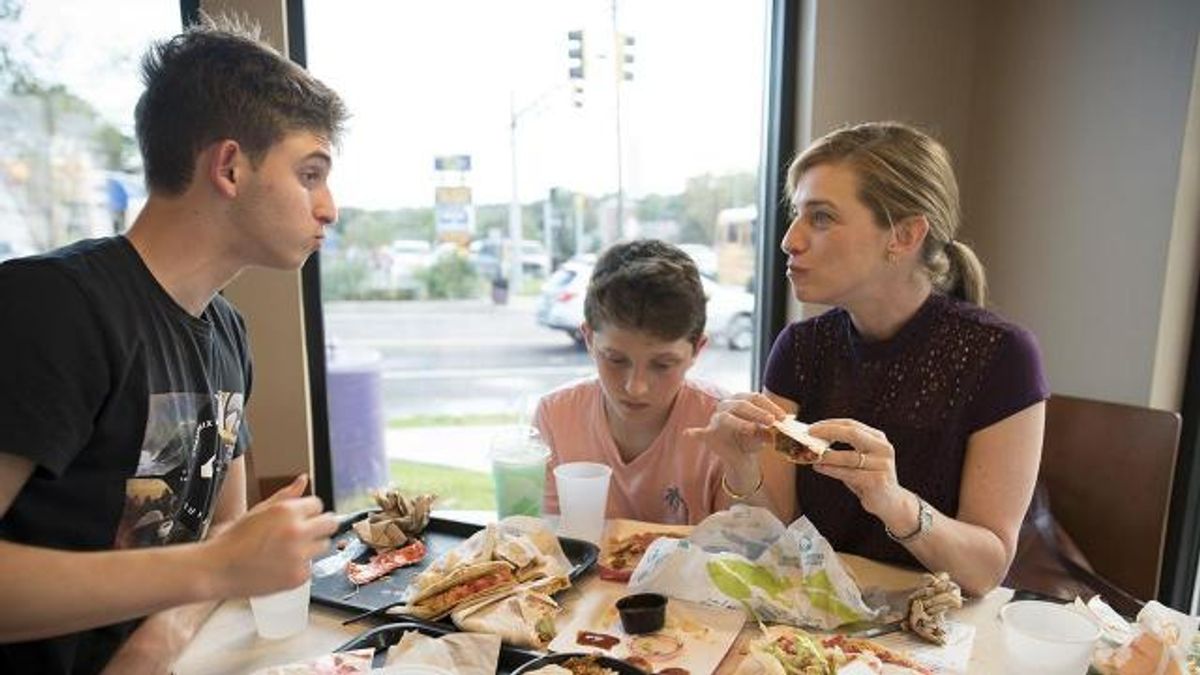
TAKOMA PARK, Md. — When you walk into a Taco Bell with Pati Jinich, the brainy and buoyant Mexican cooking authority, shame walks in with you. It feels like buying a pack of cigarettes in front of a friend who thought you had quit, or getting caught watching cat videos.
Jinich, who was born and grew up in Mexico City, has never made a drunken, late-night run for the border or explored the odd pleasures inside a Crunchwrap Supreme, the most successful product the 56-year-old company has ever spawned.
Other WRAL Top Stories
“It just never occurred to me to enter a Taco Bell,” she said. “That’s just how Mexicans think. It has zero appeal. Why would I do that?”
Yet here she was, prodded on by her social-media fans to eat there after a Harris Poll survey in September named Taco Bell the most popular Mexican restaurant brand in America.
Many of them wanted her to support their view that the fast-food chain represents the worst of America’s exploitative, consumptive culture and is as far from real Mexican food as a Trump Tower taco salad. Others professed a nostalgic fondness for the place, and sent precise instructions on what to order. Immigrants told her they were once so poor that all they could afford was a couple of Taco Bell tacos that reminded them, at least a little bit, of home.
So Jinich, a former public-policy analyst who came late to food media stardom, decided this was a perfect opportunity for a little taco diplomacy. After all, Taco Bell serves more than 2 billion customers each year at 7,000 locations.
“Maybe if they eat Taco Bell all the time, they’ll want to eat a real taco,” she said as we prepared for our field trip. “To me, it’s an entryway. Maybe I need to say, ‘Thank you, Taco Bell, for letting people know about tacos.'”
Jinich (HEEN-itch), 46, lives in a large, lovely home decorated with Mexican art and surrounded by hydrangeas in a historic part of Chevy Chase, Maryland.
Viewers of her PBS show, “Pati’s Mexican Table,” which won her the James Beard Foundation broadcast award for outstanding personality or host this year and has a combined audience of 65.5 million in the United States and abroad, would recognize it in a minute. When she’s not filming in Mexico, she’s shooting in her kitchen.
Jinich shares the house with her husband, Daniel Jinich, 53, who manages a venture capital fund. They met on a blind date in Mexico City. Like hers, his background is both Mexican and Jewish.
They moved to Dallas 20 years ago for his career. She wasn’t a cook then, but she started because she was a wife and a young mother and homesick. “We have a very Latin marriage,” she said. “The woman does the school and the health and the house.”
The couple’s three sons are frequent characters on her program and in her two cookbooks. The eldest, Alan, 19, recently headed off to college, a life change that was codified in an episode in which she showed him how to pick out avocados and cook twice-baked potatoes with Oaxacan cheese and chipotle crema.
Jinich, usually so contagiously upbeat it can be exhausting, could barely contain her sadness in front of the camera. “It’s a terrible thing, but I am happy for him, of course,” she said during the drive to Taco Bell. “In Mexico, you stay at home until you’re married or can afford your own place.”
In the back seat of her white Volvo were her other two boys: Samuel, 16, whose nickname is Sami, and Julian, a 12-year-old everyone calls Juju. They had never eaten at Taco Bell, either.
Juju, who seems to possess his mother’s charisma and makes frequent cameos on her show, was not looking forward to it.
“I have the best Mexican food at home,” he explained, “so I don’t need to go to Taco Bell.”
Food is Jinich’s third career, if you include motherhood. years ago, she was trying to put her master’s degree in Latin American studies from Georgetown University to use writing policy papers for Inter-American Dialogue, a think tank focused on Latin America and the Caribbean.
She dreaded going to work, except for the part where she got to think about lunch. One day, she was asked to compare the transitions to democracy in Peru and Mexico, but instead went deep researching the differences between Peruvian and Mexican ceviche.
That’s when she knew. “Instead of writing about strengthening democratic institutions in Mexico,” she recalled thinking, “how about I write about the food of Mexico?” She enrolled in night school at L’Academie de Cuisine in Maryland, which is now closed.
Cooking didn’t come naturally to her, although her three older sisters are in the business and her father, Moises Drijanski, is a larger-than-life kind of guy who ran two restaurants in Mexico City. He would sneak jam and caviar home in his suitcase and once fed the family so much fettuccine at Alfredo’s in Rome that the chef came out to see who was eating it all.
Many in the family were surprised that the youngest child — the studious, serious one — would become a food star. But not her dad.
“She knows what to say, when to say it and how to say it to the right people,” he said one morning over beef guisados and refried beans with scrambled eggs at Fonda Margarita, his favorite place for breakfast in Mexico City. Jinich’s parents are divorced, and she travels to Mexico regularly to visit them and to research new topics for her show. Her father teased her about how much money she must be making. She rolled her eyes.
“That’s very Jewish,” he said. “But so is giving food. How can I show you love? I will give you food.”
Both sets of her grandparents immigrated to Mexico from Eastern Europe to escape the pogroms. Some landed in Mexico City. A great-aunt who survived Auschwitz settled in Acapulco and opened an Austrian-style bakery.
Jinich grew up with dishes that were Jewish-Mexican amalgams — fresh tortillas wrapped around gribenes with a schmear of guacamole, babka sweetened with Mexican canela, and on Friday nights, gefilte fish a la Veracruzana, with a sauce of tomatoes and olives.
She is often asked to speak about Jewish-Mexican food, but she downplays that angle. “I love being Jewish, but I’m not kosher and I’m not religious,” she said. Instead, she doubled down on the Mexican part of her heritage.
In 2007, through a bit of luck, perseverance and a good connection, she persuaded the director of the Mexican Cultural Institute of Washington, D.C., to start a culinary program. “I thought I was finally going to help people understand Mexicans,” she said. The initial classes cost $35. They were hard to fill, and Jinich had to battle crippling stage fright. But they took off, and so did her skills as a public speaker.
Now, she estimates that more than a third of her work is at live events or on other people’s radio or television shows. She is so busy she can teach only four classes a year. Tickets cost $115, and they sell out fast.
Her break into TV came when Gordon Elliott, the producer who birthed the Paula Deen empire and later “The Chew” (where Jinich was a frequent guest), attended one of her classes. He booked her on Deen's show and shopped a pilot to the Food Network, which wanted to sign her up but also to soften her accent and have her do something more pan-Latin than Mexican.
Both were nonstarters for her. “I’m not going to pretend I’m the owner of Latin America and cook food I don’t know anything about,” she said.
So Jinich turned her attention to PBS, where her show premiered in 2011. She feels that public television allows a more cerebral approach: She can explore the history of vanilla, or explain how nuns in colonial Mexico introduced flan and arroz con leche.
The only downside is securing sponsors. She finds it grueling, even though she manages to raise $1.2 million each season. She didn’t have that kind of money when she started, and her first producers had little experience making cooking shows. Even though the company owners were Latino, they dressed her the way they thought Americans might want to see a Mexican woman cook, with big hoop earrings, lots of makeup and colorful clothes.
A few years ago, she switched to a production company that “isn’t all jalapeños and painted plates and a donkey in your living room.”
Jinich has written two cookbooks, “Pati’s Mexican Table” and “Mexican Today,” both published by food editor Rux Martin, who has her own imprint at Houghton Mifflin Harcourt. Martin said she found Jinich’s initial proposal unremarkable, but her show mesmerizing.
“Her ability to go between what her kids love, that wonky dimension of history, etymology and what food says about the Mexican outlook on life is remarkable,” Martin said. “She is just a natural ambassador.”
Now, Jinich says, she wants to expand that role and tackle substantial topics. “Throw me the ball,” she said. “It’s time to move more into politics.”
In the program’s seventh season, which began in September, she travels to the Baja Peninsula and takes on the border wall that was a centerpiece of President Donald Trump’s campaign.
Unlike many of her friends, she saw his election coming. “I kept saying, ‘When Trump wins and when he builds that wall, I am going to have the most incredible taco stand, and he is going to want to eat those tacos,'” she said. “I was just joking, and now people say, ‘What about your taco stand?'”
Mexican food, she said, is more popular than ever — a bridge between her two countries that people on both sides of the political divide can unite over.
“I have so many followers and fans that I look at their profile, and they’re MAGA,” she said. “Mexican food is that soft power.”
She feels pressure from purists to assert that pre-colonial, indigenous dishes are the only real Mexican food.
“Other people tell me if it’s north of the border, it’s not Mexican,” she said. “I think both are totally false. Immigration makes the culture more vibrant and more alive on both sides of the border.”
That, in a roundabout way, brings us back to Taco Bell. Before she stepped inside, Jinich regarded the restaurant in the same way she did Cinco de Mayo, a small, regional Mexican holiday that Americans have blown way out of proportion, to the chagrin of many Mexicans.
“I say: ‘Listen, why slow down the fiesta? It’s an opportunity to showcase all the richness and diversity and wealth of Mexico,'” she said. “So what if everyone is wearing the sombrero and eating a yellow cheese quesadilla and drinking trashy margaritas? Don’t say, ‘Don’t do that.’ Say, ‘Hey, you are celebrating something about Mexico! How about trying this burritas de chilorio or some really good mezcal?” She has a brother-in-arms in Gustavo Arellano, the author of “Taco USA: How Mexican Food Conquered America.”
Jinich, he said, belongs to a generation of Mexican cooks who are true to their culture and proud of Mexico’s food but see the value in showcasing it for Americans. “She’s a smart Mexican woman who doesn’t have to cha-cha-cha her way through a screen to teach people about Mexicans,” he said. “She knows that dismissing restaurants because they are serving food you don’t like isn’t going to do much good.”
He wished her good luck with Taco Bell, though.
She walked in armed with a list of 19 items to try, all suggestions from her fans. Her order filled four trays.
Her first bite: a ground beef taco in a soft flour tortilla. She squinted. She shrugged.
Maybe salsa would help? She tasted each of the four options, squeezed from plastic packets. “The association I have with salsa has nothing to do with this salsa,” she said.
A chicken chalupa was marginally better: “I can see being super-hungry and eating it, but I don’t think you really want to see everything that’s in it.”
In the end, the Dorito Locos Tacos Supreme was her favorite, even though it took her a minute to understand that the “supreme” part simply meant an upgrade of sour cream and chopped tomatoes.
Later that night, Juju had a terrible stomachache, and Jinich’s cheery thoughts about Taco Bell as a gateway to Mexican culture had turned to sadness. “They have a responsibility to do better,” she said. “They have all these resources. They need to step up to the plate.”
And who better to help than Mexicans?
“There are millions of Mexicans in the U.S.,” she said. “They should ask one.”
—
Recipe: Chipotle, Peanut and Sesame Seed Salsa
Yield: About 3 cups
Total time: 10 minutes
1 1/2 cups olive oil
1/2 cup raw unsalted peanuts (or use pecans, hazelnuts or walnuts)
4 garlic cloves, peeled
2 tablespoons sesame seeds
2 ounces dried chipotle chiles (1 1/2 to 2 cups), stemmed and seeded
1 teaspoon kosher salt, or to taste
1 tablespoon brown sugar, or to taste
3 tablespoons distilled white vinegar
1. Heat the oil over medium heat in a 12-inch skillet until it is very hot but not smoking. Add the peanuts and garlic, then cook for about 30 seconds, stirring constantly. The peanuts should just begin to turn color. Be careful to not let them scorch, which can happen quickly.
2. Add the sesame seeds and chiles and continue to stir and fry for a minute or until the chiles are lightly toasted.
3. Remove the pan from the heat and transfer the contents, including all of the oil, to a food processor or blender. Add the salt, sugar and vinegar, and blend until almost smooth. (The salsa should be uniform but have a little texture to it.)
4. Pour into a container and let cool. Refrigerate the salsa if you are not using it the day you make it.
Recipe: Spicy Clam Chorizo Pasta
Yield: 4 large servings
Total time: About 45 minutes
4 to 5 dozen small littleneck clams
4 tablespoons olive oil
1/2 pound chorizo sausage, casings removed and filling chopped
1 cup finely chopped white onion
5 garlic cloves, pressed or finely chopped
2 chiles de arbol, stemmed and chopped (keep the seeds), plus more to taste
1 cup light beer
1/2 teaspoon kosher or sea salt, or to taste
1 (28-ounce) can crushed tomatoes
2 tablespoons tomato paste
1 teaspoon honey
1 pound spaghetti
2 tablespoons chopped cilantro leaves, for garnish
2 tablespoons chopped parsley leaves, for garnish
1. Rinse and scrub the clams under cold water, making sure they are closed and unbroken. Discard any that aren’t closed. Drain well.
2. Heat 2 tablespoons of the olive oil in a large pot or casserole with a lid set over medium-high heat. Once hot, add the chorizo, breaking it into smaller pieces with 2 wooden spatulas or spoons, and fry until it begins to crisp and brown, about 4 minutes. Remove the chorizo with a slotted spoon and place in a bowl.
3. Add the 2 remaining tablespoons of olive oil to the rendered chorizo fat and reduce the heat to medium. Add the onion and cook, stirring often, for a couple of minutes until softened. Add the garlic and chile de arbol and cook for a minute, until the garlic is fragrant and the chile de arbol begins to toast. Pour in the beer, add the salt, and once it comes to a simmer, incorporate the drained clams. Let it come to a simmer again, cover with a lid, and cook for 6 to 7 minutes, shaking the pot occasionally to help distribute the clams, until the shells open.
4. Remove the lid and, using a slotted spoon, transfer the clams into a bowl, including the clam meat that may have fallen from the shells, and discarding those with closed shells. Raise the heat to medium-high and continue to cook the beer-clam liquid for 6 to 7 minutes, so it strongly simmers and a lot of the alcohol evaporates. Add the crushed tomatoes, tomato paste and honey. Stir well, reduce the heat to low, cover and cook for 10 to 12 minutes, stirring once in between.
5. Meanwhile, bring salted water to a boil in a large pot. Add the spaghetti and cook until al dente, about 9 to 10 minutes.
6. Remove about 3 dozen clams from their shells and discard those shells. Remove the lid from the pot with the sauce and incorporate the cooked chorizo, shelled clam meat and the clams still in their shells. Mix well.
7. Strain the spaghetti and add it to the sauce. Toss until it is coated. Transfer to a serving platter or individual bowls. Garnish with the parsley and cilantro, and serve.