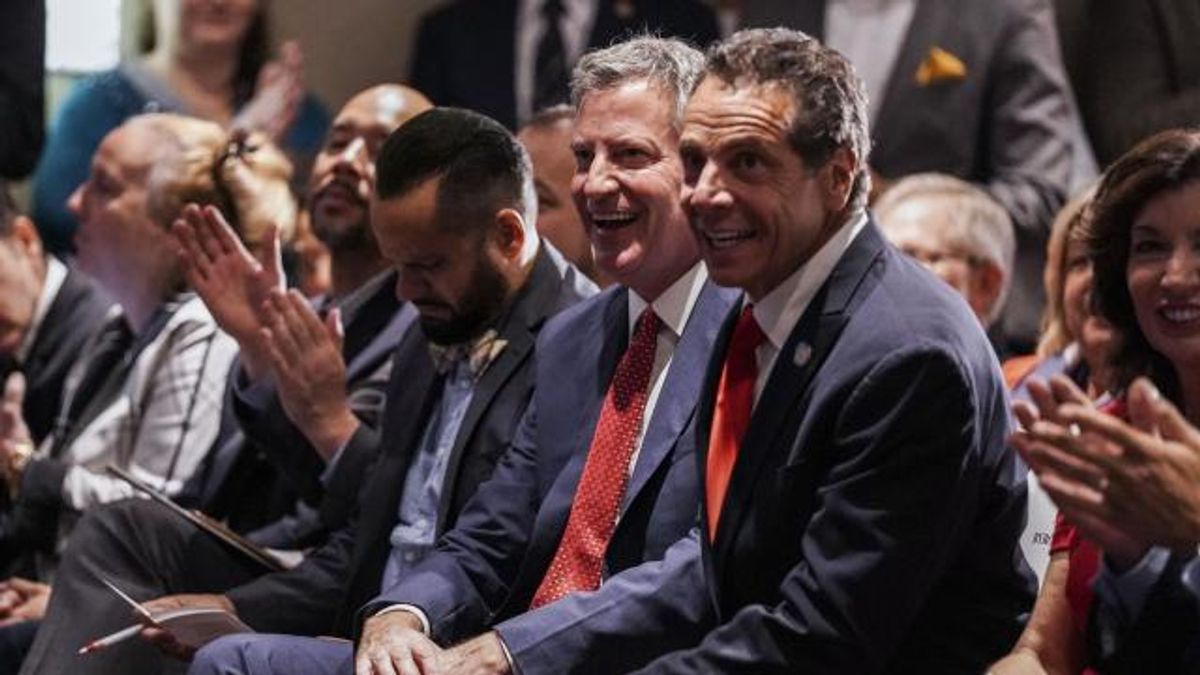
NEW YORK — There are likely few things lower on Mayor Bill de Blasio’s wish list than stumping for Gov. Andrew M. Cuomo.
For years, the men have openly warred with each other over everything from subway funding to naps. They have questioned each other’s judgment and tried to undermine the other’s policies. And before last week’s primary election, de Blasio studiously evaded questions about whom he wanted to see emerge victorious, declining to endorse either Cuomo or Cynthia Nixon.
Other WRAL Top Stories
But by the time the mayor, the governor and a swarm of other Democratic officials gathered Tuesday in a humid conference room in the Times Square Sheraton in Manhattan to promote party unity before the general election, it was not as if de Blasio had many other options. Five days earlier, Cuomo had engineered a commanding primary victory against Nixon, de Blasio’s longtime friend and supporter, and de Blasio had seemingly run out of excuses to stay out of the race.
And so it was that de Blasio ended up with a front-row seat — literally, sitting next to the governor at one point — as Cuomo trumpeted his decisive victory in one of the highest-turnout state primary elections in recent memory.
“Excited” would not have been the best word to describe the mayor’s demeanor as he took the stage after the governor, but “pained” would not be quite right, either.
Pragmatic, perhaps. Decently convincing.
“I’ve known Andrew Cuomo almost a quarter century. And this may surprise you: From time to time, we have disagreements. I know it seems unlikely,” de Blasio said, to laughs from the crowd of elected officials and union members. But, he continued, “you can also understand there’s a greater good.”
Cuomo, too, offered his share of uncharacteristic praise, introducing de Blasio as “the great mayor of the city of New York.”
Of course, that did not mean that the two men were not going to swipe at each other in subtle ways.
Cuomo, as usual, dedicated most of his speech to attacking President Donald Trump, but not before taking a moment to sneer again at the “genius pundits” who had predicted a low turnout, or the “theoretical or abstract” ideas about the definition of progressive government. It was the same tone he had adopted the day after the primary, when he dismissed the so-called progressive wave that Nixon’s allies had predicted would take him down; and it was the same attack he has repeatedly lobbed at de Blasio, an idealist compared to Cuomo and his more centrist pragmatism.
De Blasio, for his part, singled out the ouster of the former members of the state Senate’s Independent Democratic Conference, a group of Democrats who had collaborated with Republicans, declaring that he would not miss them at all. Nixon had accused Cuomo of enabling the IDC; Cuomo did not mention the IDC on Tuesday.
De Blasio’s praise of the governor’s achievements, too, occasionally seemed tepid. While he thanked Cuomo and Lt. Gov. Kathy Hochul for passing paid family leave, he offered a more milquetoast appraisal of passage of a $15 minimum wage: “I appreciate that they got it done.”
And while the mayor sang warm praises for Letitia James, the city’s public advocate and the winner of a four-way primary for attorney general — “I am proud to endorse her,” he said — he never said the word “endorse” for Cuomo. (Eric Phillips, a spokesman for the mayor, later said the joint appearance Tuesday had indeed been an endorsement.)
Then de Blasio turned to the topic of Trump. He recalled that “there were folks in our party who thought about maybe trying to get along with President Trump” after the 2016 election. The mayor did not mention names, but Cuomo had said after the election that Trump’s being from New York could prove a “bonus” for the state.
After a pause, the mayor continued: “I want to give Gov. Cuomo credit. He locked on and he challenged Donald Trump every step of the way.”
Indeed, Cuomo has recently made Trump a favorite rhetorical target, often preferring to speak about him instead of Nixon during the primary campaign. That seemed unlikely to change for the general election: In his speech Tuesday, Cuomo called Trump the “Bernie Madoff” of politics. He never said the name of his Republican opponent, Marcus Molinaro.
There were other shows of party unity. Robert Jackson, a state Senate candidate who had endorsed Nixon, attended the rally, as did the City Council speaker, Corey Johnson, who had supported Nixon’s running mate, Jumaane Williams. James acknowledged her former rivals, noting that the primary had been “bruising,” but said that she would focus on “bridging divides.”
But if there was any illusion that the impetus for the tortured family reunion was anything but pure necessity, Cuomo seemed to quickly dispense with that.
“Do we have differences as a Democratic Party? Of course we do,” he said. “But at the end of the day, we come together like a family comes together in the face of a tragedy.”