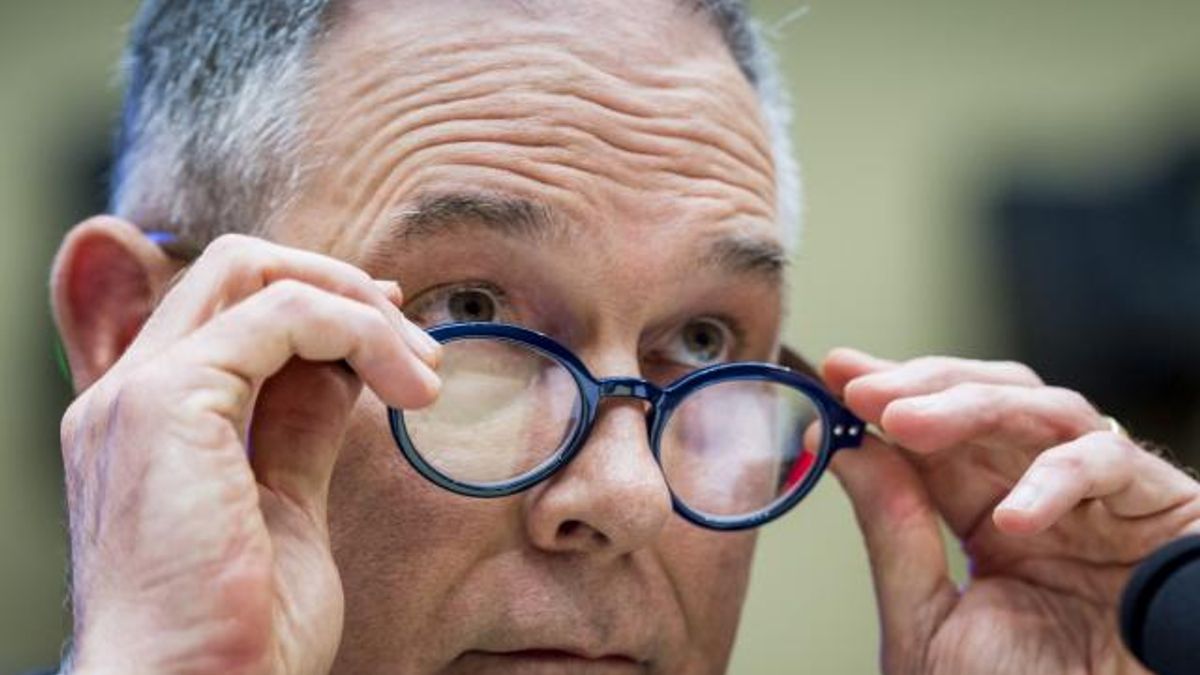
Scott Pruitt, the Environmental Protection Agency chief facing accusations of ethical infractions and lavish spending, vowed on Capitol Hill on Thursday that the charges against him were false and that decisions involving illegal actions had been made by his staff members without his knowledge. His supporters said that he may have succeeded in saving his job, for now.
“I have nothing to hide,” Pruitt said.
Other WRAL Top Stories
Pruitt, whose job security has appeared perilous recently as allegations of ethical improprieties have increased, gave a restrained performance before two House committees Thursday. He provided responses that deflected and defused, while rarely offering direct answers to questions about allegations of excessive spending or conflicts of interest.
While Democrats, who have called for his resignation, sought to force Pruitt to accept culpability for a variety of ethical missteps, Pruitt denied knowledge of or responsibility for the actions in question. Republicans, after briefly chastising Pruitt in their opening remarks, appeared largely sympathetic to the administrator, asking Pruitt friendly questions that appeared calculated to allow him to talk about his policy proposals.
As reports about Pruitt have continued to increase, some White House staff members have urged President Donald Trump to fire the EPA chief. Some Republican leaders have called for his resignation, and many in Pruitt’s own party have called for investigations into his actions. But analysts who watched his performance Thursday said he did well.
Rep. Ken Calvert, R-Calif., chairman of the appropriations subcommittee where Pruitt testified in the afternoon, called the administrator’s appearance “very professional.”
Asked if Pruitt should resign he said, “No.”
Ultimately, of course, the only opinion about Pruitt’s fate that matters is the president’s.
“It’s an audience of one, and Pruitt acquitted himself well,” said Frank V. Maisano, a principal at the law firm Bracewell, which represents energy companies that lobby the EPA. “I think his effort will be well received by the president. He has more explaining to do, but it was a good effort to mend fences. There were no lethal blows.”
Pruitt is now the subject of 10 federal investigations, including questions about his office’s illegal purchase of a secure phone booth, his condominium rental agreement with the wife of an energy lobbyist, and accusations that he demoted or sidelined EPA employees who questioned his actions.
Committee Democrats queried him sharply about the reports of his ethical lapses and pressed Pruitt on his rollbacks of environmental rules, in particular, a new policy, proposed this week, that would limit the EPA’s use of scientific research in crafting new health and environmental rules. Scientists have deplored the proposed rule, saying that it would significantly limit the agency’s use of rigorous science.
“Administrator Pruitt has brought secrecy, conflicts of interest and scandal to the EPA,” said Rep. Frank Pallone Jr., D-N.J., the ranking minority member on the House Energy and Commerce Committee, where Pruitt testified Thursday morning. “You are unfit to hold public office and undeserving of the public trust,” he said. “Every indication we have is you really should resign.”
Greg Walden, R-Ore., chairman of the House Energy committee, offered light criticism before moving on to praising Pruitt for his efforts to roll back environmental regulations. “I am concerned that the good progress being made on the policy front is being undercut by allegations of your management of the agency and use of its resources,” he said. “These issues are too persistent to ignore.”
Conservative lawmakers from fossil-fuel producing states, who have long pushed for the rollback of EPA regulations, bypassed even slight criticism of Pruitt, attributing the scrutiny on his actions to a political witch hunt.
Rep. David B. McKinley, R-W.Va., told Pruitt sympathetically that the attacks on him “have an echo of McCarthyism.” In many ways, the past 14 months of Pruitt’s tenure has been building to this moment.
As Oklahoma’s attorney general, he made a name for himself aggressively battling the agency he now leads. Pruitt’s confirmation was fiercely opposed by Democrats, environmentalists and even EPA employees. Since taking the helm of the agency, Pruitt has worked to strip the EPA of funding, reduce its staff and curb its ability to develop new regulations on fossil fuel pollution.
No EPA director in history has achieved Pruitt’s level of notoriety. Since the agency was formed, its administrators have been second-tier Washington figures. But Pruitt’s antagonism toward climate science has made him a nationally prominent and divisive figure.
Critics said that more than the ethical and spending issues, the real damage to the EPA has been Pruitt’s systematic weakening of the agency’s ability to protect the environment and public health. While Pruitt’s performance in Thursday’s hearings may make or break his future within the Trump administration, many said his legacy was already set.
“It’s just been a flagrant, shameless series of calculated decisions to dismantle the country’s most successful domestic enterprise,” William K. Reilly, who led the EPA under President George H.W. Bush, said of Pruitt’s leadership. “It’s really a national tragedy,” he said.
At Thursday morning’s hearing, Rep. Joe Barton, R-Texas, who has long denied the overwhelming evidence of human effects on climate change, offered sympathy. “Mr. Pruitt, you’re not the first victim of Washington politics,” he said.
Democrats unsuccessfully sought to pin down Pruitt on questions about his expenditures, and to force him to accept culpability for some the actions now under investigation.
Rep. Tony Cárdenas, D-Calif., asked about Pruitt’s soundproof booth, installed in his EPA office at a cost of $43,000. The Government Accountability Office has ruled that the expenditure broke the law.
“I was not aware of the approval of the $43,000,” Pruitt told him, “and if I had known about it, congressman, I would not have approved it.”
Cárdenas responded that “if someone was spending $43,000 in my office, I would know about it.” Rep. Diana DeGette, D-Colo., launched into questions about Pruitt’s involvement in real estate deals in Oklahoma that have been reported in The New York Times, referring to the purchaser of his home as a “shell company.”
“It’s not a shell company,” he said quickly, and added that such financial structures were commonly used to purchase real estate in Oklahoma.
She then asked Pruitt whether he had paid taxes on rent he received. He said the issue had been handed over to an accountant.
“I’m not doing this to hassle you. I’m doing this as an elected official,” DeGette said as she ended her questions. “Everything we do has to be to the highest ethical standards.”
Rep. Paul Tonko, D-N.Y., the ranking minority member on the House Energy’s subcommittee on the Environment, pressed Pruitt on his claims that he was unaware that the EPA had used an obscure legal provision to grant hefty raises to political appointees, bypassing approval by the White House. Pruitt has said the decision was taken by his chief of staff, Ryan Jackson.
“Did you authorize Mr. Jackson to sign those documents for you?” Tonko asked.
“I was not aware of the amount and I was not aware of the bypassing that was going on,” Pruitt replied.
Even some Republicans criticized Pruitt for repeatedly blaming his staff.
“If you say give me a phone booth, and your staff does it, you should say, I’m at fault,” said Rep. John Shimkus, R-Pa., chairman of the House Energy subcommittee, speaking to reporters after the morning hearing. “It’s never good to blame your staff. Or at least do it behind closed doors.” And Rep. Anna G. Eshoo, D-Calif., used her turn at questioning to try to get Pruitt to accept culpability. “You have a solid record of violating ethics rules from the state level to the federal government,” she told Pruitt. “I think it’s an embarrassment.” And then she asked, “Do you have any remorse? Yes or no?”
Pruitt responded: “I think there are changes I’ve made already. I’ve made a change from first class to coach travel.” Eshoo returned to her call for a yes-or-no answer, and asked Pruitt whether he would reimburse the government. He launched into a long response, but she cut him off.
“With all due respect, I may be elected, but I’m not a fool,” she said. “This is not ‘dodge-question’ day.”