It was created in 1936 to measure aptitude for potential Navy pilots. Somewhere between then and now, the Wonderlic Personnel Test became almost synonymous with the NFL Combine. Pin the blame on former Dallas Cowboys coach Tom Landry, as he was the first to incorporate it in the league as a way to test his squad's mental prowess. It's supposedly an accurate gauge of a player's intelligence and problem-solving aptitude under pressure.
Unlike the SAT, most of us will never take the Wonderlic Test in our lifetime, which builds it up in our mind as some sort of mythical, mental challenge. However, since the Internet is a beautiful place filled with wonder around every click, it's not overly difficult to find sample tests. So, despite not having taken any sort of written exam over the course of the last 15 years, I figured, why not? Let's make a story out of it, too!
Other WRAL Top Stories
That was two years ago. No one else in the office really shared my enthusiasm for going back to high school, at the time. This year, I was fortunate enough to find five others willing enough to put their IQ out there.
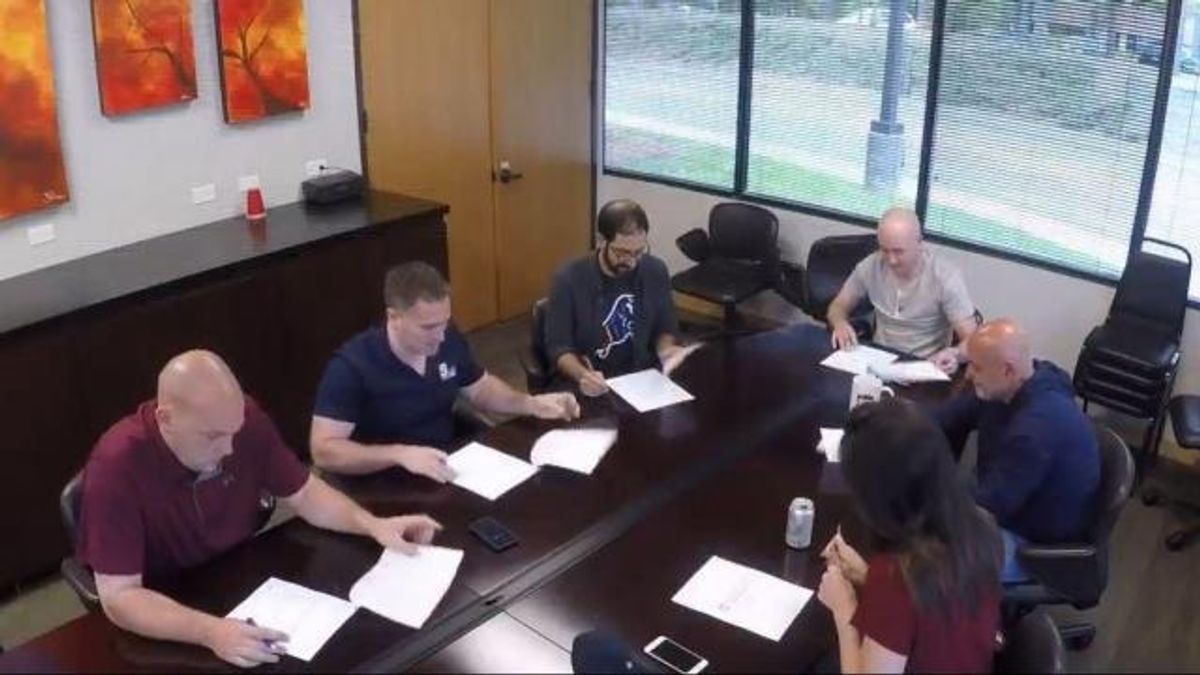
On Monday, I sat down with 99.9 The Fan Co-Hosts Adam Gold and Joe Ovies, their producer Alec Campbell, WRALSportsFan.com's Marilyn Payne, and WRAL-TV photographer Brad Simmons to do it to it. Twelve minutes to hammer through 50 questions, such as:
1. (15 / 5) x (10 / 2) =
- a. 10
- b. 5
- c. 2.5
- d. 15
- e. 13
2 Are the following words similar, contradictory, or not related? Optional Observational
- a. Contradictory
- b. Not Related
- c. Similar
3. Mike is 11 years old. Jim is twice as old as Mike. When Jim is 50 years old, how old will Mike be?
- a. 61
- b. 39
- c. 25
- d. 44
- e. 36
Nothing overly challenging, but time consuming enough to where if one spends a good deal of time on one question, valuable seconds toward solving another are sacrificed. That's the trap I fell victim to at times. I spent close to a minute on one problem that involved adding five numbers with numerous decimal spaces. When graded, I got the proper answer, but when you've got about 14 seconds per question, I put myself in a bad spot.
I didn't manage to get past question 42, because I didn't skip any. Others in the group did at least reach question 50, because they skipped some (mostly the math ones) along the way. I've always been pretty adept at mathematics, to a fault actually. I got a 750 on the math portion of my SAT and wanted a recount almost immediately because I didn't think there was any way I didn't flawless victory that half of the test. My college professors tried to sway me into an Engineering field several times over, but nope, I had my mind made up on entering the money-making world of...journalism.
In a math-heavy sample like we took, that likely gave me somewhat of an advantage, as our grades came out as such:
Marilyn Payne, WRALSportsfan.com, 28 (the equivalent to Russell Wilson and Peyton Manning)
Alec Campbell, 99.9 The Fan, 28 (the equivalent to Russell Wilson and Peyton Manning)
Adam Gold, 99.9 The Fan, 30 (the equivalent to Phil Rivers and Terrell Suggs)
Brad Simmons, WRAL-TV Photographer, 31 (the equivalent to JJ Watt, Russell Bodine, and Kareem Martin)
Joe Ovies, 99.9 The Fan, 32 (the equivalent to Matt Ryan and Jessee Palmer)
Myself, 40 (the equivalent to Alex Smith and Carson Wentz)
All of us finished above the NFL average score of 20. When you break it down by position, some spots on the field shine brighter than others in terms of intelligence. Halfbacks average 16, quarterbacks 24, and the smartest position by test score? Offensive linemen, who average 26.
Players' scores aren't published, but they do leak out, including some of the more notable low ones:
Morris Claiborne – 4
Mario Manningham – 6
Frank Gore – 6
Tavon Austin – 7
Terrelle Pryor – 7
And some of the notable high ones:
Pat McInally – 50
Mike Mamula – 49
Ben Watson – 48
Ryan Fitzpatrick – 48
Matt Birk – 46
McInally, a punter (from Harvard, of course) is the only known player to notch a perfect score. He actually took the exam again a few years later and followed up with a 49. The lost point was blamed on "too many concussions," back when that was something that others would laugh and not cringe at.
As you can judge by some of those results, a high score doesn't exactly translate to NFL success in the same fashion that a low score doesn't correlate to NFL failure. Drew Henson scored nine points higher than his Michigan quarterback counterpart Tom Brady on the Wonderlic. Between the two of them, they have five Super Bowl rings, four Super Bowl MVPs, and 3 regular season MVPs.
All-in-all, while it was a fun experience to see what all the Combine hub-bub was about, I'm reminded of why I didn't feel a gaping hole in my heart from a 15-year test-taking absence. I'm sure my red-ink score of "40" will find a nice spot, front-and-center on my fridge.