Sea Turtles Use Magnetic Fields to Find Their Birthplace Beach
Sea turtles use the Earth’s magnetic fields to navigate back to the area where they were born decades earlier, according to a new study that used loggerhead genetics to investigate their travels.
Other WRAL Top Stories
After swimming for years in a giant loop from nesting grounds in North Carolina and Florida to North Africa, the turtles find their way back to nest on beaches within about 40 to 50 miles of where they were born. The new study suggests that the turtles learned their home beach’s distinctive magnetic signature, through what is called geomagnetic imprinting.
“This is vital information if you want to restore sea turtles to areas where they once lived before being hunted to extinction,” said Kenneth Lohmann, a professor at the University of North Carolina, Chapel Hill, and senior author of the study published recently in Current Biology.
He added that the same concepts may be applicable for restoring salmon and other fish to rivers because many birds and fish also use magnetic fields for navigation.
“That’s really cool and really impressive, and they do it traveling through the seemingly featureless open ocean,” said J. Roger Brothers, the paper’s first author and a sea turtle expert, who is scheduled to receive his Ph.D. from Chapel Hill next month.
The turtles can perceive both the magnetic field’s intensity and its inclination angle, the angle that the field lines make with respect to the Earth’s surface, earlier research has shown.
By using previously reported genetic information from more than 800 nesting Florida loggerheads, Lohmann and Brothers were able to show that there was more genetic similarity among turtles that nest on beaches with similar magnetic signatures than there was among turtles that nest on beaches that were physically close to each other.
“We expect that geographically close locations will be genetically related, and geographically distant locations will have distinct populations. That’s not what we see,” Brothers said. “The variation in Earth’s magnetic field around the nesting area seems to really predict genetic differentiation much better than geographic distance.”
— KAREN WEINTRAUB
Farmland Birds in France in Steep Decline
Birds in farming regions of France are in trouble, and that may indicate problems in similar areas across Europe.
Scientists involved in bird-counting surveys in France have reported precipitous declines in agricultural regions, even among common birds well adapted to human activity — the generalists, like blackbirds, that seem to do well in most circumstances.
This finding follows news of a devastating loss of insects in Germany, a decline of nearly 80 percent over the past 40 years.
The loss of birds has been going on for a long time.
But the most recent results from two surveys — one nationwide in France, the other limited to one region — caused scientists to sound an alarm, because the results suggest that agricultural methods are hurting birds, according to Benoit Fontaine, a conservation biologist at the National Museum of Natural History in Paris and a leader of the national survey, conducted twice a year by volunteers.
“In the agricultural land,” he said, “there is something really bad going on.”
Over the past 17 years, the numbers of birds in farming areas have dropped by a third. Some of the species have declined even more: Meadow pipit populations, for example, fell by 68 percent. Fontaine described the situation as “catastrophic.”
He suspects that pesticides used in agriculture and intensification of land use are linked to the decline, although neither survey comes to conclusions about causes or makes any policy recommendations. But he pointed to the loss of insects, the major food source for many birds, as a likely result of pesticide use.
Vincent Bretagnolle, an ecologist at the Centre for Biological Studies Chizé, led the other survey, which has been conducted by scientists in the Deux-Sevres region in the western part of the country for 24 years.
The trend is long-term, he said, except that recently, particularly at the national level, the dip has been steeper, and the more generalist bird species have been affected as they were not in the past.
Bretagnolle also suspected pesticides and more intensive use of land by farmers as a culprit, and said farmers in the area he surveys are trying different methods aimed at saving some species.
— JAMES GORMAN
Clown Fish Need More Energy to Live in a Bleached Home
If you’ve seen “Finding Nemo,” you’re familiar with the special relationship between clown fish and anemones, the stinging spaghetti rugs of the reef that Nemo calls home.
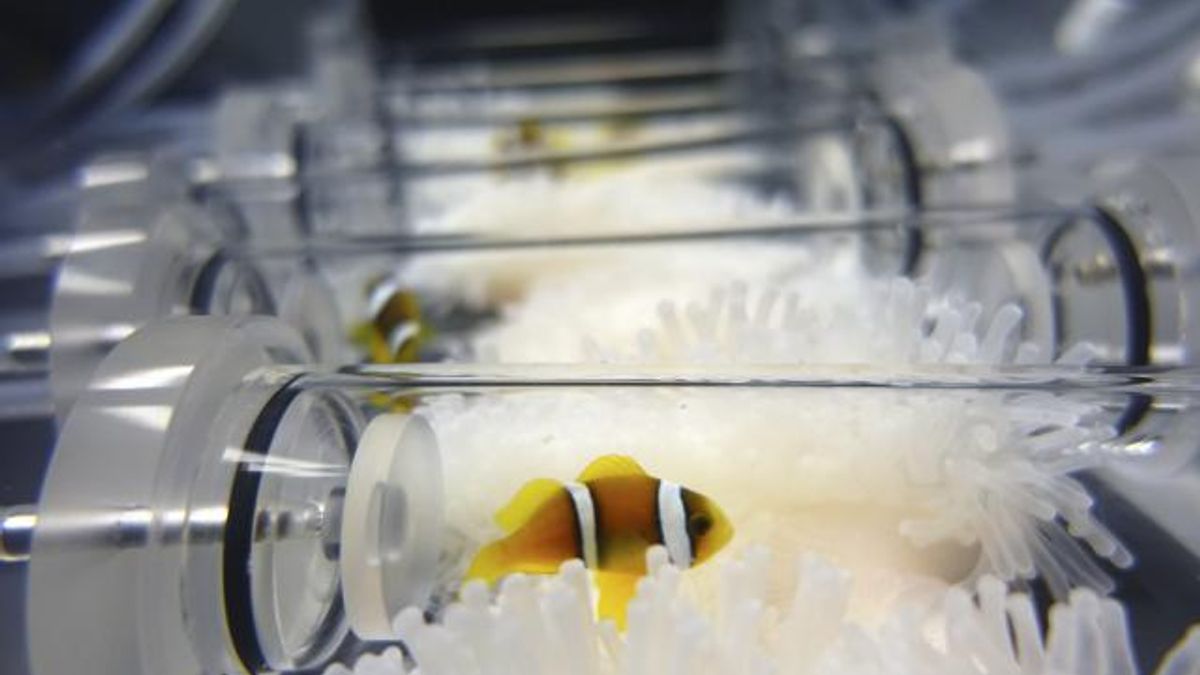
Normally, algae inside the anemone convert sunlight into energy to feed the anemone, which provides protection for the fish and its eggs. That’s why the clown fish chooses to live in the anemone.
But when warming temperatures or another environmental disturbance cause coral and anemones to bleach, the situation changes. Algae die. Anemones shrink. And clown fish, most of which remain in their bleached home, don’t reproduce like they used to.
Although a bleached anemone is deprived of algae, it’s still alive and may one day recover, said Tommy Norin, an ecological physiologist at the University of Glasgow in Scotland. There’s no reason the fish, which doesn’t even eat the algae, should be suffering. But it does.
To try to get a handle on this mystery, Norin and a team of collaborators looked at physiological indicators of stress in clown fish living around bleached anemones. Their work, published recently in Proceedings of the Royal Society B, suggests the higher cost of living in a stressful environment may partly explain these clown fish struggles.
Researchers collected 16 fish from a healthy coral reef near French Polynesia in the Pacific Ocean and took them back to the lab. They put half in tanks with healthy anemones, and half in tanks with anemones that had been bleached with hot water. The anemones were still living and had not yet shrunk, but their algal companions were gone.
After two weeks, the researchers moved the clown fish into tanks pumping out oxygen every few minutes and measured how much oxygen the fish consumed during their most sedentary times.
This gave them an idea of the fish’s basal metabolic rate — that is, how much energy the animals needed to sit around and do nothing.
The researchers found that the clown fish living with the bleached anemones had a higher basal metabolic rate than the fish living around healthy anemones. That is, the fish needed more energy to just stay alive around bleached anemones.
— JOANNA KLEIN
The Evolution of the Eyebrow
Eyebrows have become an obsession of late, tattooed or microbladed, shaped and drawn in bold dark lines, making a statement far beyond braiding or waxing.
Lifting one and not the other often signals disbelief, amusement, curiosity. Raising both can suggest surprise or dismay. But it wasn’t always that way.
Early humans had thick, bony brow ridges that were far less nimble than ours, incapable of expressing much of anything beyond, “Don’t mess with me, Thag.”
Scientists have long thought those brows served some structural purpose, like support for chewing prehistoric food. That they could also be used to signal aggression or intimidate competitors was largely dismissed as an evolutionary perk, as were the more flamboyant brows of modern humans.
But when Ricardo Miguel Godinho, an evolutionary anthropologist at the University of York, made digital recreations of a skull believed to be 300,000 to 125,000 years old, he found no evidence that its brow ridges provided any of the practical benefits suggested by earlier studies. “He tested out the different possible explanations, and, effectively, there’s no reason for it,” said Penny Spikins, an anthropologist who conducted the study with Godinho.
The findings, published April 9 in Nature Ecology & Evolution, suggest that the human brow has always been a primarily social tool, and that the smoother foreheads and expressive brows of modern humans may have evolved to accommodate our increasingly complex relationships.
“With a flatter, more vertical forehead, that whole area above the eyes becomes much more mobile, and the muscles can make some really subtle communicative gestures,” Spikins said. And those gestures, like lifting your eyebrows to show you recognize someone, she said, “tend to be more about expressing friendliness than intimidation.”
Though such a hypothesis is difficult to test without a time machine, Spikins said it emerged from the real-life observations of Paul O’Higgins, a co-author of the study. “Paul was frustrated that his daughters spent so much time in the bathroom mirror perfecting their eyebrows, and was saying, ‘What are eyebrows for?'” she recalled. “That’s when we thought maybe this is actually quite important.”
— DOUGLAS QUENQUA
Fossil Finger Bone Pushes Back Date of African Exodus
Archaeologists have announced the discovery of a fossilized human finger bone in the desert of Saudi Arabia that they said was 85,000 years old.
If confirmed, the finding would be the first and earliest Homo sapiens fossil found on the Arabian Peninsula, as well as the oldest specimen of our species to be directly dated outside Africa and its doorstep, the Levant.
Along with recent finds of 80,000-year-old human teeth from Asia and 65,000-year-old human relics from Australia, the Arabian finger bone provides further evidence that early modern humans spread out of Africa much earlier and farther than previously thought.
“It’s a discovery that we’ve been expecting for a while,” said Robyn Inglis, an archaeologist at the University of York in England who was not involved in the research. “It’s become increasingly clear that humans dispersed far out of Africa and the Levant before 60,000 years ago, a date suggested by genetics.”
Traditionally, the migration of Homo sapiens out of Africa was portrayed as a single exodus from the continent that highlights one stop to the next. But archaeologists and paleoanthropologists have challenged that idea, saying the journey was much more complicated and probably filled with numerous routes, departures and delays.
“This discovery of a fossil finger bone for me is like a dream come true because it supports arguments that our teams have been making for more than 10 years,” said Michael Petraglia, an archaeologist from the Max Planck Institute for the Science of Human History in Germany and an author on the paper, which was published in Nature Ecology & Evolution.
“This find, together with other finds in the last few years, suggest that modern humans, Homo sapiens, are moving out of Africa multiple times during many windows of opportunity during the last 100,000 years or so,” he said.
At the time when this ancient person lived, the Arabian Peninsula was almost alien from what it is today. Instead of being bone dry with endless red sand, it was a lush grassland awash in lakes and rivers and teeming with wildlife like ostriches, gazelles and hippos.
“Our study shows that the early spread of our species was aided by climate change and that humans spread into very diverse types of habitats as they moved beyond Africa,” Huw Groucutt, an archaeologist from the University of Oxford and lead author on the paper, said.
— NICHOLAS ST. FLEUR