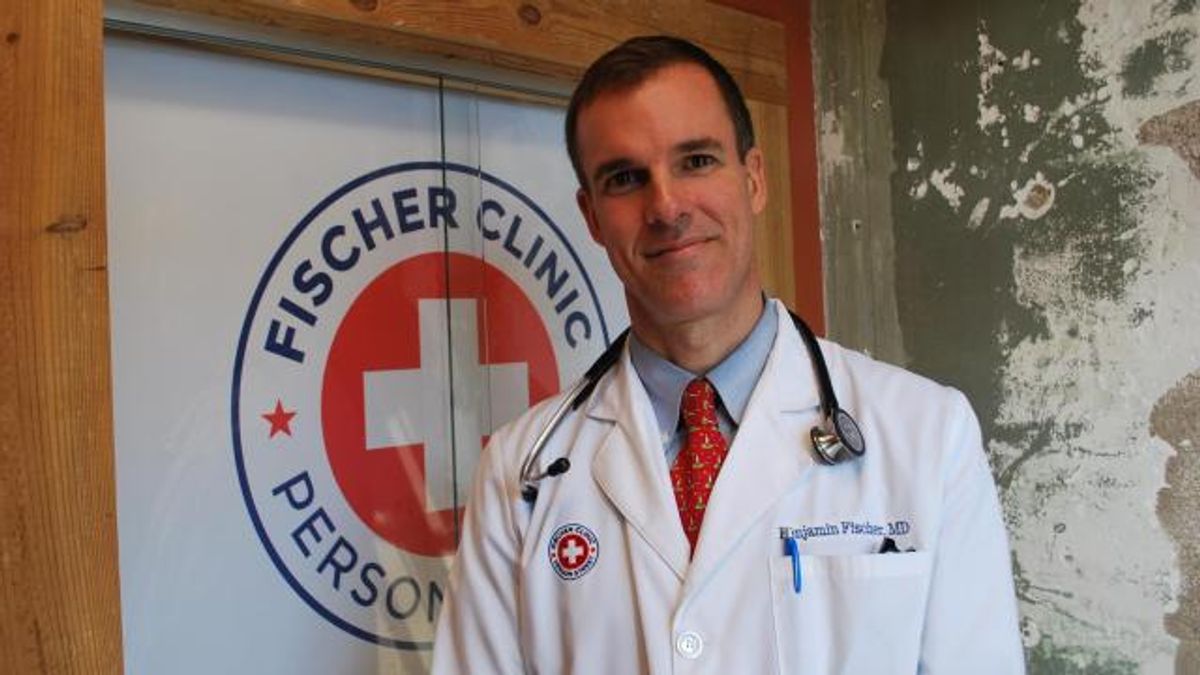
As the wife of a hospitalist, I know that the practice of medicine has changed a lot in the 25 years since my husband began. I know patients are often older, have much more complicated needs and long medical histories to digest. I know that in traditional primary care practices the number of patients treated per shift has gone up, while the time spent with each patient has gone down. “There’s little time to practice the art of medicine,” my husband has said repeatedly. But in the last six months, I have heard from multiple clients about a direct primary care practice where there is time for that: The Fischer Clinic. I recently reached out to Dr. Ben Fischer to ask how that was possible.
- What is a direct primary care practice?
In most traditional practices, the patient pays the physician indirectly through his or her insurance. In a direct primary care practice, the patient pays the physician directly. The significance of this is that the direct primary care physician serves the health interests of the patient rather than the insurer, has lower overhead due to not having to file insurance claims, and can spend more time with their patients. This is different from a concierge practice, which bills insurers on top of its annual fee and therefore still bears the heavy, expensive and distracting administrative burdens associated with insurance regulatory requirements. - What does it cost?
At The Fischer Clinic, our fees are $50/month (up to age 45), $60 (ages 45-60), and $70 for patients over 60. Dependent children are $30/month. This fee covers whatever care is needed: Hospital visits, phone calls, emails, office visits. - What is your background?
Prior to 2016, I was a partner at Raleigh Medical Group. I had been with that group since 2007. We were a traditional practice, working under contracts with insurers. While I enjoyed my partners and the practice, I couldn’t take care of my patients as I felt called to. - What’s different in terms of a typical visit?
Previously, I had 30-45 minute physicals and 15 minute sick visits. I now spend an hour on a physical and 30 minutes on a sick visit. More importantly, because I’m not charting to fulfill insurance billing criteria during the visit, I’ve much more than doubled the amount of time I can pay attention to my patients. - What about the level of care?
A good doctor who knows you really well will generally take better care of you than a brilliant doctor who has never met you before. Any doctor can tell you that knowing the patient, including their medical history, their personality, their temperament, their social situation, etc. is really important in making diagnoses and effective treatment plans. We know our patients well. The older we get, generally the more we go through, so that continuity becomes ever more important as we age. - How long does it take to be seen?
We are available for same day or next day urgent visits. We are able to see our patients for non-urgent, scheduled visits within a week or two. After hours, my patients have my phone number. We can make house calls, if needed. - Can you write prescriptions?
Yes. - What happens if I go into the hospital?
I visit my patients in the hospital. My partner, Zane Lapinskes, and I have privileges to admit our own patients to WakeMed. - What about referrals?
We maintain good relationships with specialists in town and refer just like any other primary care physician. If the patient has insurance, they can use their insurance in the visit with the specialist. - Can you share a story that reveals something more about your practice?
I have an older, chronically very ill patient with a complicated personal life history. I would always enjoy seeing her at my prior practice, but she would always make me terribly behind when she came. On one of our first visits in my new practice, I was reviewing her medical history to be sure I had it accurately recorded in my new charts. As I inquired about her children, I recalled that her son had died at age 6. I apologized for asking and was planning to move along, but she wanted to linger on the topic. She pointed at a picture of my youngest child, then age 6, and said “imagine kissing that little child goodbye in the morning and never seeing her again.” It really put me in her shoes. We both cried over her loss. She returned for an appointment the following week and pulled out a black and white picture of her son, which I still have, and said she wanted to tell me about him. In my previous practice, my mind would have been racing on two tracks – how am I going to "code" this visit into some sort of billable unit, and how am I going to not fall terribly behind? In my new practice, I was able to relax. It was clearly important to her that I know these things and the story gave me tremendous insight into her life. It also built a much stronger relationship. Because of this, at a recent hospitalization, it was natural and comfortable to discuss end of life issues. - Anything else?
We live in a world that on the surface seems to be connected, given our advanced digital communications. However, these technologies might be contributing to how disconnected we feel. This model of practice allows for and fosters real connection.
Other WRAL Top Stories