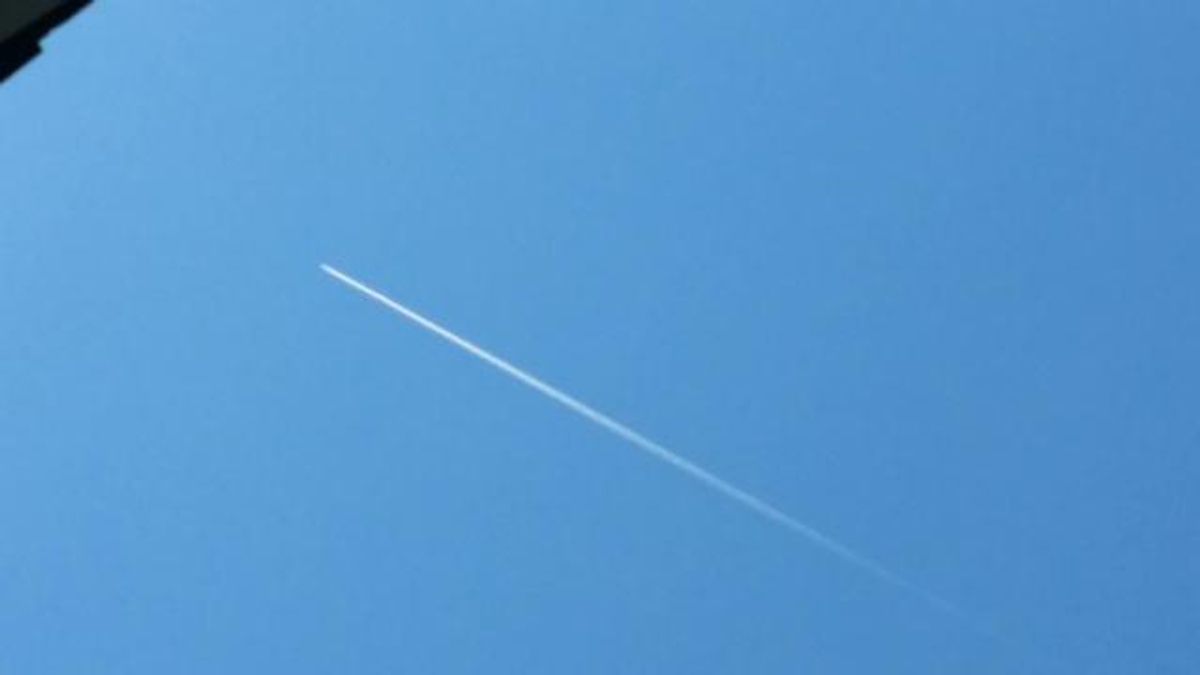
NASA launched an Antares rocket Sunday from the Wallops Flight Facility on Wallops Island, Virginia, and the flight path was briefly visible to residents of eastern North Carolina under clear blue skies.
The rocket propelled a Cygnus spacecraft acked with 3,668 pounds of supplies for the six astronauts aboard the International Space Station (ISS). That cargo includes:
Other WRAL Top Stories
- 1684 pounds of crew supplies including food
- 783 pounds of hardware for the crew’s health care, and ongoing
- Maintenance of the station’s structure, electrical and thermal control systems.
- 18 pounds of computing, photo and television equipment
- 87 pounds of equipment to support spacewalks
- 721 pounds of science and research equipment
Among that payload are science experiments created by students, including some from North Carolina.
An experiment created by an 11-member team from Mendenhall Middle School in Greensboro will investigate how calcium sulfate crystals grown in space differ from those grown on Earth.
Their investigation builds upon previous findings that jellyfish born in space lack the ability to sense direction after returning to Earth. "We wondered if the same thing would happen to humans born in space," according to the team’s proposal. This is Guilford County Schools’ fourth Student Spaceflight Experiments Program flight.
The launch was visible up and down the East Coast including as far west as Raleigh, where the rocket was low on the horizon. Those closer to the coast got a better view of the rocket higher in the sky. At Kitty Hawk the rocket reached about 20º above the horizon.
The rocket’s path matches that of the International Space Station traveling from the northwest to the southeast. Initially, the Cygnus spacecraft will travel in the same plane as the ISS but in a lower orbit. The spacecraft will spend about three days raising that orbit to catch up with the ISS bringing it within about 2.5 miles of the station. Cygnus will slowly approach to within 40 feet of the station where astronauts grapple it with the robotic arm and berth it to the Harmony node of the station.
The ISS will next be visible in our skies:
- Tuesday 5:22 a.m. from the southwest lasting 6 minutes
- On Wednesday, the ISS will exit the Earth’s shadow at 4:34 a.m. in the south and travel to the southeast over 4 minutes
- The next evening appearance of the ISS will during the first few days of August.
Tony Rice is a volunteer in the NASA/JPL Solar System Ambassador program and software engineer at Cisco Systems. You can follow him on twitter @rtphokie.