If you are sick of all the wintry weather, you're in luck: Government forecasters expect warmer-than-normal temperatures for our part of the United States.
The National Oceanic and Atmospheric Administration (NOAA) released its outlook Thursday for the spring 2014 season, predicting warmer-than-normal temperatures for the southeastern US, as well as parts of the Pacific coast, the desert Southwest, southern Plains and all of Alaska. NOAA expert John Gottschalck conceded, however, that the short-term outlook through the rest of March into early April still points to cooler-than-normal temperatures and wetter-than-normal precipitation across much of the eastern and northeastern United States.
Other WRAL Top Stories
For the whole of the spring, precipitation will be just about normal; however, NOAA does not expect drought conditions to develop east of the Mississippi during the next three months.
Drought conditions are expected to intensify across portions of the West, including California. Drought conditions may expand eastward into portions of Arizona, New Mexicoand western Texas and Oklahoma, as well. These dry conditions may lead to an early onset of the wildfire season in the southwest. Meanwhile, drought conditions are expected to improve in the Pacific Northwest and parts of the central Plains.
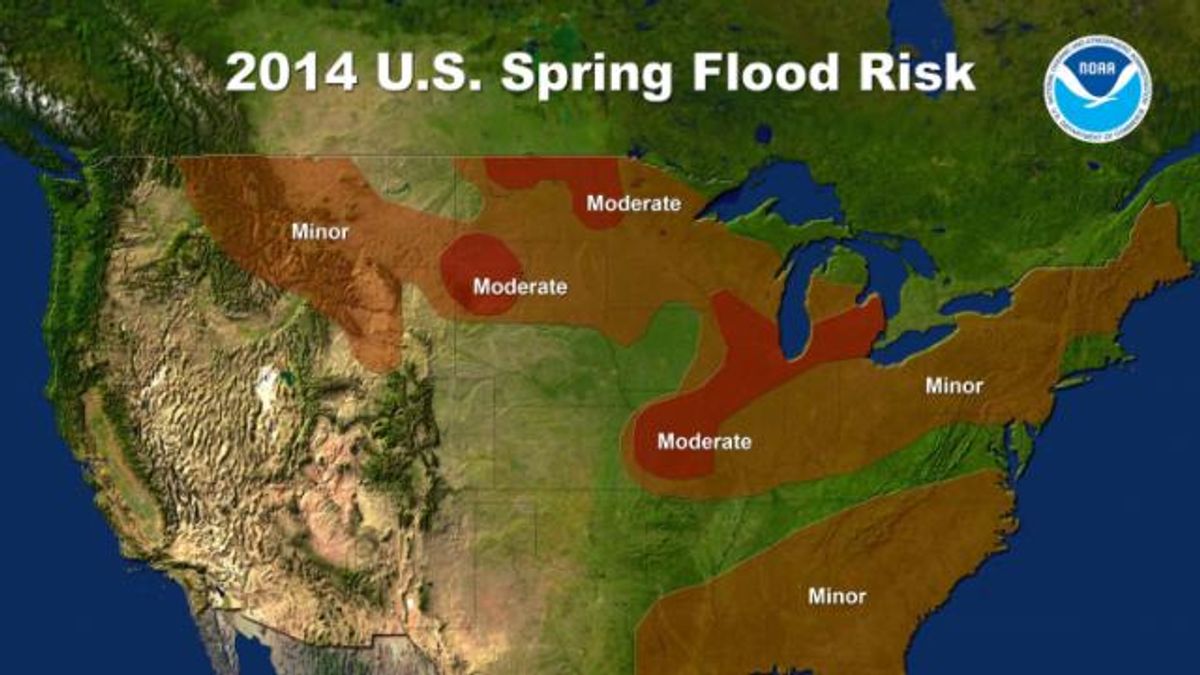
The colder-than-normal winter for parts of the country has resulted in more river and lake ice than normal, with some 92.2 percent of the Great Lakes covered in ice as of early March. The river ice has also resulted in more ice jams than in a typical winter, leading to mostly minor river flooding across the Mississippi and Missouri river basins.
Higher-than-normal snowpack and deep frost depths are expected to contribute to additional minor-to-moderate river flooding in these areas through the spring thawing season.
"This year's spring flood potential is widespread and includes rivers in highly populated areas putting millions of Americans at risk," said Louis Uccellini, Ph.D., director of NOAA's National Weather Service. "Although widespread major river flooding is not expected, an abrupt warming or heavy rainfall event could lead to isolated major flooding."