Log in to WRAL.com with one click using your favorite social network:
OR
Log in using your WRAL.com account:


Wrong email/password combination.

Forgot password?

Register with WRAL.com using your favorite social network:
OR
Register for a WRAL.com account using our web form.

Login Options

3:45 p.m. • 2-12-12

Weather Forecast for Raleigh

  • Mon: Partly Cloudy.
    • Hi: 50° F
  • Tue: Rain.
    • Hi: 53° F
  • Wed: Partly Cloudy.
    • Hi: 57° F

Other Locations

> 7 Day Forecast

Doppler Image

Marketplace Links

Social Links

Main Menu

N.C. State Seeks New Ways to Water Athletic Fields


e-mail print friendly
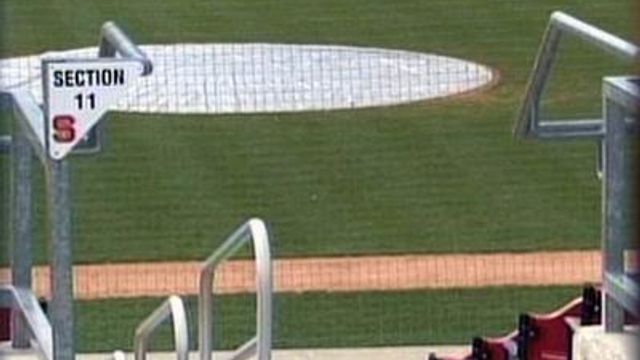
N.C. State Baseball Field

North Carolina State University's athletics department is facing a tougher opponent than anything it has faced in the ACC – the drought.

To deal with that, the Wolfpack is considering digging six wells to provide water for fields ranging from Carter-Finley Stadium to the new softball facility that opens Wednesday.

Ray Brincefield, N.C. State's assistant athletics director for facilities, said the school has not been using city water from its irrigation system since the city went to Stage 2 restrictions on Oct. 18.

Instead, the school trucks in water from Lake Raleigh on the Centennial Campus to water 33 acres of athletics fields.

That’s time-consuming and expensive, however – and it could drain the lake.

So, Brincefield and school officials are now looking at sinking six wells instead.

“Do we tanker truck (water in) all year? … That’s going to be a headache,” Brincefield said. “Or do we start looking into wells?”

The school would want the wells in place by May 1, which is the start of the growing season for Bermuda grass.

Brincefield wants to make sure the grass continues to flourish.

“More than anything, it’s a safety thing when you put high-profile athletes in danger,” he said. “Secondly, it’s protecting the investment [in the grass]. "

“We’re probably leaning toward well water," he added. "And also from a budgetary standpoint, as we are all smart enough to realize, when we get out of these restrictions, the price of water from the city is going to increase.”

RELATED TOPICS: Raleigh, NC State University

e-mail print friendly

29 Comments


WRAL.com welcomes your comments on this story. All comments are moderated prior to publication based on our posting guidelines. Please review them prior to posting and if your message is not approved.

View Comments VIEW ALL 29 COMMENTS

This story is closed for comments. Comments on WRAL.com news stories are accepted and moderated between the hours of 8 a.m. and 8 p.m. Monday through Friday.

Latest Comments
The RBC center was built for entertainment purposes and the NHL team.. NCSU rents time from the RBC center. It wasn't built for NCSU.

Also the athletics dept funds themselves at NCSU, they do not use tax payer dollars. Dont believe me? Call them and ask.

well let's see, the RBC center was built primarly for NC State, and we the tax payers of wake county helped pay for it along with a resturant tax, for the very same reason......so yes we the tax payers do and have paid for things at NC state.

FUN: I believe the money that they are spending in the Athletics dept. comes from revenue from the games, and sponsors... not taxpayer money.

It's dangerous for athletes to play on dead, uneven grass. Football games alone bring in tons of money to the university. If the field is not up to par and the athletes can't play on it, the university would loose hundreds of thousands of dollars. The wells are a good idea. Don't be so naieve to think they just want the grass green.

If the wells don't affect ground water, and ground water is the problem right now because of the drought, why don't we start drilling more wells throughout Wake County? If people wanted to spend the money, they could put a well in so they didn't have to be on the city's water system, or at the very least drastically reduce their use of city water.

But they're also talking about changing legislation so well owners have to abide by the same restrictions as everyone on city water systems.

So, which is it? Either wells have an impact on the drought or they don't. Any experts here care to explain the discrepancy?

Oh my, we aren't doing a very good job of educating people about groundwater. Very sad. 1) There are no underground rivers or streams here. 2) The water these wells would likely be extracting would be hundreds or even thousands of years old. 3) These wells would have a negligible effect on surface water supplies. 4) Property owners are entitled to use the groundwater resource under their land. The groundwater system in the piedmont and mountains has a natural buffer (saprolite storage) that helps mitigate the effects of drought. Managed properly, the groundwater resource is adequate to sustain our water needs well into the future.

View Comments VIEW ALL 29 COMMENTS
Report It

Multimedia

Click Here