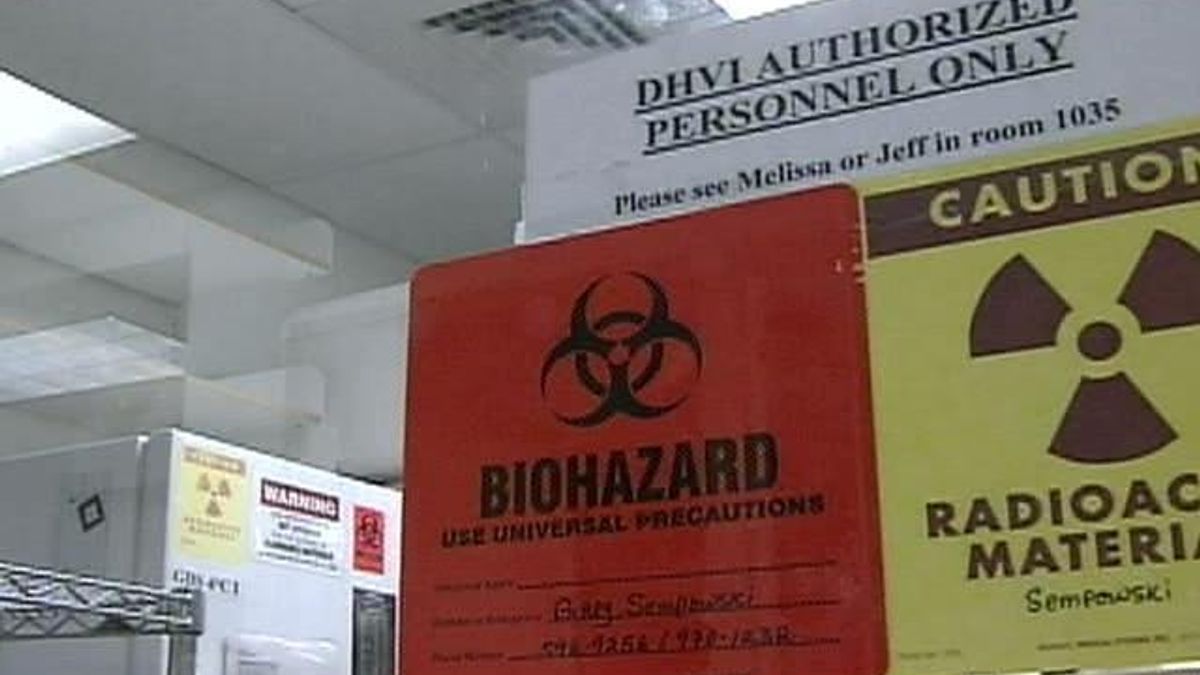
Doctors have divided views on a proposed biodefense lab in Butner.
Some say it could lead to the biggest public health disaster in the state's history, while others say it will help fight diseases that do not yet have a cure.
Other WRAL Top Stories
The Umstead Research Farm area is one site among five where Congress is considering placing the National Bio and Agro-Defense Facility. Scientists would study diseases like nipah and hendra.
Dr. Joseph Melamed, with Wake Radiology, said the stakes are too high to place a scientific facility dealing with potent viruses in such an populated area. Thirty-three other doctors have signed a petition against the biodefense lab that Melamed started circulating two weeks ago.
"If any of these diseases were to escape this facility, it could lead to a devastating public health disaster," Melamed said.
"These facilities do not belong in high population areas," he added. "They certainly don't belong in a watershed for a 50-mile radius with a population of 2 million people."
The biodefense lab would be more like the Centers for Disease Control in Atlanta, where scientists study potentially deadly diseases in a secure setting, than a high risk to spread disease, Dr. Barrett Slenning, a veterinarian at North Carolina State University, argued.
The lab would be run through the U.S. Department of Homeland Security.
Although the lab would be near the watershed for Falls Lake, Raleigh's primary water source, Slenning said there would be no danger of diseases getting out of the facility.
"These facilities are designed knowing that people will make mistakes," Slenning said. "If they make a mistake, it gets caught by the first backup. If they make another mistake, it gets caught by the second backup."
Melamed contended that putting the facility handling Ebola and anthrax viruses in Butner would be plain reckless.
"If you contract any of these diseases, there's no need for you to go to the hospital, to Duke or UNC or any of the tertiary care medical centers," Melamed said. "There's nothing we can do for you."
Slenning argued that the possible benefits of the biodefense lab outweigh any hypothetical risks.
"Having the facilities, the diagnostics near us is what will make or break the difference if we ever get any kind of outbreak," Slenning said.
Congress was also considering sites in Texas, Kansas, Mississippi and Georgia and was not expected to make a decision until fall 2008.