Log in to WRAL.com with one click using your favorite social network:
OR
Log in using your WRAL.com account:


Wrong email/password combination.

Forgot password?

Register with WRAL.com using your favorite social network:
OR
Register for a WRAL.com account using our web form.

Login Options

6:55 a.m. • 2-11-12

Weather Forecast for Raleigh

  • Today: Mostly Cloudy.
    • Hi: 50° F
  • Sun: Clear.
    • Hi: 41° F
  • Mon: Mostly Cloudy.
    • Hi: 50° F

Other Locations

> 7 Day Forecast

Doppler Image

Marketplace Links

Social Links

Main Menu

State Road Money Shrinking as Congestion Increases


e-mail print friendly
Transportation Funding Drops While Congestion Increase

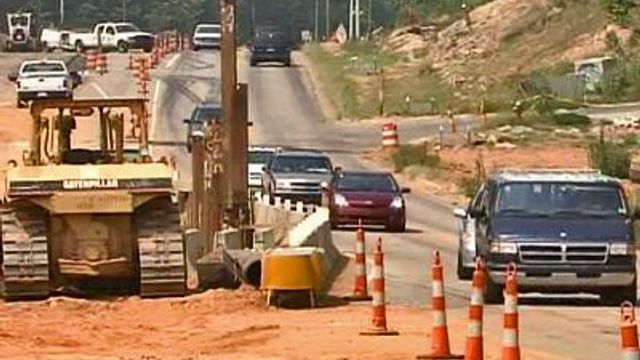
The state Legislature budgeted less money for transportation projects in 2007, despite a study by UNC-Charlotte researchers that ranks the state's traffic congestion among the country's 10 worst.

NC Go!, a statewide transportation advisory group, studied the budget passed by the 2007 General Assembly. The group pointed out several cuts:

  • a $6.5 million decrease for new road construction
  • a $41 million reduction in urban maintenance funds
  • a $170 million transfer from the state's Highway Trust Fund to the General Fund

The Department of Transportation projects a $65 billion shortfall in the state's transportation budget over the next 20 years. The 2007 budget signed by Gov. Mike Easley contained no steps to cover the funding gap.

"We have less money available for new construction. That's going backwards," Beau Mills, chairman of NC Go!, said. "We're really concerned about that."

The cuts eventually pass the bill for road work down the line to local governments, municipal leaders said.

In 2006, Cary spent $23 million to work on state-owned roads in the town – a sum that Cary engineers said is greater than the state paid to fix roads across Wake County.

Garner Mayor Ronnie Williams said that state promises for road funding are a decade late. His community cannot pay for road in work in the range that Cary has and must wait for the state to act, Williams said.

Lawmakers are considering holding a special General Assembly session in the fall to discuss transportation funding, but some legislators have said that wouldn't be the most effective way to deal with the issue.

"There's no sense in bringing back 170 legislators to discuss something in a hodge-podge manner," Sen. Neal Hunt, R-Wake, said. "Go ahead and have the transportation committees from the House and Senate come back and discuss what our needs are."

Easley has called for a study group to examine the state's road needs.

The Legislature is mulling multiple options to cover the long-term gap in the transportation budget, including building toll roads, creating local tax districts and raising vehicle-registration and highway-use fees.

Lawmakers are also considering raising the state's gas tax. North Carolina currently has the fifth-highest state gas tax in the country.

Beyond a special session in the fall, the next opportunity for the Legislature to address transportation funding will be during the short session to be held in May 2008.
RELATED TOPICS: Wake County, Cary, Garner

e-mail print friendly

181 Comments


WRAL.com welcomes your comments on this story. All comments are moderated prior to publication based on our posting guidelines. Please review them prior to posting and if your message is not approved.

View Comments VIEW ALL 181 COMMENTS

This story is closed for comments. Comments on WRAL.com news stories are accepted and moderated between the hours of 8 a.m. and 8 p.m. Monday through Friday.

Latest Comments
I just don't understand why more people aren't pushing for flex hours and most employers treat the topic like it's taboo. It seems like a very high percentage of congestion could be eased if commuting periods were spread out. I realize that is a temporary solution given the Triangle's rate of growth, but we've read how far behind road funding is.

Well, they got a figure wrong in the story. It isn't a 65 million dollar shortfall over the next 20 years, but actually a 65 BILLION dollar shortfall. The shortfall is actually larger than the expected revenues! Most folks are paying about $350 a year in gas tax per car, less than they pay for cable or phone service. If the gas tax and vehicle sales tax were doubled, there would be no shortfall, and we could replace many of these bridges that are in poor condition and widen roads that have congestion.

If Governor Sleasy and his Democrat cronies in the house and Senate weren't moving 170 million a year from the highway trust fund to the general fund we wouldn't be in this mess.

Highway funds paid for by the gas tax shouldn't be used to funding socialist feel good social programs.

If they aren't going to use all of the gas tax for road construction and maintenance, they should reduce the gas tax.

blindasabat, I had a little trouble understanding the 1st part of your post, but it is clear you are no fan of bike paths.

My preference is to have wide outer lanes with bikes and cars on the same roads, but if the bike paths had better connectivity they would get much more use. It cost much less to accomadate a bike than a car. If more people felt safe commuting by bike, you would have less cars in your way on the road. In addition to cleaner air to breath and cheaper gas. Why all the hostility towards such an inexpensive win-win situation?

tsherbet - no they cannot move all of the money collected, but under the statute as written (you know that thing called the law) the legislature can move 170M or close to that amount back every year. It stems from the first year of the law and the surplus the gas tax was creating that was funding education and other items. It is a part of the statute, thus legal, thus not stealing.

View Comments VIEW ALL 181 COMMENTS
Report It

Multimedia

Click Here