EMS Crews Leave Medical Trash at Wreck Scenes
Raleigh, N.C. — In their rush to care for accident victims and get them to nearby hospitals, paramedics are leaving some used medical supplies along area roads.
WRAL news crews found latex gloves mixed with the litter along U.S. Highway 64 near Wendell after a fatal Christmas Day wreck and along U.S. Highway 1 in Franklin County following a November accident.
The discarded gloves present a potential biological hazard, and Skip Kirkwood, the director of Wake County Emergency Medical Services, urged people to steer clear of them and call the nearest fire department or EMS squad to clean them up if they're found.
"We always want to do the right thing, but we put taking care of sick and injured people and life and safety over getting every last bit of debris at a scene," Kirkwood said. "(Cleaning up is) not at the top (of our list), but it is a priority. We carry red biohazard bags on all of our vehicles. You'll see our people religiously pick up and dispose of materials, but sometimes things slip by. Sometimes things happen."
Emergency workers often rely on tow truck operators responding to wrecks to assist them with the clean-up.
"At night, you can't see everything with artificial light. You get light glare, and a thin rubber glove is something hard to see. But we do try to pick it up if we see anything like that," said Charles Bullock of B&B Wrecker Service, who has been clearing accident scenes for 30 years.
The state spent $16 million last year on cleaning roadside litter.
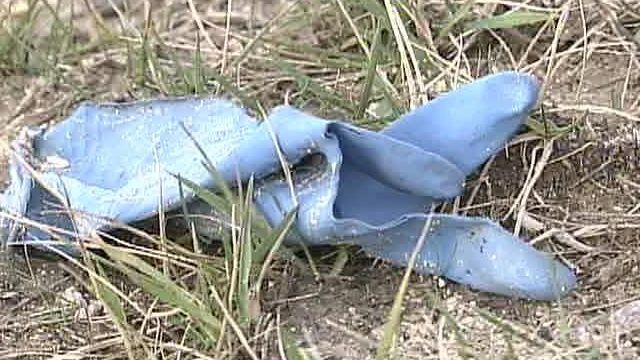
WRAL news crews found latex gloves mixed with the litter along U.S. Highway 64 near Wendell after a fatal Christmas Day wreck and along U.S. Highway 1 in Franklin County following a November accident.
The discarded gloves present a potential biological hazard, and Skip Kirkwood, the director of Wake County Emergency Medical Services, urged people to steer clear of them and call the nearest fire department or EMS squad to clean them up if they're found.
"We always want to do the right thing, but we put taking care of sick and injured people and life and safety over getting every last bit of debris at a scene," Kirkwood said. "(Cleaning up is) not at the top (of our list), but it is a priority. We carry red biohazard bags on all of our vehicles. You'll see our people religiously pick up and dispose of materials, but sometimes things slip by. Sometimes things happen."
Emergency workers often rely on tow truck operators responding to wrecks to assist them with the clean-up.
"At night, you can't see everything with artificial light. You get light glare, and a thin rubber glove is something hard to see. But we do try to pick it up if we see anything like that," said Charles Bullock of B&B Wrecker Service, who has been clearing accident scenes for 30 years.
The state spent $16 million last year on cleaning roadside litter.
- Reporter: Mark Roberts
- Photographer: Robert Meikle
- Web Editor: Matthew Burns
RELATED TOPICS: Wake County, Franklin County, Wendell
Copyright 2011 by Capitol Broadcasting Company. All rights reserved. This material may not be published, broadcast, rewritten or redistributed.
40 Comments
| MOST | Viewed | E-mailed | Discussed |
Most E-mailed Stories
Most E-mailed Videos | |||
| MOST | Viewed | E-mailed | Discussed |
Most Discussed Stories
Most Discussed Blog Posts | |||
Multimedia
Key dates in the investigation of Lance Armstrong on charges he used performance-enhancing drugs.
Key events in Iran's relations with the West.
An interactive look at the controversial decision and reversal of the Susan G. Komen Foundation to stop funding breast exams at Planned Parenthood.
Renaissance Park- Raleigh's Newest Urban Community
Travel NC By Train: Click for Daily Schedules!
Bundle & Save! Get free delivery of a PODS® container - See how


![[SLIDESHOW]](http://wwwcache.wral.com/asset/share/2012/02/09/10711513/4f348e7981bb5-51x75.jpg)
![[SLIDESHOW]](http://wwwcache.wral.com/asset/entertainment/out_and_about/2012/02/04/10712136/pics_agunn53833-100x75.jpg)
![[SLIDESHOW]](http://wwwcache.wral.com/asset/entertainment/2012/02/11/10719067/10719072-1329050037-100x75.jpg)
![[SLIDESHOW]](http://wwwcache.highschoolot.com/asset/content/2012/02/11/10717011/10717011-1328936455-100x75.jpg)
![[SLIDESHOW]](http://wwwcache.highschoolot.com/asset/content/2012/02/11/10717059/10717059-1328939591-100x75.jpg)


WRAL.com welcomes your comments on this story. All comments are moderated prior to publication based on our posting guidelines. Please review them prior to posting and if your message is not approved.
This story is closed for comments. Comments on WRAL.com news stories are accepted and moderated between the hours of 8 a.m. and 8 p.m. Monday through Friday.
January 4, 2007 9:54 p.m.
January 3, 2007 7:33 p.m.
But, since this article was about EMS, I would like to challenge Mr. Roberts or any of his colleagues to come and ride with an EMS unit (or a couple of EMS units)
January 3, 2007 8:28 a.m.
January 2, 2007 8:26 p.m.
What I can say for certain is that I've never left a patient dying on the side of the road to make sure that every bit of trash was picked up before we hit the sirens to go to the hospital.
We usually have no more than 10 minutes onscene to assess, treat, and transport all the patients involved in an MVC. For the wreck cited in the article that meant two truly critical patients, and 2 fatalities, one a child. I'd hope that WRAL could understand that a glove might be overlooked.
As for the biohazard danger- I assure you there's a far greater risk posed by the traffic whizzing by than from any pathogens on a latex glove. If you want to make the world safer move over and slow down next time you see flashing lights.
January 2, 2007 4:26 p.m.