Imaging technology guides treatment of ankle injuries
Repeated ankle injuries can lead to arthritis later in life for some people. However, imaging technology is helping Duke University researchers find a better way to correct ankle injuries.
Posted — UpdatedLandscaper Joanna Payne, 37, of Mebane, suffered repeated injuries to her right ankle, beginning in high school.
“Turned it after a softball game, having some horseplay in the locker room,” Payne said.
Three years ago, she partially tore three ligaments. With each additional injury, the ligaments could weaken and the joint become more unstable. It is a common problem that can lead to arthritis and ankle-replacement surgery later on.
“We thought, why do they develop arthritis later? There has to be something that's going on,” Dr. James Nunley said.
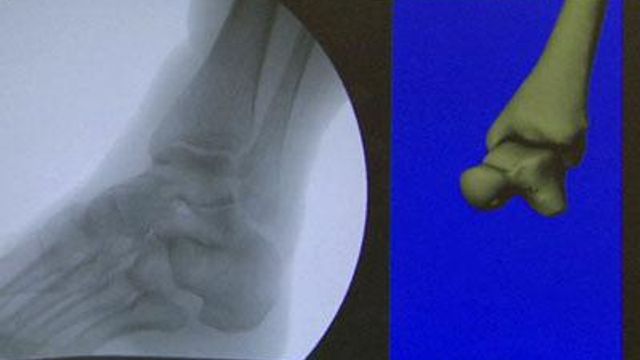
Nunley, a Duke University Medical Center orthopedic surgeon, and his research team combined the latest in X-rays and magnetic resonance imaging (MRI) to look at the mechanics of injured ankle joints.
“We can see bones in very high detail,” Adam Caputo, a Duke University medical student, said of the imaging technology.
Three-dimensional images reveal weakened or torn ligaments, which allow the bones to move abnormally.
“So it's the equivalent of almost having the tire of your car be out of alignment,” Nunley said.
The outside edge of the cartilage wearing down leads to bone rubbing on bone, or arthritis. Surgeries to reattach tendons only aimed to stabilize the ankle.
“This was totally wrong and led to tremendous problems,” Nunley said.
In a study, Nunley used the imaging as a guide to repair tendons and bring the bones back into alignment. Thirteen weeks after surgery, Payne was almost painless.
“It's tight sometimes. I can tell when I overdo it a little bit and I have to back off," Payne said. "Our feet have to carry you for the rest of your life. It's the only two you've got."
Since imaging technology to treat ankle injuries is new, researchers are just now beginning to see patients a year out from surgery.
If results are successful, the imaging technology could become the standard approach to treating ankle injuries and preventing joint osteoarthritis.
• Credits
Copyright 2024 by Capitol Broadcasting Company. All rights reserved. This material may not be published, broadcast, rewritten or redistributed.